Anton Alice
- 68
- 1
Hello,
please take a look at the following picture:
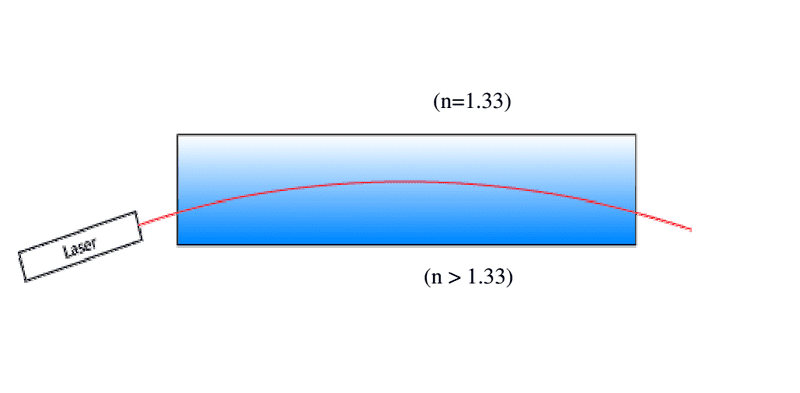
So we have a salt solution, with increasing refractive index, as you go down the solution.
The Laser is steadily refracted at the layers from high-to-low index and therefore bends in clockwise direction.
But how is it possible for the laser to bend down again? And also, shouldn't we also see reflections? Because at any point, there is a layer of high-to-low index transition. And at any such point there should also be a reflection. And as the angle of incidence get higher, as the laser path gets more horizontal, the reflection should dominate.
EDIT:
Does it bend down, because of total internal reflection at the peak of the curve?
please take a look at the following picture:
So we have a salt solution, with increasing refractive index, as you go down the solution.
The Laser is steadily refracted at the layers from high-to-low index and therefore bends in clockwise direction.
But how is it possible for the laser to bend down again? And also, shouldn't we also see reflections? Because at any point, there is a layer of high-to-low index transition. And at any such point there should also be a reflection. And as the angle of incidence get higher, as the laser path gets more horizontal, the reflection should dominate.
EDIT:
Does it bend down, because of total internal reflection at the peak of the curve?