How Is Heat Calculated in a Diesel Cycle Using Volumes and Temperatures?

Click For Summary
SUMMARY

The discussion focuses on calculating heat transfer in a diesel cycle using the first law of thermodynamics and specific volumes. The process involves adiabatic compression and expansion, with key equations derived for heat input (Qin) and heat output (Qout). The participant successfully reformulated Qin in terms of V1, V2, V3, and T1, achieving the desired variables through the ideal gas law and adiabatic relations. The final expression for Qin is P[V3((f/2)+1)-V2((f/2)+1)], while the calculation for Qout remains to be fully resolved.

PREREQUISITES
  • Understanding of the diesel engine cycle and ideal gas laws.
  • Familiarity with the first law of thermodynamics (ΔU = W + Q).
  • Knowledge of adiabatic processes and the adiabatic law (TV^(γ-1) = constant).
  • Basic proficiency in thermodynamic equations and manipulations.
NEXT STEPS
  • Explore the derivation of the adiabatic relations in thermodynamics.
  • Study the implications of the first law of thermodynamics in cyclic processes.
  • Learn how to express pressure in terms of volume and temperature using the ideal gas law.
  • Investigate the calculation of heat transfer in various thermodynamic cycles beyond the diesel cycle.
USEFUL FOR

Students and professionals in mechanical engineering, thermodynamics, and automotive engineering, particularly those focused on diesel engine performance and heat transfer analysis.

cloud809
Messages
3
Reaction score
0
1. Ideal gas cycle - diesel engine cycle. You begin at some volume V1. Perform an adiabatic compression to V2. Perform an expansion to V3 at constant pressure. Next, perform an adiabatic expansion to V4, Last, it moves back to V1 at a fixed volume, while decreasing temperature back to original starting point.
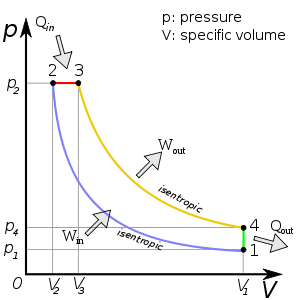
300px-DieselCycle_PV.svg.png

NOTE: Ignore "specific volume," and just consider it to be generic "volume" for my case.

Find Qin and Qout in terms of V1, V2, V3, and T1.


--

2. 1st law: ΔU = W + Q, where W = -∫PdV

We're told that the 1st law is the assumed starting point for this problem.


--

3. For Qin, I began that ΔU = 0 for 2→3, so -W2→3=Qin. This yielded

Qin=- (-∫23PdV)

or Qin = P(V3-V2).

Am I right to assume that ΔU=0 for this 2→3 phase? I can't find how to incorporate V1 and T1 if my method was ok.

--

Then, for Qout, I noted that W = 0 for 4→1, so ΔU4→1=Qout.

So, I found that ΔU = Nk(f/2)BΔT, or Qout = NkB(f/2)(T1-T4). And again, I'm running into the same issue of not filling the parameters of the original question.
 
Physics news on Phys.org
One thing I just realized is that for 2→3, I shouldn't have said ΔU = 0. Instead, I should have set up Qin as:

Qin = ΔU - W, where

ΔU = NkB(f/2)ΔT

ΔU = NkB(f/2)[(PV3-PV2)/NkB]

and W is still W=-P(V3-v2)

so, once simplified (Qin = ΔU - W), Qin=P[V3((f/2)+1)-V2((f/2)+1)].

This still doesn't put it in terms of V1, V2, V3, T1 however.
 
cloud809 said:
so, once simplified (Qin = ΔU - W), Qin=P[V3((f/2)+1)-V2((f/2)+1)].

This still doesn't put it in terms of V1, V2, V3, T1 however.
Try to express P in terms of volume and temperature. Don't forget the adiabatic law ##TV^{\gamma-1} =## const.
 
Thanks for the reply TSny.
I've considered something similar and figured it out I believe.
I used P1V11+f/2=P2V21+f/2, solved for P2, and substituted that into my Qin equation. And since there was still a P1 in there, I used the PV=NkBT for P1 to put it in terms of T1. Now my Qin satisfies all 4 variables (V1, V2, V3, T1).

Now to spend a bit more time and figure out Qout...
 
Sounds good!
 

Similar threads

Replies
14
Views
2K
  • · Replies 3 ·
Replies
3
Views
1K
  • · Replies 6 ·
Replies
6
Views
6K
  • · Replies 1 ·
Replies
1
Views
3K
Replies
8
Views
2K
  • · Replies 5 ·
Replies
5
Views
2K
  • · Replies 7 ·
Replies
7
Views
2K
Replies
5
Views
3K
  • · Replies 3 ·
Replies
3
Views
2K
  • · Replies 23 ·
Replies
23
Views
12K