How Is Kinetic Energy Calculated at Point A in a Loop-the-Loop?

Click For Summary

Homework Help Overview

The discussion revolves around calculating the kinetic energy of a block sliding along a loop-the-loop track, starting from a height. The problem involves concepts of conservation of energy and potential energy at different points along the track.

Discussion Character

  • Exploratory, Assumption checking, Conceptual clarification

Approaches and Questions Raised

  • Participants discuss the application of conservation of energy, questioning the kinetic energy at different points, particularly at point A. There is a focus on understanding the definitions of potential energy and the choice of reference points for height.

Discussion Status

The discussion is active, with participants clarifying assumptions about potential energy at various points and engaging in back-and-forth to establish a consistent reference for height. Guidance has been offered regarding the correct interpretation of potential energy and its relation to kinetic energy.

Contextual Notes

There is a noted confusion regarding the choice of reference points for height, with participants encouraged to select a consistent zero point for potential energy calculations. The original height at point P is given as 55 m, and there is debate about the height at point A.

am08
Messages
43
Reaction score
0
[SOLVED] Kinetic Energy

A small block of mass m = 1.5 kg slides, without friction, along the loop-the-loop track shown. the block starts from the point P at rest a distance h = 55.0 m above the bottom of the loop of radius R = 19.0 m. What is the kinetic energy of the mass at the point A on the loop?
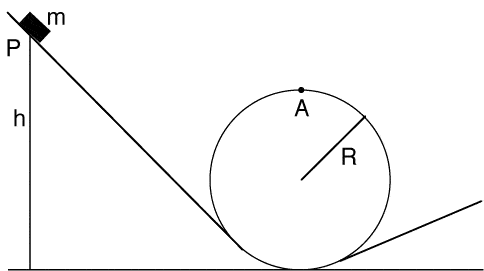
prob17a.gif


So I use conservation of energy K1 + PE1 = K2 + PE2 or .5mv^2(1) + mgR(1) = .5mv^2(2) + mgR(2)

At point A there's 0 KE.

Is this right? Do I just plug numbers in?
 
Physics news on Phys.org
.5mv^2(1) + mgR(1) = .5mv^2(2) + mgR(2)

This equation seems to be correct, but how did you get KE= zero ??
 
assumption...

is it not zero?
 
Noo. At point P there is 0 KE. At point A there is. Tell me what are R(1) and R(2)? Then you can plug numbers in.
 
R(1) and R(2) is the radius - 19m
 
Nope. What you are calling mgR should be written mgh where h is the vertical displacement from some fixed position of your choice. h is 55m at P. What is it at A?
 
PE = 0 at A
 
am08 said:
PE = 0 at A

You can make that choice. Then what is PE at P?
 
Wouldn't it be mgh
 
  • #10
Let's keep this simple. PE=mgh. They gave you h=55m at P. So PE at P is mg(55m). What's h at A? Then what's PE at A?
 
  • #11
17 m

Got it dick... thanks for sticking with me and helping me out with this problem
 
  • #12
Nope. 38m. You keep changing origins on me! Pick a zero point and stick with it. If we say h=55m then we are measuring everything from the horizontal line in your picture. You could also measure everything from any other point but that's too confusing. Let's just stick with this one.
 
  • #13
I gather you got the right answer. Yes, 55m-38m=17m. So mg(17m)=(1/2)mv^2. If you understand it, that's great.
 

Similar threads

  • · Replies 21 ·
Replies
21
Views
5K
  • · Replies 13 ·
Replies
13
Views
2K
  • · Replies 12 ·
Replies
12
Views
13K
Replies
3
Views
2K
  • · Replies 4 ·
Replies
4
Views
2K
  • · Replies 58 ·
2
Replies
58
Views
3K
Replies
6
Views
1K
Replies
17
Views
2K
  • · Replies 12 ·
Replies
12
Views
2K
Replies
55
Views
6K