How is the characteristic age of pulsars typically calculated?

Click For Summary
SUMMARY

The characteristic age of pulsars is calculated using the differential equation dP/dt = K*P^(2-n). The solution to this equation is T = (P/((n-1)*dP/dt))*(1-(P0/P)^(n-1)). This formula is derived by separating variables and integrating, leading to the expression τ = (P/(n-1)·dP)·[1-(P0/P)^(n-1)]. In typical calculations, K is treated as a constant, n is set to 3, and P0/P is approximated as 0, resulting in an overestimation of the pulsar's age.

PREREQUISITES
  • Understanding of differential equations
  • Familiarity with pulsar physics
  • Knowledge of integration techniques
  • Basic concepts of astrophysics
NEXT STEPS
  • Study the derivation of solutions for differential equations in astrophysics
  • Learn about the physics of pulsars and their lifecycle
  • Explore the implications of varying K and n in pulsar age calculations
  • Read "Pulsars" by Manchester & Taylor for in-depth understanding
USEFUL FOR

Astronomers, astrophysicists, and students studying pulsar dynamics and age estimation methodologies.

rnielsen25
Messages
25
Reaction score
1
Hi everyone.
I'm trying to derive the formula for the characteristic age of a pulsar.

What I'm starting with is the following differential equation.
dP/dt=K*P2-n

What i think is odd, is several places they say solving this differential equation gives the following solution.
T=(P/((n-1)*dP/dt))*(1-(P0/P)n-1

Here is a picture of the equation too:
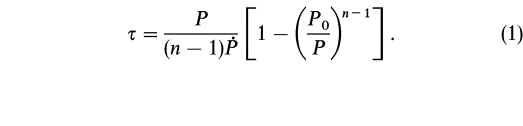
df1.gif


But how do you get from equation 1. to this equation.
Please help me out, if you could explain it step by step, i would really appreciate it.
Because it doesn't make sense if you're trying to separate both variables and integrate?
 
Last edited by a moderator:
Astronomy news on Phys.org
Hope this helps:
\dot{P}=\frac{dP}{dt}=kP^{2-n}
dt=\frac{dP}{kP^{2-n}}
\tau=t-t_{0}=\int_{P_{0}}^P \frac{dP}{kP^{2-n}}=\frac{1}{k}\frac{P^{n-1}-P_{0}^{n-1}}{n-1}=\frac{P^{n-1}}{k(n-1)}[1-(\frac{P_{0}}{P})^{n-1}]
k=\frac{\dot{P}}{P^{2-n}}
\tau=\frac{P}{(n-1)\dot{P}}[1-(\frac{P_{0}}{P})^{n-1}]
 
In some texts this is considered the "true" age of pulsar, although the true age would also have k and n as functions of time.

The characteristic age is typically when k is kept as constant, n = 3, and ##\frac{P_0}{P} = 0##, this is an overestimation, but a decent approximation.

Have you read M&T, Pulsars?
 

Similar threads

  • · Replies 10 ·
Replies
10
Views
2K
  • · Replies 4 ·
Replies
4
Views
2K
  • · Replies 3 ·
Replies
3
Views
2K
  • · Replies 0 ·
Replies
0
Views
3K
  • · Replies 35 ·
2
Replies
35
Views
9K
  • · Replies 7 ·
Replies
7
Views
811
  • · Replies 9 ·
Replies
9
Views
4K
Replies
2
Views
2K
  • · Replies 6 ·
Replies
6
Views
2K
  • · Replies 45 ·
2
Replies
45
Views
7K