How is the Coriolis generalized potential obtained

Click For Summary
SUMMARY

The Coriolis generalized potential is derived by integrating through the radial positions r and R, as indicated in equation (42). The discussion clarifies that the Coriolis force, being an inertial force influenced by the Earth's rotation, does not necessitate integration through velocity v, since its effects are inherently accounted for. In contrast, other inertial forces, like centrifugal force, require integration through both position and velocity to determine the generalized potential accurately.

PREREQUISITES
  • Understanding of Coriolis force and its implications in physics.
  • Familiarity with generalized forces and potentials in mechanics.
  • Knowledge of integration techniques in the context of physics.
  • Basic grasp of inertial forces and their dependence on velocity.
NEXT STEPS
  • Study the derivation of the Coriolis force in rotating reference frames.
  • Learn about centrifugal force and its integration requirements in mechanics.
  • Explore the concept of generalized potentials in classical mechanics.
  • Investigate the role of velocity in determining inertial forces in various physical systems.
USEFUL FOR

This discussion is beneficial for physics students, mechanical engineers, and researchers focusing on dynamics and inertial forces in rotating systems.

AlephClo
Messages
32
Reaction score
1
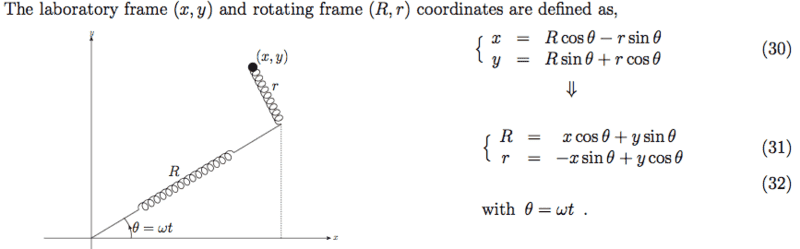
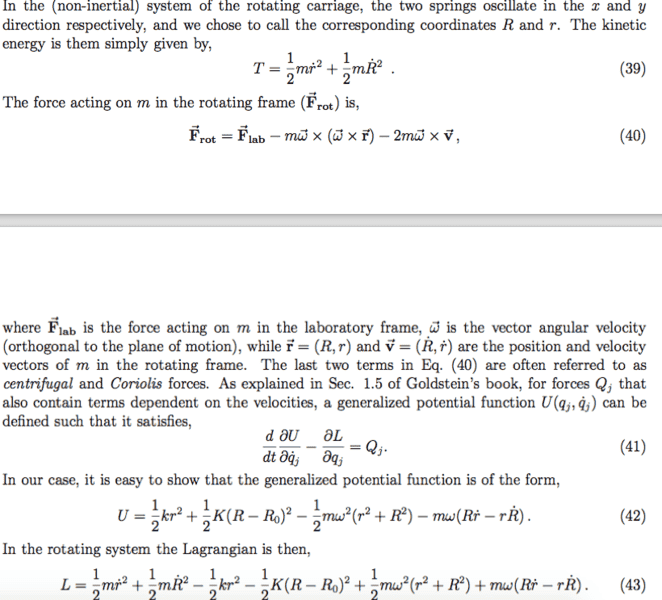
The Coriolis potential last term of (42) is obtained by integration through r and R from last term of (40).
I do not understand why we do not need to integrate through v as well, since the Coriolis force depends on v?
upload_2019-1-17_17-22-28-png.png

upload_2019-1-17_17-23-20-png.png


Homework Equations


Equation (41) is wrong I think, L must be replaced by U.
The forces for the 2 springs are F(r)= -kr, and F(R)= -kR (bold are vectors)
The generalized force Qj = Fi ⋅ δri/δqj (δ is del the partial derivative; j and i are indices)

The Attempt at a Solution


the 4 terms of (42) are obtainable from the intergration relatively to r and R.
Since the Coriolis force is dependent of the velocity v, why we do not need to Integration relative to v = (dr/dt, dR/dt) as well?

Or more generally when is it required that we integrate through position and velocity the force that depends on position and velocity to obtain a generalized potential.

Thank you.


Attachments

  • upload_2019-1-17_17-22-28-png.png
    upload_2019-1-17_17-22-28-png.png
    13.4 KB · Views: 873
  • upload_2019-1-17_17-23-20-png.png
    upload_2019-1-17_17-23-20-png.png
    51.6 KB · Views: 897
Physics news on Phys.org
The Coriolis force is a type of inertial force that depends on the velocity of the object. It is an effect of the Coriolis acceleration, which is caused by the rotation of the Earth. Therefore, there is no need to integrate through velocity for the Coriolis potential because it is already taken into account by the rotation of the Earth. However, if you were considering a different type of inertial force, such as a centrifugal force, then you would need to integrate both position and velocity in order to obtain the generalized potential.
 

Similar threads

  • · Replies 1 ·
Replies
1
Views
5K
  • · Replies 2 ·
Replies
2
Views
2K
  • · Replies 16 ·
Replies
16
Views
4K
  • · Replies 3 ·
Replies
3
Views
2K
  • · Replies 3 ·
Replies
3
Views
3K
  • · Replies 12 ·
Replies
12
Views
2K
  • · Replies 8 ·
Replies
8
Views
4K
  • · Replies 1 ·
Replies
1
Views
2K
  • · Replies 2 ·
Replies
2
Views
2K
  • · Replies 14 ·
Replies
14
Views
4K