Axion
- 2
- 0
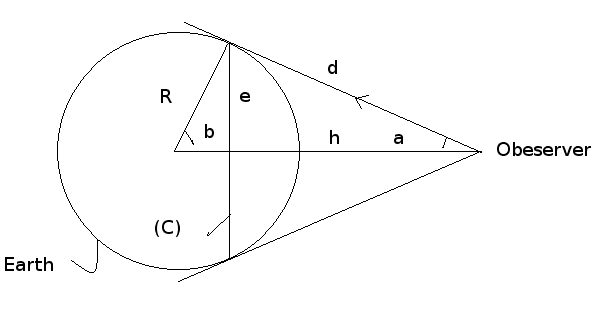
I propose a calculation of the drop X in the horizon that an observer sees due to the curvature of the Earth surface the parameters are:
h: the elevation of the observer from the surface of the Earth in km
H: the length of the horizon at which the drop is perceived in km
R: the radius of the spherical Earth ≈ 6371 km
d: the distance from the observer to the horizon in km
The following ( see figure 1) sets the layout for the calculation, the observer field of view intersects the globe in the circle (C).
Computing d:
We have: (R+h)2=d2+R2
⇒ d=√(2hR+h2)
Computing e: e is the radius of (C)
we have sin(b)=cos(a)⇒ e/R=√(1-(e/d)2)⇒e=Rd/√(R2+d2)
Now switching to the plane of the circle (C) (see figure 2):
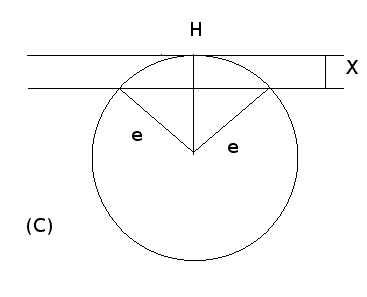
Computing the drop X(h,H):
X=e-√(e2-H2/4)
Now under the reasonable approximation that h<<R:
X(h, H)=H2/2√(Rh)⇒ X(h, H)=0.00626×H2/√h (km)
For example; if H=1 km and h=2 m (human height)⇒ X(1, 0.02)= 44.3 m .
h: the elevation of the observer from the surface of the Earth in km
H: the length of the horizon at which the drop is perceived in km
R: the radius of the spherical Earth ≈ 6371 km
d: the distance from the observer to the horizon in km
The following ( see figure 1) sets the layout for the calculation, the observer field of view intersects the globe in the circle (C).
Computing d:
We have: (R+h)2=d2+R2
⇒ d=√(2hR+h2)
Computing e: e is the radius of (C)
we have sin(b)=cos(a)⇒ e/R=√(1-(e/d)2)⇒e=Rd/√(R2+d2)
Now switching to the plane of the circle (C) (see figure 2):
Computing the drop X(h,H):
X=e-√(e2-H2/4)
Now under the reasonable approximation that h<<R:
X(h, H)=H2/2√(Rh)⇒ X(h, H)=0.00626×H2/√h (km)
For example; if H=1 km and h=2 m (human height)⇒ X(1, 0.02)= 44.3 m .