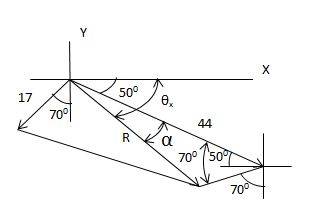
How is the Sine law written for this problem?

  • Thread starter Thread starter Benjamin_harsh
  • Start date Start date
  • Tags Tags
    Law Sine
Click For Summary
SUMMARY

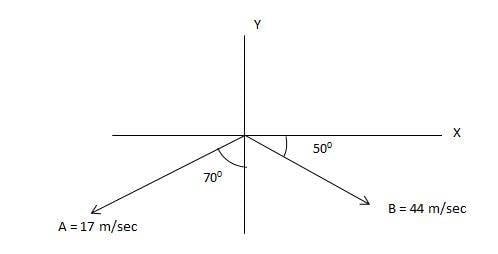
The discussion centers on applying the Sine Law to find the resultant vector of two vectors, A and B, with magnitudes of 17 m and 44 m, respectively, and an angle of 70 degrees between them. The resultant vector R is calculated to be 41.39 m/s, and the angle α is determined to be 22.70 degrees, resulting in a total angle θx of 72.70 degrees from the positive x-axis. Participants also emphasize the importance of proper LaTeX formatting, specifically using "\sin" instead of "Sin" and the correct representation of angles.

PREREQUISITES
  • Understanding of vector addition and resultant vectors
  • Familiarity with the Sine Law and Cosine Law in trigonometry
  • Basic knowledge of LaTeX for mathematical expressions
  • Ability to interpret geometric diagrams accurately
NEXT STEPS
  • Study the application of the Sine Law in various geometric configurations
  • Learn about the Cosine Law and its relationship with vector calculations
  • Explore advanced LaTeX formatting techniques for mathematical documentation
  • Investigate alternative methods for calculating angles, such as the tangent rule
USEFUL FOR

Students, educators, and professionals in physics and engineering who require a solid understanding of vector analysis and trigonometric laws for problem-solving in two-dimensional contexts.

Benjamin_harsh
Messages
211
Reaction score
5
Homework Statement
Find the resultant vector of vectors A and B shown in the figure.
Relevant Equations
##\large \frac {R}{Sin 70^0} = \frac {17}{Sin\alpha}##
Find the resultant vector of vectors A and B shown in the figure.
244621


Solution:
By geometry method:

244622


Cosine law for the right side triangle.

##R^{2} = 17^{2} + 44^{2} - 2 (17)(14).cos 70^{0}##

##R = 41.39 m/sec##

By Sin law,

##\large\frac {R}{Sin 70^0} = \frac {17}{Sin\alpha}##

##sin \alpha = \large \frac{17.sin 70^{0}}{R} = \frac{17.sin 70^{0}}{41.39}##

##\alpha = 22.70^{0}##

##\theta_{x} = 50 + \alpha = 50 + 22.70##

##\theta_{x} = 72.70^{0}##
 
Physics news on Phys.org
Is there a question here ?

PS tip: in ##\LaTeX##, use \sin and not Sin or sin
Idem \cos, \tan, \log, etc.
 
Benjamin_harsh said:
By Sin law,

##\large\frac {R}{Sin 70^0} = \frac {17}{Sin\alpha}##

##sin \alpha = \large \frac{17.sin 70^{0}}{R} = \frac{17.sin 70^{0}}{41.39}##
Expanding a bit on @BvU's comments regarding ##\LaTeX :##

Your code for the expression:
##\large\frac {R}{Sin 70^0} = \frac {17}{Sin\alpha}##

is: ##\large\frac {R}{Sin 70^0} = \frac {17}{Sin\alpha}##.

As BvU recommends, use "\sin" rather than "Sin".
Also, there is no degree symbol built into ##\LaTeX ##. Using "^0", as you did, is one work-around. Another is to use "^\circ".
You can get large fractions by using "\dfrac" rather than "\large\frac". Using "\large" the way you did makes everything that follows large, not just the fraction. You could avoid making all that large by 'wrapping' the expression in braces: " { \large \frac{num}{denom} } ".

Using the following code: ##{\large\frac {R}{\sin 70^\circ}} = \dfrac {17}{\sin\alpha}## gives the result:

##{\large\frac {R}{\sin 70^\circ}} = \dfrac {17}{\sin\alpha}##
(The first fraction is done using the "\large" feature)

One more thing:
Use "\cdot" rather than a period, ".", for multiplication.

##\sin \alpha = \dfrac{17 \cdot \sin 70 ^\circ }{R} = \dfrac{17 \cdot \sin 70^\circ }{41.39}## gives the result:

##\sin \alpha = \dfrac{17 \cdot \sin 70 ^\circ }{R} = \dfrac{17 \cdot \sin 70^\circ }{41.39}##
 
I am not asking about LATEX. I am asking about concept.
 
Benjamin_harsh said:
I am not asking about LATEX. I am asking about concept.
Yup. Looks good.
So your resultant vector has a magnitude of 41.39 m/s and makes an angle of ##72.70^\circ## clockwise from the positive ##x##-axis.​

You can check your answer using x-components and y-components.

The ##\LaTeX## tips were given free of charge by @BvU and me. :smile:
 
  • Like
Likes   Reactions: NascentOxygen and BvU
Please explain this sin law equation. ##\large \frac {R}{sin70_{0}} = \frac{17}{sin \alpha}##.?
##70^{0}## is not the full angle, It is just a portion of the angle. So how sine law is calculated on portion of the angle?
 
It's the full angle: the 70##^\circ## is shown in the right half of the figure (that you should redraw a bit more to scale).
244731
 
How ##17## included in the sine law? See, in the diagram, ##17## is far away from ##\alpha## so how it is included ?
 
Did you already re-draw the picture a bit more to scale as I suggested ?
Then you'll see more easily where the 17 is sitting: opposite the angle ##\alpha##.
Please do a little bit of pondering answers before shooting off yet another question :wink:

244732
 
  • Love
Likes   Reactions: Benjamin_harsh
  • #10
  • Like
Likes   Reactions: neilparker62
  • #11
Demonstrating a mstery of which drawing program, exactly ?
 
  • #12
BvU said:
Demonstrating a mastery of which drawing program, exactly ?
I used LibreOffice Draw.

To call my abilities to use it "mastery" would be a stretch. I almost gave up using it (for making this figure) but then made a small break-through with making circular arcs. I can now make the arc I want in about half of my attempts.
 
  • Like
Likes   Reactions: BvU
  • #13
Benjamin_harsh said:
Please explain this sin law equation. ##\large \frac {R}{sin70_{0}} = \frac{17}{sin \alpha}##.?
##70^{0}## is not the full angle, It is just a portion of the angle. So how sine law is calculated on portion of the angle?
For the record, it's also possible to calculate ##\alpha## without recourse to R or the sin rule. Referring to SammyS's very excellent diagram, drop a perpendicular from where the green arrows meet to the side of length 44. Then: $$ \tan{\alpha} = \frac{17\sin{70^\circ}}{44-17\cos{70^\circ}} $$ This is the 'tan rule' but unfortunately nobody ever teaches it in school!

PS: have picked up all the above 'tips' re use of ## \LaTeX ##!
 
Last edited:
  • Like
Likes   Reactions: SammyS

Similar threads

  • · Replies 5 ·
Replies
5
Views
1K
  • · Replies 20 ·
Replies
20
Views
2K
Replies
3
Views
3K
  • · Replies 97 ·
4
Replies
97
Views
6K
Replies
2
Views
2K
Replies
7
Views
3K
  • · Replies 12 ·
Replies
12
Views
3K
Replies
1
Views
1K
Replies
9
Views
2K
  • · Replies 29 ·
Replies
29
Views
4K