How long does it take for the disk to stop rotating?

12 replies · 3K views · last reply
Istiak
Messages
158
Reaction score
12
Homework Statement
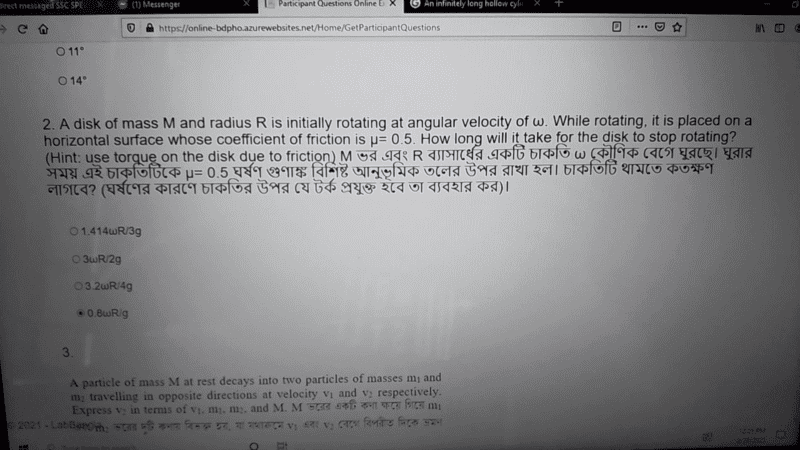
A disk of masses M and radius R is initially rotating at angular velocity \omega. While rotating, it is placed on a horizontal surface whose coefficient of friction is \mu =0.5 How long take for the disk to stop rotating?
Relevant Equations
\tau = r . F
Question :

Photo of a screen showing a multiple-choice physics question in English and Bengali: a disk of mass M and radius R rotating at angular velocity ω on a surface with friction coefficient 0.5, with four answer options listed.


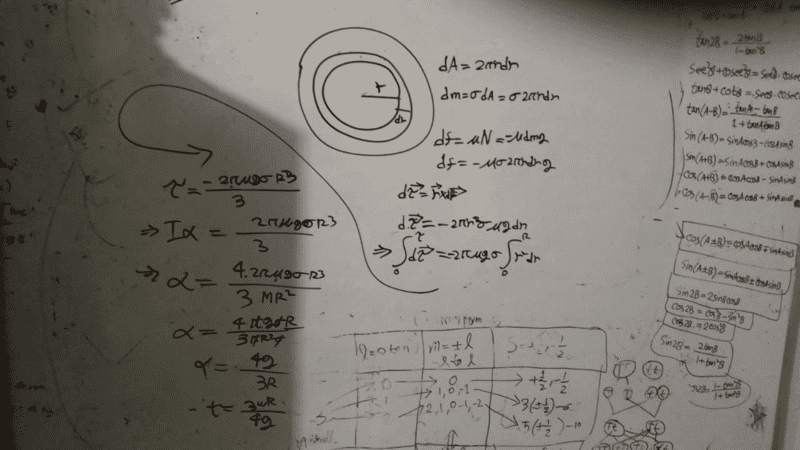
Solution attempt :

Handwritten physics working on a whiteboard: a ring-shaped disk diagram with radius r and element dA = 2πr dr, torque integral, and a derivation giving angular acceleration α = 4πσμ₀R³/(3MR²), with trigonometric identities on the right.
for
 
Are you asking us to check your working because it does not give one of the answers in the list?

Your writing/working is difficult to read and follow. But as far as I can tell you have made a simple error: you appear to have substituted μ=1 rather than μ=0.5
 
  • Like
Likes   Reactions: Delta2
You have made a simple algebraic error. The moment of inertial of a solid disk with respect to the z-axis is ##\frac{1}{2}MR^2##. So when you divide by this to find the angular acceleration you should get $$a=\frac{4\pi\mu g\sigma R^3}{3MR^2}$$, but you have keep an additional factor of 2 (which later you get rid by replacing ##\mu=0.5##). So after simplifications you actually get $$a=\frac{2g}{3R}$$ which lead you to one of the available options.
 
  • Like
Likes   Reactions: Steve4Physics
Steve4Physics said:
Are you asking us to check your working because it does not give one of the answers in the list?

Your writing/working is difficult to read and follow. But as far as I can tell you have made a simple error: you appear to have substituted μ=1 rather than μ=0.5
2×0.5=1
 
Delta2 said:
You have made a simple algebraic error. The moment of inertial of a solid disk with respect to the z-axis is ##\frac{1}{2}MR^2##. So when you divide by this to find the angular acceleration you should get $$a=\frac{4\pi\mu g\sigma R^3}{3MR^2}$$, but you have keep an additional factor of 2 (which later you get rid by replacing ##\mu=0.5##). So after simplifications you actually get $$a=\frac{2g}{3R}$$ which lead you to one of the available options.
Handwritten physics derivation on a whiteboard: a ring of radius R with dA = 2πr dr, dm = σ dA, dF = μN, and torque integrals from 0 to R, leading to α = 4πμσgR/(3MR²).
 
Your error is one line above from where your green arrow is pointing. You write that $$a=\frac{4 \cdot 2 \pi\mu g\sigma R^3}{3MR^2}$$ while the correct is (as i said at my earlier post) that $$a=\frac{4\pi\mu g\sigma R^3}{3MR^2}$$
 
  • Like
Likes   Reactions: Steve4Physics
Let me ask you one straight question, what do you take it to be the moment of inertia of the solid disk? $$\frac{1}{2}MR^2$$ OR $$\frac{1}{4}MR^2$$?
MoI around the z axis (perpendicular to the plane of the disk) is the first, while MoI around x or y-axis is the second...
 
Delta2 said:
Your error is one line above from where your green arrow is pointing. You write that $$a=\frac{4 \cdot 2 \pi\mu g\sigma R^3}{3MR^2}$$ while the correct is (as i said at my earlier post) that $$a=\frac{4\pi\mu g\sigma R^3}{3MR^2}$$
Why there won't be 4 times 2?
 
Istiakshovon said:
Why there won't be 4 times 2?
Because the Moment of Inertia of the solid disk (around the z-axis perpendicular to xy plane-the plane of the disk) is ##I=\frac{1}{2}MR^2## so you actually have ##2\cdot 2=4## there and NOT ##4\cdot 2=8##...
 
Istiakshovon said:
2×0.5=1
So I believe.

You have made an error involving a factor of 2. It might be (as @Delta2 notes) something to do with the ½ in ½MR², or as I note, something to do with the value of μ (=0.5). Maybe it's a mixture of the two - e.g. incorrectly mixing the two ½s.

For me, the main problem is that your hand-writing is very difficult to read, so it's hard to be certain exactly what you've done.

But the only 2 things you now need to do are:
1) carefully repeat your working (say from 'Iα =' onwards) to locate your mistake;
2) click 'Likes' for @Delta2 and me to acknowledge the time/effort/help we have supplied!
 
  • Like
Likes   Reactions: Delta2
Steve4Physics said:
So I believe.

You have made an error involving a factor of 2. It might be (as @Delta2 notes) something to do with the ½ in ½MR², or as I note, something to do with the value of μ (=0.5). Maybe it's a mixture of the two - e.g. incorrectly mixing the two ½s.

For me, the main problem is that your hand-writing is very difficult to read, so it's hard to be certain exactly what you've done.

But the only 2 things you now need to do are:
1) carefully repeat your working (say from 'Iα =' onwards) to locate your mistake;
2) click 'Likes' for @Delta2 and me to acknowledge the time/effort/help we have supplied!
Handwritten derivation on a whiteboard of the friction torque on a rotating disk: dA = 2πr dr, df = μN = μ dm g, torque τ = (2/3)R³πσμg, angular acceleration α = 4Rπσμg/(3M), and t = ω/α = 3Mω/(4πσμg) leading to t = 3ωR/(2μg).


Is it OK now?
 
  • Like
Likes   Reactions: Delta2
Istiakshovon said:
View attachment 285452

Is it OK now?
That's the same answer as I get - so I'd say yes! The important thing is that you found/understood where you made the mistake.
 
  • Like
Likes   Reactions: Istiak