How long does it take to reach 50% of V1?

  • Thread starter Thread starter Matt Howard
  • Start date Start date
Click For Summary

Discussion Overview

The discussion revolves around determining the time it takes for a capacitor to charge to 50% of a given voltage (V1 = 14V) in an electrical circuit. Participants explore the equations governing capacitor charging and discharging, as well as the algebraic manipulations necessary to solve for time.

Discussion Character

  • Technical explanation
  • Mathematical reasoning
  • Debate/contested

Main Points Raised

  • One participant expresses uncertainty about how to calculate the time for the capacitor to reach 50% of V1 and seeks guidance.
  • Another participant provides the equations for charging and discharging a capacitor, suggesting their use in the calculation.
  • A participant attempts to apply the charging equation but struggles with algebraic manipulation to isolate time.
  • There is a discussion about the significance of the time constant and its relation to the voltage reached by the capacitor.
  • One participant critiques a previous approach, emphasizing the importance of focusing on the voltage rather than the percentage charged at specific time constants.
  • Clarification is sought regarding the timing of the switch's position change, which is confirmed by another participant.
  • A later reply highlights the need to take natural logarithms to solve for time, indicating a step that may have been unfamiliar to some participants.
  • One participant concludes that they have resolved their confusion and completed the work after receiving assistance.

Areas of Agreement / Disagreement

While some participants agree on the use of specific equations and methods, there remains uncertainty regarding the best approach to isolate time and the interpretation of the capacitor's charging process. The discussion does not reach a consensus on a single method or solution.

Contextual Notes

Participants express varying levels of familiarity with the mathematical concepts involved, and there are unresolved algebraic steps in the process of solving for time. The discussion also reflects differing interpretations of the significance of time constants in relation to voltage levels.

Matt Howard
Messages
5
Reaction score
1
I'm unsure of the best way to go about finding out the time it takes for the capacitor to reach a voltage of 50% of V1.

V1: 14V
Resistor before 2pt switch: 1K ohm
Resistor after 2pt switch: 220 ohm
Capacitor: 1.4 micro farads
(Charging) 1 time constant is 1.7mS
(Discharging) 1 time constant is 308 micro seconds

I've attached a picture of the circuit with the values labelled.
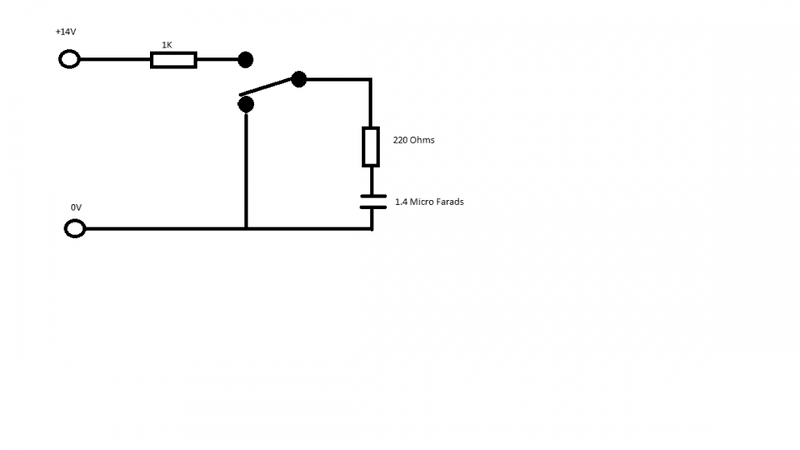
CR Circuit.png
Is there an equation for working this out or is there a specific way of working it out? Any help or suggestions are greatly appreciated - I'm not looking for anyone to do the work for me just looking for a jab in the right direction

I thought I could work it out based on the idea that at 1TC the capacitor has reached 63% of the supply voltage (8.82V) and working out the difference there but kept getting myself in a right muddle.
 
Physics news on Phys.org
You know that charging a capacitor goes according to V=V_{s}(1-e^{\frac{-t}{T}})? And discharging goes as V=V_{0}(e^{\frac{-t}{T}})?
 
I think I vaguely remember that from class. so for me it would be something like: 7=14(1-e-t/1.7x10-3)? Is that right?
I'm assuming it's t I'm looking for so how would I go about transposing that to solve for t?
 
Matt Howard said:
I think I vaguely remember that from class. so for me it would be something like: 7=14(1-e-t/1.7x10-3)? Is that right?
I'm assuming it's t I'm looking for so how would I go about transposing that to solve for t?
What have you tried?

There's some algebraic simplifications which can be done the equation before solving for t.
 
So simplified is 7=14-14e-t/1.7x10-3

The only idea I could find (Until Svein commented) was working it out from the fact that the capacitor is 63% charged when 1 time constant had lapsed. I worked out the voltage from that and thought I could work out the time from the differences in percentage and voltage. I.e a very confusing way of doing it that a friend suggested.
 
Matt Howard said:
So simplified is 7=14-14e-t/1.7x10-3

Yep, that is correct.

Solve for t.

ln .5 = -t/(1.7E-3)

t = 1.18 ms.
 
Matt Howard said:
So simplified is 7=14-14e-t/1.7x10-3

The only idea I could find (Until Svein commented) was working it out from the fact that the capacitor is 63% charged when 1 time constant had lapsed. I worked out the voltage from that and thought I could work out the time from the differences in percentage and voltage. I.e a very confusing way of doing it that a friend suggested.

This sounds like nonsense. Setting the capacitor voltage to 7 volts in the formula is good. What is said above probably isn't going to do you any favors.
You don't care when it's charged, you just care when it's 7 volts.
 
The assumption being made is that the switch is moved from its lower position (shown) to its upper position at t=0. Is that what you're told?

I ask only because a different switching scenario is possible.
 
That is correct, the switch is being moved from the lower position to the upper position at t=0
 
  • #10
So ... you're all sorted now?

The unfamiliar step was that where you need to take natural logarithms of both sides, in the process losing the exponential function.
 
  • #11
Yes, I am sorted now, thank you very much! I have now completed the work, thanks again!
 
  • Like
Likes   Reactions: NascentOxygen

Similar threads

  • · Replies 5 ·
Replies
5
Views
2K
  • · Replies 2 ·
Replies
2
Views
2K
  • · Replies 4 ·
Replies
4
Views
2K
  • · Replies 6 ·
Replies
6
Views
3K
  • · Replies 3 ·
Replies
3
Views
3K
  • · Replies 1 ·
Replies
1
Views
2K
  • · Replies 2 ·
Replies
2
Views
3K
  • · Replies 9 ·
Replies
9
Views
2K
Replies
2
Views
2K
Replies
17
Views
4K