How much heat is converted into work?

  • Thread starter Thread starter iceT
  • Start date Start date
  • Tags Tags
    Heat Work
Click For Summary
SUMMARY

The discussion centers on the conversion of heat into work using a Carnot engine, with specific parameters of 5000 joules of heat input and reservoir temperatures of 500 K and 250 K. The maximum efficiency of the Carnot engine is calculated using the formula eCarnot = 1 - (Tc/Th), resulting in an efficiency of 0.5. Consequently, only 2500 joules of the 5000 joules input is converted into work. Additionally, the work done during a gas expansion process along a defined path is determined by calculating the area under the pressure-volume graph.

PREREQUISITES
  • Carnot engine efficiency calculation
  • Understanding of thermodynamic principles
  • Pressure-volume work calculations
  • Graph interpretation in thermodynamics
NEXT STEPS
  • Study the Carnot cycle and its applications in thermodynamics
  • Learn about the first and second laws of thermodynamics
  • Explore pressure-volume work calculations in different thermodynamic processes
  • Investigate graphical methods for calculating work done in thermodynamic systems
USEFUL FOR

Students of thermodynamics, engineers working with heat engines, and anyone interested in understanding the principles of energy conversion and work calculations in thermodynamic systems.

iceT
Messages
8
Reaction score
0
1) Five thousand joules of heat is put into a Carnot engine whose hot and cold reservoirs have temperatures of 500 and 250 K, respectively. How much heat is converted into work?

here's what i did...
i know that... QC / QH = TC / TH
W = 5000, Tc = 250, Th = 500, Qh = ?, Qc = ?

first I found Qh , which = (eCarnot = W/Qh) ----- and solve for Qh and get (Qh = W/eCarnot) ------eCarnot also equals [1-(Tc/Th)] = [1-( 250 / 500 ) ] = 0.5
so Qh = W / [1-(Tc/Th) = 5000 / 0.5 = 10000
after I got Qh I used the equation (Qc = Qh - W) to solve for Qc and this should be the answer...
Qc = Qh - W = 10000-5000 = 5000 , so Qc = 5000 ...but it still wrong :cry:


2) The pressure and volume of a gas are changed along a path ABCA in the figure. The vertical divisions on the graph represent 4.5 105 Pa, and the horizontal divisions represent 4.0 10-3 m3. Determine the work done (including algebraic sign) in each segment of the path.
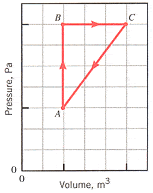
cj6_p15-10alt.gif


a ) A to B = ? J
b ) B to C = ? J
c ) C to A = ? J

This question..i know that W= P ( Vf-Vi )
but i still can't locate the dots on the graph! :confused:
 
Physics news on Phys.org
For question one the maximum efficencey of a carnot engine is given by;

[tex]1 - \frac{T_{C}}{T_{H}}[/tex]

This will give you a fraction. This in the fraction of the energy which can be used (i.e. work done). So all you need to do is multiply the input energy ([itex]Q_{H}[/itex]) by this fractional efficency.

-Hoot:smile:
 
iceT said:
1) Five thousand joules of heat is put into a Carnot engine whose hot and cold reservoirs have temperatures of 500 and 250 K, respectively. How much heat is converted into work?
The 5000 J. of heat represents Qh not W.

W = .5 Qh = 2500 J.

So only 2500 J of the 5000 is converted into work.


2) The pressure and volume of a gas are changed along a path ABCA in the figure. The vertical divisions on the graph represent 4.5 105 Pa, and the horizontal divisions represent 4.0 10-3 m3. Determine the work done (including algebraic sign) in each segment of the path.

a ) A to B = ? J
b ) B to C = ? J
c ) C to A = ? J

This question..i know that W= P ( Vf-Vi )
but i still can't locate the dots on the graph! :confused:
The work done is the area under the graph between those points.

AM
 

Similar threads

  • · Replies 2 ·
Replies
2
Views
2K
Replies
1
Views
1K
  • · Replies 2 ·
Replies
2
Views
3K
  • · Replies 20 ·
Replies
20
Views
3K
  • · Replies 2 ·
Replies
2
Views
3K
  • · Replies 6 ·
Replies
6
Views
3K
  • · Replies 23 ·
Replies
23
Views
4K
  • · Replies 1 ·
Replies
1
Views
2K
  • · Replies 11 ·
Replies
11
Views
3K
  • · Replies 3 ·
Replies
3
Views
4K