How much work done by friction? (coefficient given)

Click For Summary
SUMMARY

The discussion centers on calculating the work done by friction on an inclined plane, specifically involving a crate weighing 95 N and a coefficient of friction of µ = 0.20. Participants emphasize the need to first calculate the normal force, which is essential for determining the frictional force using the formula: Friction = coefficient of friction * Normal force. The work done by friction can then be calculated using the equation W = Fs, where 's' is the distance moved, noted as 5 meters in the discussion.

PREREQUISITES
  • Understanding of inclined planes and forces
  • Knowledge of the coefficient of friction
  • Ability to calculate normal force
  • Familiarity with work-energy principles
NEXT STEPS
  • Learn how to calculate normal force on an inclined plane
  • Study the work-energy theorem in physics
  • Explore the implications of different coefficients of friction
  • Practice problems involving friction on inclined planes
USEFUL FOR

Students studying physics, particularly those focusing on mechanics and forces, as well as educators looking for practical examples of friction calculations.

Lothar
Messages
19
Reaction score
0
Hello everyone,
I've been working on this problem for the last hour and a half. My teacher has asked us to calculate the work done by friction on an inclined plane. This is the problem:
A worker pushes a crate weighing W = 95 N up an inclined plane. The worker pushes the crate horizontally, parallel to the ground, as illustrated in Figure 10-21.
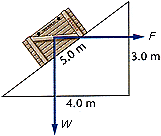
physics.gif

(c) The coefficient of friction is µ = 0.20. How much work is done by friction? (Be careful with the signs you use.)

How do I do this? We have not learned anything about coefficient of friction in my class.

Thank you
 
Physics news on Phys.org
I don't know why you continue in this thread, since I answered you in the other thread...

Friction = coefficient of friction * Normal force

So I would say, calculate the normal force, use the given coefficient of friction and there you have it. W=Fs, so multiply by s to find the work done by the force of friction.
 
Hi Lothar,

You first need to calculate the force exerted due to friction, the equation for this can be found here:

http://en.wikipedia.org/wiki/Friction

Have you been supplied with a distance that the crate is pushed?
 
@ ImAnEngineer
I understand that that is the formula. I don't know how to use it though. And I moved this to a new topic because I new that people would back away from a long topic (my last one), and if they did click it, they would not spend the time reading all the way to my new question.

@ astrorob
No I was not supplied with a distance. I put all information known in the first post.
I do have the amount of work done by friction though, as well as the amount of work done if a man pushes at a certain force.
 
astrorob said:
Hi Lothar,
Have you been supplied with a distance that the crate is pushed?
It's in the figure; 5m.

Lothar said:
@ ImAnEngineer
I understand that that is the formula. I don't know how to use it though.
How could you not understand how to use it? Just fill it in... Or do you not know how to find the normal force? In that case, how about drawing the resultant vector of F and W first?
 

Similar threads

  • · Replies 58 ·
2
Replies
58
Views
5K
  • · Replies 4 ·
Replies
4
Views
3K
Replies
2
Views
2K
Replies
1
Views
954
  • · Replies 5 ·
Replies
5
Views
2K
  • · Replies 33 ·
2
Replies
33
Views
4K
Replies
4
Views
3K
  • · Replies 4 ·
Replies
4
Views
3K
  • · Replies 3 ·
Replies
3
Views
3K
Replies
8
Views
2K