How to calculate complicated factorial

  • Context:
  • Thread starter Thread starter aruwin
  • Start date Start date
  • Tags Tags
    Factorial
Join the discussion
Ask a follow-up here, or get your own question answered by working scientists, mathematicians and engineers — people, not an autocomplete.
Real named experts · corrections over time · the nuance an AI answer skips
6 replies · 3K views
aruwin
Messages
204
Reaction score
0
Hello.
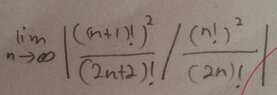
I know what factorial means but how do I calculate this? Could someone explain to me on how to do it?
 

Attachments

  • factorial.jpg
    factorial.jpg
    13.9 KB · Views: 144
Physics news on Phys.org
aruwin said:
Hello.
I know what factorial means but how do I calculate this? Could someone explain to me on how to do it?

$\displaystyle \begin{align*} \left| \frac{\frac{ \left[ \left( n + 1 \right) ! \right] ^2 }{ \left( 2n + 2 \right) !} }{ \frac{ \left( n ! \right) ^2 }{ \left( 2n \right) ! } } \right| &= \left| \frac{\left[ \left( n + 1 \right) ! \right] ^2 }{ \left( 2n + 2 \right) ! } \cdot \frac{ \left( 2n \right) !}{\left( n! \right) ^2} \right| \\ &= \left| \frac{ \left[ \left( n + 1 \right) n! \right] ^2 \left( 2n \right) ! }{ \left( 2n + 2 \right) \left( 2n + 1 \right) \left( 2n \right) ! \left( n! \right) ^2 } \right| \\ &= \left| \frac{ \left( n + 1 \right) ^2 \left( n! \right) ^2 }{ \left( 2n + 2 \right) \left( 2n + 1 \right) \left( n ! \right) ^2 } \right| \\ &= \left| \frac{ \left( n + 1 \right) ^2}{\left( 2n + 2 \right) \left( 2n + 1 \right) } \right| \end{align*}$

Can you evaluate the limit now?
 
Prove It said:
$\displaystyle \begin{align*} \left| \frac{\frac{ \left[ \left( n + 1 \right) ! \right] ^2 }{ \left( 2n + 2 \right) !} }{ \frac{ \left( n ! \right) ^2 }{ \left( 2n \right) ! } } \right| &= \left| \frac{\left[ \left( n + 1 \right) ! \right] ^2 }{ \left( 2n + 2 \right) ! } \cdot \frac{ \left( 2n \right) !}{\left( n! \right) ^2} \right| \\ &= \left| \frac{ \left[ \left( n + 1 \right) n! \right] ^2 \left( 2n \right) ! }{ \left( 2n + 2 \right) \left( 2n + 1 \right) \left( 2n \right) ! \left( n! \right) ^2 } \right| \\ &= \left| \frac{ \left( n + 1 \right) ^2 \left( n! \right) ^2 }{ \left( 2n + 2 \right) \left( 2n + 1 \right) \left( n ! \right) ^2 } \right| \\ &= \left| \frac{ \left( n + 1 \right) ^2}{\left( 2n + 2 \right) \left( 2n + 1 \right) } \right| \end{align*}$

Can you evaluate the limit now?

Sorry, I am not sure how to evaluate the limit. I just know that n should be substituted with infinity.
 
aruwin said:
Sorry, I am not sure how to evaluate the limit. I just know that n should be substituted with infinity.

NO! You NEVER "substitute infinity", as infinity is NOT a number. Besides, $\displaystyle \begin{align*} \frac{\infty}{\infty} \end{align*}$ is a meaningless indeterminate expression.

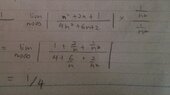
My advice would now be to expand out all the brackets, and then multiply by $\displaystyle \begin{align*} \frac{\frac{1}{n^2}}{\frac{1}{n^2}} \end{align*}$. Once you have done this, you should be able to see what happens to each term as $\displaystyle \begin{align*} n \to \infty \end{align*}$.
 
Prove It said:
NO! You NEVER "substitute infinity", as infinity is NOT a number. Besides, $\displaystyle \begin{align*} \frac{\infty}{\infty} \end{align*}$ is a meaningless indeterminate expression.

My advice would now be to expand out all the brackets, and then multiply by $\displaystyle \begin{align*} \frac{\frac{1}{n^2}}{\frac{1}{n^2}} \end{align*}$. Once you have done this, you should be able to see what happens to each term as $\displaystyle \begin{align*} n \to \infty \end{align*}$.

I got 1/4. One more question, why do we have to multiply by $\displaystyle \begin{align*} \frac{\frac{1}{n^2}}{\frac{1}{n^2}} \end{align*}$ ?
 

Attachments

  • IMG_6666.JPG
    IMG_6666.JPG
    16.3 KB · Views: 131
$$$$
aruwin said:
I got 1/4. One more question, why do we have to multiply by $\displaystyle \begin{align*} \frac{\frac{1}{n^2}}{\frac{1}{n^2}} \end{align*}$ ?

1/4 is correct. I think you've answered your own question - when you divide by the highest power of n, you can see what the "negligible" terms are (i.e. the ones that go to 0).
 
Prove It said:
1/4 is correct. I think you've answered your own question - when you divide by the highest power of n, you can see what the "negligible" terms are (i.e. the ones that go to 0).

Thank you for your explanation!