How to Calculate Force and Center of Pressure on a Submerged Plate?

Click For Summary
SUMMARY

The discussion focuses on calculating the force and center of pressure on a submerged plate in a swimming pool scenario. The plate measures 60 cm square, with its top edge positioned 30 cm below the water surface. Key equations discussed include the hydrostatic pressure formula F = pgh, where pressure increases with depth, necessitating that the center of pressure is located below the centroid of the plate. Participants clarified that y-bar should be measured from the water surface, leading to a correct understanding of the center of pressure calculation.

PREREQUISITES
  • Understanding of hydrostatic pressure principles
  • Familiarity with the concept of center of pressure
  • Knowledge of basic calculus for integration
  • Ability to interpret geometric dimensions in fluid mechanics
NEXT STEPS
  • Study the derivation of the hydrostatic pressure formula F = pgh
  • Learn about the relationship between centroid and center of pressure in fluid mechanics
  • Explore integration techniques for calculating center of pressure
  • Review examples of submerged surfaces in fluid dynamics
USEFUL FOR

Students and professionals in engineering, particularly those specializing in fluid mechanics, as well as anyone involved in designing submerged structures or studying hydrostatic forces.

Jaydude
Messages
3
Reaction score
0
1. The problem statement:

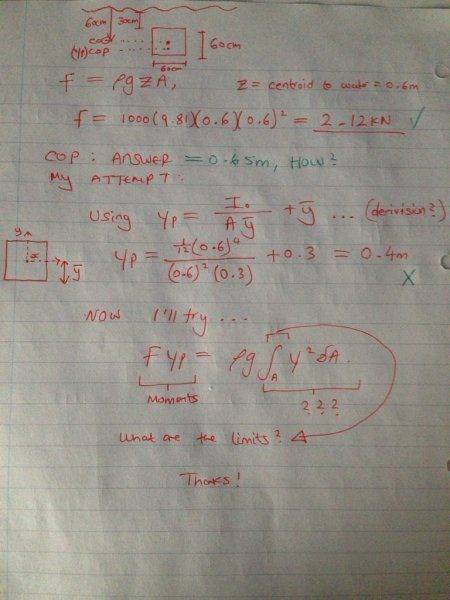
A removable plate is mounted in the end of a swimming pool. The plate is 60cm square with the top edge 30cm below surface of water. Compute the force on plate and distance to centre of pressure below surface of water.

2. Homework Equations .
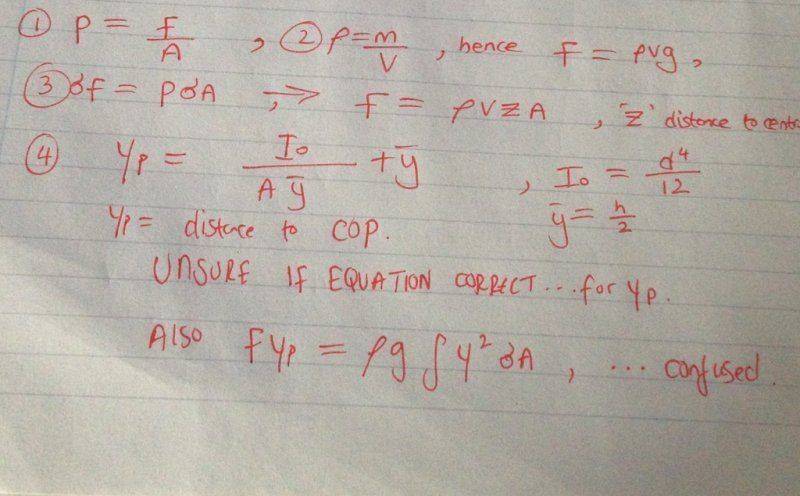
ImageUploadedByPhysics Forums1428511297.905568.jpg


3. The attempt at solution :

ImageUploadedByPhysics Forums1428511756.434984.jpg


Spent a lot of research and time on cop to no avail, so this is my last resort!

Kind regards ,

Jay
 
Physics news on Phys.org
Just I've Notices that you've written F = pgh, In fact it's the change in pressure that equals pgh, I don't know,maybe you can the force out of that!
Try to modelize your situation by defining the limits ;)
Hope that helps :)
 
Jaydude said:
1. The problem statement:

A removable plate is mounted in the end of a swimming pool. The plate is 60cm square with the top edge 30cm below surface of water. Compute the force on plate and distance to centre of pressure below surface of water.

2. Homework Equations .
View attachment 81705

3. The attempt at solution :

View attachment 81706

Spent a lot of research and time on cop to no avail, so this is my last resort!

Kind regards ,

Jay
Your calculation for yp is OK except for one detail. y-bar for the plate must be measured from the surface of the water, not the top edge of the plate.

Remember, since the pressure increases with depth, the center of pressure must be lower than the centroid of the plate. :wink:
 
SteamKing said:
Your calculation for yp is OK except for one detail. y-bar for the plate must be measured from the surface of the water, not the top edge of the plate.

Remember, since the pressure increases with depth, the center of pressure must be lower than the centroid of the plate. :wink:

Thanks , still can't get the answer though!
Tried using y bar as 0.9 and 0.45.
Do I use the water line as the reference line and measure y bar up to...where? Centroid, the bottom plate part, see what I mean?
And Yep, my badly drawn diagram shows COP lower than centroid :)
 
Solved ! I see what you now mean, y bar is 0.6, distance between centroid and water line, that makes more sense, thank you!

Just lastly if possible, what is that last equation in my original first post, with the integral sign? A more complex version of the Yp formula I used initially? Thanks!
 
I think, in order to calculate the centre of pressure you can use the same formula as for the centre of mass(you can simply look it up in wikipedia https://en.wikipedia.org/wiki/Center_of_mass). Just replace the total mass with the total force and the volume density with the pressure and integrate over the whole square.
 
Its simple, use your x bar to be 0.6 I.e distance from centre of gravity to free surface,that way you would get the answer 0.65
 
And that's what you rightly denoted as y bar...
So,y bar= 0.3 +0.3
Which is the addition of the distance of centre of gravity and the distance of the square from the free surface...
 
Dannyville587 said:
And that's what you rightly denoted as y bar...
So,y bar= 0.3 +0.3
Which is the addition of the distance of centre of gravity and the distance of the square from the free surface...
You realize that this thread is almost 3 years old, right? The OP has not been seen for almost 3 years.

Anyway, as SteamKing correctly pointed out in post #3, the center of pressure is below the center of mass of the plate.

This thread is hereby closed.
 

Similar threads

  • · Replies 15 ·
Replies
15
Views
3K
Replies
19
Views
1K
  • · Replies 1 ·
Replies
1
Views
2K
Replies
2
Views
2K
Replies
4
Views
4K
  • · Replies 6 ·
Replies
6
Views
2K
  • · Replies 3 ·
Replies
3
Views
3K
  • · Replies 12 ·
Replies
12
Views
8K
  • · Replies 7 ·
Replies
7
Views
3K
  • · Replies 8 ·
Replies
8
Views
3K