How to calculate rotor flux of the three phase squirrel cage induction motor?

Click For Summary
SUMMARY

The discussion focuses on calculating the rotor flux of a three-phase squirrel cage induction motor with specific parameters, including a nominal power of 22.4 kW, a stator voltage of 230V, and a stator current of 39.5A. The user employed the T equivalent circuit to derive the rotor flux using nominal values and the Scilab command 'linsolve', resulting in a rotor flux phasor of λr=0.5554856−0.0613638j, which corresponds to |λr|=0.5588647 V⋅s. Concerns were raised regarding the validity of this calculation, particularly the low value of the rotor flux, prompting requests for verification of the applied methodology.

PREREQUISITES
  • Understanding of three-phase induction motor operation
  • Familiarity with T equivalent circuit analysis
  • Proficiency in using Scilab for numerical computations
  • Knowledge of phasor representation in electrical engineering
NEXT STEPS
  • Research the calculation of rotor flux in three-phase induction motors using T equivalent circuits
  • Learn how to utilize Scilab for electrical engineering simulations
  • Explore the impact of stator and rotor parameters on motor performance
  • Study the relationship between rotor flux and motor efficiency
USEFUL FOR

Electrical engineers, students studying motor control, and professionals involved in the design and analysis of induction motors will benefit from this discussion.

adamaero
Messages
109
Reaction score
1
Homework Statement
How to calculate rotor flux of the three phase squirrel cage induction motor?
Relevant Equations
Rotor flux and more
Three phase squirrel cage induction motor with given parameters (stator winding connected in delta)

  • nominal power: Pn=22.4kW
  • nominal stator voltage: Vsn=230V
  • nominal stator current: Isn=39.5A
  • nominal stator frequency: fsn=60Hz
  • nominal speed: nn=1168min−1
  • number of pole pairs: 3
  • stator resistance per phase (T equivalent circuit): Rs=0.294Ω
  • stator leakage inductance per phase (T equivalent circuit): Lsl=0.00139H
  • rotor resistance per phase (T equivalent circuit): Rr=0.156Ω
  • rotor leakage inductance per phase (T equivalent circuit): Lrl=0.0007401H
  • magnetizing inductance per phase (T equivalent circuit): Lm=0.041H

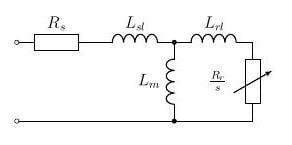
I have been struggling with calculation of the nominal value of the rotor flux. My idea was that I will use the T equivalent circuit for that purpose
8tYEX.jpg


and I will use nominal values of the motor quantities i.e. I set the motor operating point into the nominal operation point (nominal slip, nominal stator voltage etc.). Then I calculate phasor of the stator current (Is) and phasor of the rotor current (Ir) according to the below given set of equations
https://forum.allaboutcircuits.com/attachments/1620849888346-png.238168/

For the motor parameters mentioned above the Scilab command linsolve gave mehttps://forum.allaboutcircuits.com/attachments/1620849901203-png.238169/
Based on the known phasors of the stator and rotor current I used the below given equation for calculation of the phasor of the rotor flux
https://forum.allaboutcircuits.com/attachments/1620849925020-png.238170/
which gives λr=0.5554856−0.0613638j i.e. |λr|=0.5588647V⋅s.

This value seems to me to be too low. So I have doubts regarding the way I have used for its calculation. Unfortunately I don't know any other way for its calculation which I can use for verification. Can anybody tell me whether the applied procedure is correct or not?
 
Physics news on Phys.org
@adamaero, please repost the 2nd, 3rd, and 4th images. Use the Attach files button to attach files. A link to an external site won't work.
 
adamaero said:
Homework Statement:: How to calculate rotor flux of the three phase squirrel cage induction motor?
Relevant Equations:: Rotor flux and more

Three phase squirrel cage induction motor with given parameters (stator winding connected in delta)

  • nominal power: Pn=22.4kW
  • nominal stator voltage: Vsn=230V
  • nominal stator current: Isn=39.5A
  • nominal stator frequency: fsn=60Hz
  • nominal speed: nn=1168min−1
  • number of pole pairs: 3
  • stator resistance per phase (T equivalent circuit): Rs=0.294Ω
  • stator leakage inductance per phase (T equivalent circuit): Lsl=0.00139H
  • rotor resistance per phase (T equivalent circuit): Rr=0.156Ω
  • rotor leakage inductance per phase (T equivalent circuit): Lrl=0.0007401H
  • magnetizing inductance per phase (T equivalent circuit): Lm=0.041H

I have been struggling with calculation of the nominal value of the rotor flux. My idea was that I will use the T equivalent circuit for that purpose
View attachment 283353

and I will use nominal values of the motor quantities i.e. I set the motor operating point into the nominal operation point (nominal slip, nominal stator voltage etc.). Then I calculate phasor of the stator current (Is) and phasor of the rotor current (Ir) according to the below given set of equations
1.png
For the motor parameters mentioned above the Scilab command linsolve gave me
2.png

Based on the known phasors of the stator and rotor current I used the below given equation for calculation of the phasor of the rotor flux
3.png

which gives λr=0.5554856−0.0613638j i.e. |λr|=0.5588647V⋅s.

This value seems to me to be too low. So I have doubts regarding the way I have used for its calculation. Unfortunately I don't know any other way for its calculation which I can use for verification. Can anybody tell me whether the applied procedure is correct or not?
 
I am not sure what do you mean by "rotor magnetic flux”. I don't think the leakage rotor magnetic field it has to be included since the stator and rotor main magnetic field has to be the same.
However, you may calculate-using T equivalent diagram-the current Is . At first calculate the equivalent impedance of parallel Xm with Xlr and Rr/s and then divide Vsn by total impedance Rs+jXs+jXm||(Rr/s+jXlr).The result will be the same. Ir you may calculate by dividing the Is voltage drop on the equivalent impedance of jXm and Rr/s+jXlr by Zr=Rr/s+jXlr.
I think the flux units are average values but Is and Ir are rms.
i=Imax*sin(ωt) Iav=Imax/π Irms=Imax/√2 Iav=√2*Irms/π
 
I am sorry. Iav=1/ π ʃ Imax*sin(ωt)dt| ωt=0 up to ωt= π| then
Iav=2*Imax/π ; Irms=Imax/√2; Iav=2*√2*Irms/π
My mistake!
 

Similar threads

  • · Replies 7 ·
Replies
7
Views
3K
  • · Replies 6 ·
Replies
6
Views
2K
  • · Replies 4 ·
Replies
4
Views
3K
  • · Replies 6 ·
Replies
6
Views
3K
Replies
5
Views
6K
Replies
4
Views
3K
  • · Replies 2 ·
Replies
2
Views
2K
  • · Replies 14 ·
Replies
14
Views
7K
  • · Replies 5 ·
Replies
5
Views
2K
  • · Replies 4 ·
Replies
4
Views
4K