How to calculate rpm of an aeolipile

Click For Summary
SUMMARY

The forum discussion centers on calculating the RPM of an aeolipile, a steam-powered device. Key considerations include the nozzle diameter of 3mm and the need to calculate steam exit velocity based on internal pressure. Participants emphasize that the limiting rotational speed is influenced by losses and steam jet exit velocity. Suggestions include experimenting with load characteristics and using historical techniques for construction, such as soldering and simple seals, to replicate the original Roman design.

PREREQUISITES
  • Understanding of basic thermodynamics and fluid dynamics
  • Familiarity with the principles of steam propulsion
  • Knowledge of the rocket equation and its applications
  • Experience with mechanical design and historical engineering techniques
NEXT STEPS
  • Research the rocket equation and its application to steam propulsion systems
  • Explore fluid dynamics principles related to nozzle design and gas exit velocity
  • Investigate methods for measuring load/speed characteristics in turbines
  • Learn about historical engineering techniques used in Roman-era devices
USEFUL FOR

Students, hobbyists, and engineers interested in steam propulsion, historical engineering projects, and the practical application of thermodynamic principles.

Tinokoloski
Messages
5
Reaction score
0
Hi!
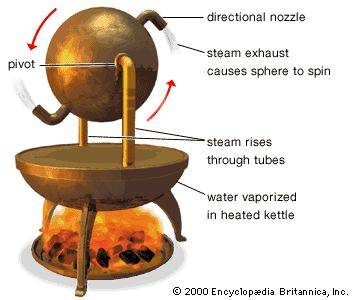
I am making an aeolipile as a school project, and I was wondering if you could calculate the rpm.
6cda027fd141d7dbc96c1c11dafeb2ba--dinosaur-history-ancient-aliens.jpg

This is the basic principle of an aeolipile.

You should be able to calculate the rotating velocity right? Knowing the mass and ignoring any resistance.
But then you'll need the rotating force. I looked at the rocket equation, but you need to know the exiting gas velocity for that. The diameter of the nozzle is 3mm, would it be possible to calculate the velocity steam could move out of such a nozzle after calculating the pressure inside the hollow ball?

Thanks in advance!

Tino
 

Attachments

  • 6cda027fd141d7dbc96c1c11dafeb2ba--dinosaur-history-ancient-aliens.jpg
    6cda027fd141d7dbc96c1c11dafeb2ba--dinosaur-history-ancient-aliens.jpg
    16.8 KB · Views: 2,020
Physics news on Phys.org
In the absence of friction and turbulence, the tangential velocity of the wheel would increase without limit - which is what would happen in a space rocket with an engine that can run for ever. I think the limiting rotational speed will be governed entirely by the losses and the exit velocity of the steam jets.
 
  • Like
Likes   Reactions: CWatters and anorlunda
sophiecentaur said:
In the absence of friction and turbulence, the tangential velocity of the wheel would increase without limit - which is what would happen in a space rocket with an engine that can run for ever. I think the limiting rotational speed will be governed entirely by the losses and the exit velocity of the steam jets.

Ah yes of course, but what formulas would you use to calculate that rotational force? Or are there just too many variables to get a reasonable answer?

You would need something like this I assume?
rktthsum.gif
 

Attachments

  • rktthsum.gif
    rktthsum.gif
    18.7 KB · Views: 2,751
It is not that complicated for your turbine . You only have subsonic flow through parallel nozzles . That is not too difficult to deal with .

To answer your original question though the top speed running free is hard to estimate .

A more useful and interesting thing to do would be to put some controllable load on the turbine and measure the turbines load/speed characteristics . You could also experiment then with different arm/nozzle configurations to get best results .
 
  • Like
Likes   Reactions: Tinokoloski
Something like that probably . Then you would need to estimate the drag. I bet there's a formula somewhere for a rotating sphere and you could approximate the jets to cylinders and assume they are traveling in a straight line normal to the axis. Drag formula for a short cylinder must also be available.
 
  • Like
Likes   Reactions: Tinokoloski
Interesting school project. What are you using for seals where the steam tubes enter the rotating drum?
 
  • Like
Likes   Reactions: sophiecentaur
Tinokoloski said:
Hi!
I am making an aeolipile as a school project, and I was wondering if you could calculate the rpm.

View attachment 215250
This is the basic principle of an aeolipile.

You should be able to calculate the rotating velocity right? Knowing the mass and ignoring any resistance.
But then you'll need the rotating force. I looked at the rocket equation, but you need to know the exiting gas velocity for that. The diameter of the nozzle is 3mm, would it be possible to calculate the velocity steam could move out of such a nozzle after calculating the pressure inside the hollow ball?

Thanks in advance!

Tino
I would like to encourage you to consider adding this compressor design to the inside of the sphere and see if there is any usable thermal energy value between intake air and discharge through the tip jets.
The design should be changed to draw air in through the center of the rotor and then discharged into the sphere.

upload_2017-11-20_11-17-54.png
 

Attachments

  • upload_2017-11-20_11-17-54.png
    upload_2017-11-20_11-17-54.png
    19.4 KB · Views: 1,487
sandy stone said:
Interesting school project. What are you using for seals where the steam tubes enter the rotating drum?

That's the tricky part, we have to use the materials that were available during that period of time (the roman ages). So we are going to solder the tubes to the drum and then have a sleeve bearing on one of the connecting tubes. So the only way to prevent too much steam to leak out is to use some kind of viscous lubrication right? Then of course you don't want to have too much resistance as it does not generate a lot of force.

RonL said:
I would like to encourage you to consider adding this compressor design to the inside of the sphere and see if there is any usable thermal energy value between intake air and discharge through the tip jets.
The design should be changed to draw air in through the center of the rotor and then discharged into the sphere.

View attachment 215329

That's an interesting idea!
However, as stated we are trying to build it with the techniques that were available in the roman ages! I don't believe this was invented back then...

Thanks for your help!
 
Tinokoloski said:
That's an interesting idea!
However, as stated we are trying to build it with the techniques that were available in the roman ages! I don't believe this was invented back then...

Thanks for your help!
Sorry, I didn't think about the fact that you were trying to replicate the original thinking part of the process. :sorry: Best wishes for your project :smile:
 
  • Like
Likes   Reactions: Tinokoloski
  • #10
Tinokoloski said:
That's the tricky part, we have to use the materials that were available during that period of time (the roman ages). So we are going to solder the tubes to the drum and then have a sleeve bearing on one of the connecting tubes. So the only way to prevent too much steam to leak out is to use some kind of viscous lubrication right?
Well, that is kind of tricky. Perhaps you could make some kind of stuffing box? I guess they wouldn't let you use teflon-coated packing, but you could probably come up with something that would work, even just hemp rope.
 
  • #11
sandy stone said:
Well, that is kind of tricky. Perhaps you could make some kind of stuffing box? I guess they wouldn't let you use teflon-coated packing, but you could probably come up with something that would work, even just hemp rope.

Ah yes of course! That is a good idea, we could indeed use some kind of simple fabric to make it a bit more air tight.

Thanks!
 
  • #12
The original did not rely on gas-tight seals, as far as I'm aware.
The bracket just "pinched" the sphere, much like they picked-up big stone blocks in those days - a couple of indents and some pincers.
The sphere had pipes that went roughly to the middle - to get steam without water, and the whole thing was heated - in an open flame.
So, don't fill more than half full to start with, the centrifugal action will throw the water to the edges in full operation.
This is a lot easier to build than anything with bearings or pressure seals.
 
  • #13
nice thing about the simple approach is that if it's a bit off-centre, wobbly, then you can change the axis points with a hammer - just deepen the indent a little as you move it a few mm in the desired direction.
 
  • #14
Indeed. Simple is always better.
 
  • #15
Heronsball.jpg
this sort of thing - the bearings do not puncture the sphere.
as you can see, if the pipes don't extend into the centre of the sphere then water will come out, and the duration will be short.
 

Attachments

  • Heronsball.jpg
    Heronsball.jpg
    8.9 KB · Views: 1,004
  • #16
Bonkers said:
The original did not rely on gas-tight seals, as far as I'm aware.
The bracket just "pinched" the sphere, much like they picked-up big stone blocks in those days - a couple of indents and some pincers.
The sphere had pipes that went roughly to the middle - to get steam without water, and the whole thing was heated - in an open flame.
So, don't fill more than half full to start with, the centrifugal action will throw the water to the edges in full operation.
This is a lot easier to build than anything with bearings or pressure seals.

We looked into something like this, but heron specifies the bowl in the bottom containing the water and the steam traveling through the pipes to the ball on top! Of course there is no evidence that he really managed to make it, but that’s what we’re trying to find out by building it ourselves!

It has been built this way a few times, the bearing does not have to be completely air tight, as long as some pressure can build up in the ball.

 
Last edited:

Similar threads

  • · Replies 7 ·
Replies
7
Views
3K
  • · Replies 60 ·
3
Replies
60
Views
6K
  • · Replies 6 ·
Replies
6
Views
657
  • · Replies 12 ·
Replies
12
Views
3K
  • · Replies 4 ·
Replies
4
Views
2K
  • · Replies 6 ·
Replies
6
Views
2K
  • · Replies 9 ·
Replies
9
Views
4K
  • · Replies 14 ·
Replies
14
Views
4K
  • · Replies 20 ·
Replies
20
Views
5K
  • · Replies 2 ·
Replies
2
Views
1K