How to calculate the extension of a spring?

  • Thread starter Thread starter abruzzi112
  • Start date Start date
  • Tags Tags
    Extension Spring
Click For Summary
SUMMARY

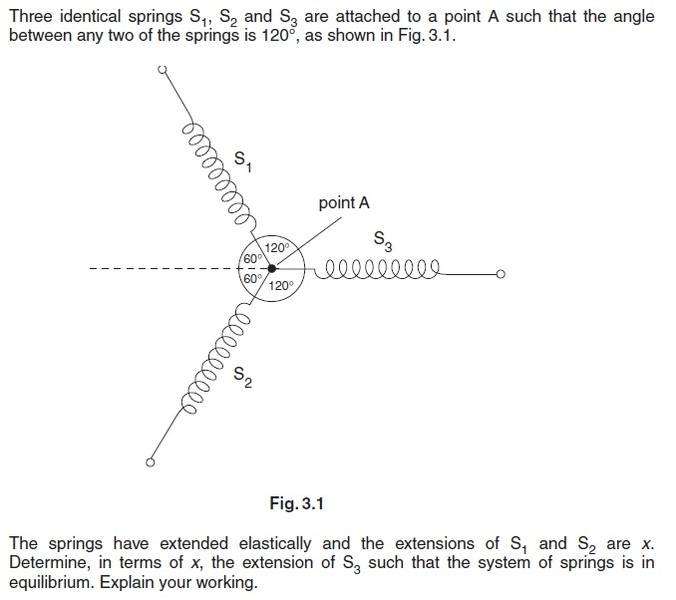
The discussion focuses on calculating the extension of identical springs using Hooke's Law, which states that the force exerted by a spring is proportional to its extension. The spring constant, denoted as k, is crucial for determining the extension when a force is applied. The problem specifically involves extending two springs by a distance x and incorporates the sine of 30 degrees, which equals 0.5, to aid in calculations. Understanding these principles is essential for solving similar physics problems effectively.

PREREQUISITES
  • Hooke's Law and its applications
  • Understanding of spring constants (k)
  • Basic trigonometry, specifically sine values
  • Concept of force and extension in springs
NEXT STEPS
  • Study the derivation and applications of Hooke's Law
  • Explore problems involving multiple springs in series and parallel
  • Learn about the relationship between force, mass, and acceleration in spring systems
  • Investigate real-world applications of springs in engineering and mechanics
USEFUL FOR

Students studying physics, educators teaching mechanics, and anyone interested in understanding the principles of spring dynamics and Hooke's Law.
abruzzi112
Messages
1
Reaction score
0
I usually have problems regarding Hooke's law and stuff. Please help me with the question below.. I came across it when I was doing my revision.
An explanation will be appreciated.
Thanks!

wNc3G2r.jpg
 
Physics news on Phys.org
This is homework-like. What have you tried?

The problem states that the springs are identical. It may help to pick an arbitrary spring constant and call it k. What is the effect of extending the first two springs by a distance x?

It may also help to recall that the sine of 30 degrees is 0.5
 
The book claims the answer is that all the magnitudes are the same because "the gravitational force on the penguin is the same". I'm having trouble understanding this. I thought the buoyant force was equal to the weight of the fluid displaced. Weight depends on mass which depends on density. Therefore, due to the differing densities the buoyant force will be different in each case? Is this incorrect?

Similar threads

  • · Replies 4 ·
Replies
4
Views
2K
Replies
16
Views
3K
Replies
20
Views
1K
Replies
1
Views
1K
  • · Replies 8 ·
Replies
8
Views
2K
Replies
16
Views
1K
Replies
2
Views
1K
  • · Replies 15 ·
Replies
15
Views
2K
  • · Replies 19 ·
Replies
19
Views
1K
Replies
20
Views
3K