Graduate How to calculate the interband velocity matrix in a graphene system

Click For Summary
In graphene systems, the velocity operator can be expressed as v = ∂H/ħ∂p, with matrix elements calculated as <ψ|v|ψ>, yielding v_x = v_F cos(θ) and v_y = v_F sin(θ} for intraband velocity. A new method for calculating the velocity matrix, as presented by Mikhailov, involves deriving the velocity operator from the equations of motion rather than directly from the Hamiltonian. The two approaches yield the same results but differ in their mathematical methods; the first is a direct calculation from the Hamiltonian, while the second is an indirect calculation based on motion equations. Understanding these differences is crucial for applying the appropriate method in research. Both methods are valid and widely recognized in condensed matter physics.
Sunny Huang
Messages
1
Reaction score
0
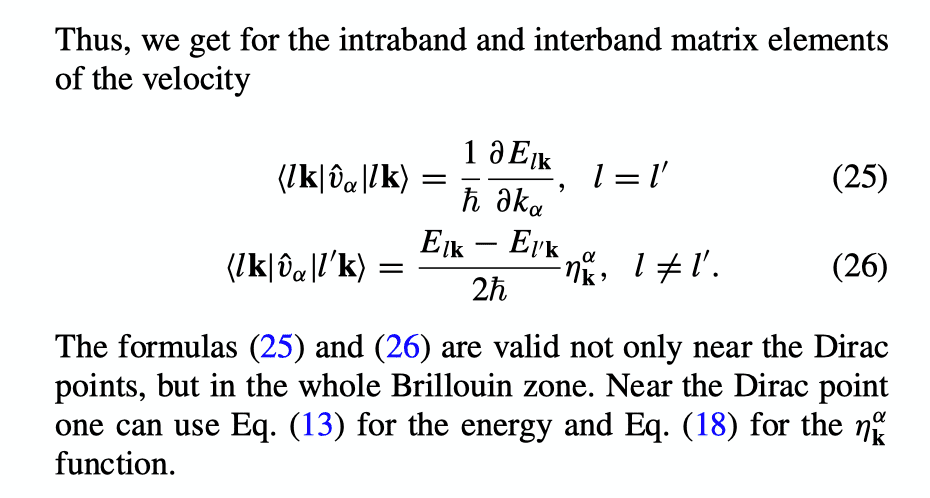
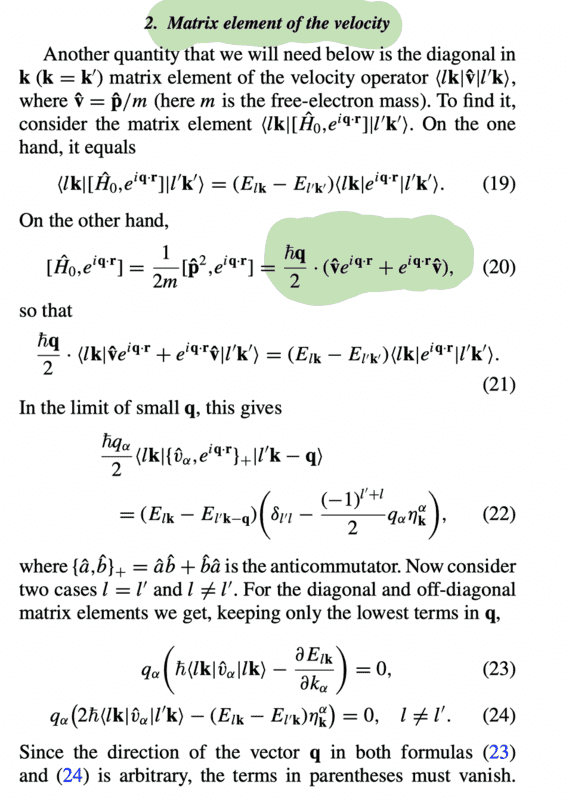
In graphene system, the velocity operator sometimes is v= ∂H/ħ∂p, and its matrix element is calculated as <ψ|v|ψ>, i.e., v_x = v_F cos(θ) and v_y = v_F sin(θ) [the results are the same with Eq. 25] for intraband velocity. Recently, I see a new way to calculate the velocity matrix (Mikhailov, Sergey A. "Quantum theory of the third-order nonlinear electrodynamic effects of graphene." Physical Review B 93.8 (2016): 085403.). But I cannot understand the Eq. 20 (see the following picture). Additionally, what the difference between the two ways to define the velocity operator?
WX20200619-130539@2x.png

?hash=a3b4a1c2177c20e8308553c65c300a66.png
 

Attachments

  • WX20200619-130557@2x.png
    WX20200619-130557@2x.png
    21.3 KB · Views: 186
Physics news on Phys.org
The two ways of calculating the velocity operator are essentially the same; they just use different mathematical methods to calculate the same values. The first way is to use the Hamiltonian to derive the velocity operator as v= ∂H/ħ∂p, where H is the Hamiltonian and p is the momentum. This method has been used for a long time and is well known in condensed matter physics.The second way, as described in Mikhailov's paper, is to calculate the velocity operator by using the equations of motion. In this method, the equations of motion for electrons in graphene are written as \frac{\partial \psi (r)}{\partial t} = \frac{1}{i\hbar} \left[ H_{0} + \sum_{i=1}^{4} H_{i} , \psi (r) \right]where H_0 is the kinetic energy and H_i are the interaction terms. Then, the velocity operator is derived from these equations of motion asv_{x,y} = \frac{1}{i\hbar} \left[ H_{0} + \sum_{i=1}^{4} H_{i} , x_{x,y} \right]The main difference between the two approaches is that the first approach is a direct calculation of the velocity operator from the Hamiltonian, while the second approach is an indirect calculation of the velocity operator from the equations of motion.
 
Time reversal invariant Hamiltonians must satisfy ##[H,\Theta]=0## where ##\Theta## is time reversal operator. However, in some texts (for example see Many-body Quantum Theory in Condensed Matter Physics an introduction, HENRIK BRUUS and KARSTEN FLENSBERG, Corrected version: 14 January 2016, section 7.1.4) the time reversal invariant condition is introduced as ##H=H^*##. How these two conditions are identical?

Similar threads

Replies
5
Views
6K
  • · Replies 8 ·
Replies
8
Views
2K
Replies
2
Views
3K
Replies
8
Views
2K
  • · Replies 1 ·
Replies
1
Views
3K
Replies
3
Views
2K
  • · Replies 16 ·
Replies
16
Views
6K
  • · Replies 9 ·
Replies
9
Views
7K
  • · Replies 175 ·
6
Replies
175
Views
26K
  • · Replies 125 ·
5
Replies
125
Views
20K