SUMMARY
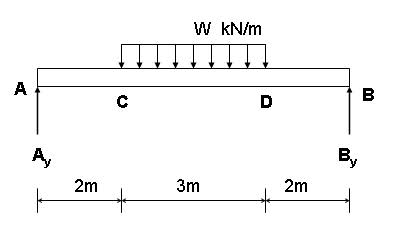
The maximum bending moment for a simply supported beam subjected to a uniformly distributed load (UDL) of 40 kN/m occurs at the midpoint of the beam, specifically 3.5 m from the left end. The calculation method involves converting the UDL into an equivalent point load and applying the bending moment formula. The correct approach includes constructing a shear diagram to visualize the forces acting on the beam. The final value of the maximum bending moment should be expressed in kNm with one decimal place.
PREREQUISITES
- Understanding of simply supported beam mechanics
- Knowledge of uniformly distributed loads (UDL)
- Familiarity with bending moment calculations
- Ability to construct shear and moment diagrams
NEXT STEPS
- Study the principles of shear and moment diagrams for beams
- Learn how to convert uniformly distributed loads into equivalent point loads
- Explore the calculation of bending moments in structural engineering
- Review examples of maximum bending moment calculations for various loading conditions
USEFUL FOR
Civil engineers, structural engineers, and students studying mechanics of materials will benefit from this discussion, particularly those focusing on beam analysis and design.