Discussion Overview
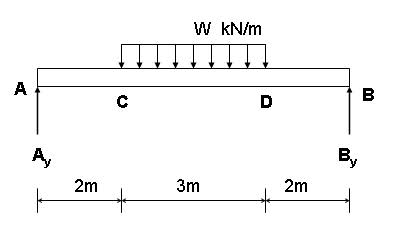
The discussion revolves around calculating the maximum bending moment of a simply supported beam subjected to a uniformly distributed load (UDL). Participants explore methods and approaches for determining this value, focusing on the application of structural analysis principles.
Discussion Character
- Homework-related
- Mathematical reasoning
- Technical explanation
Main Points Raised
- One participant states that the maximum bending moment occurs at the mid-length of the beam, specifically 3.5 m from the left end A.
- Another participant requests the original poster to share their attempted calculations to better understand where they might be encountering difficulties.
- A participant suggests constructing a shear diagram as a preliminary step in solving the problem.
- There is a recommendation to convert the uniformly distributed load into a point load for simplification.
Areas of Agreement / Disagreement
Participants have not reached a consensus on the correct method to calculate the maximum bending moment, and multiple approaches are being discussed without resolution.
Contextual Notes
Some assumptions regarding the beam's support conditions and load distribution may not be explicitly stated. The discussion also lacks detailed mathematical steps and definitions that could clarify the proposed methods.
Who May Find This Useful
This discussion may be useful for students or practitioners in civil or structural engineering who are interested in the analysis of simply supported beams under uniformly distributed loads.