How to calculate the minimum kinetic energy (special relativity)?

Click For Summary
The discussion focuses on calculating minimum kinetic energy in special relativity using conservation laws. Participants emphasize the importance of working with energy and momentum rather than velocities. Key equations highlighted include conservation of total energy and momentum, as well as the energy-momentum-mass equation. Errors in initial calculations are acknowledged, with suggestions to simplify the approach by using the correct relationships. The conversation concludes with a resolution to the problem, indicating that the solution was found quickly after addressing the mistakes.
Efeguleroglu
Messages
24
Reaction score
2
Homework Statement
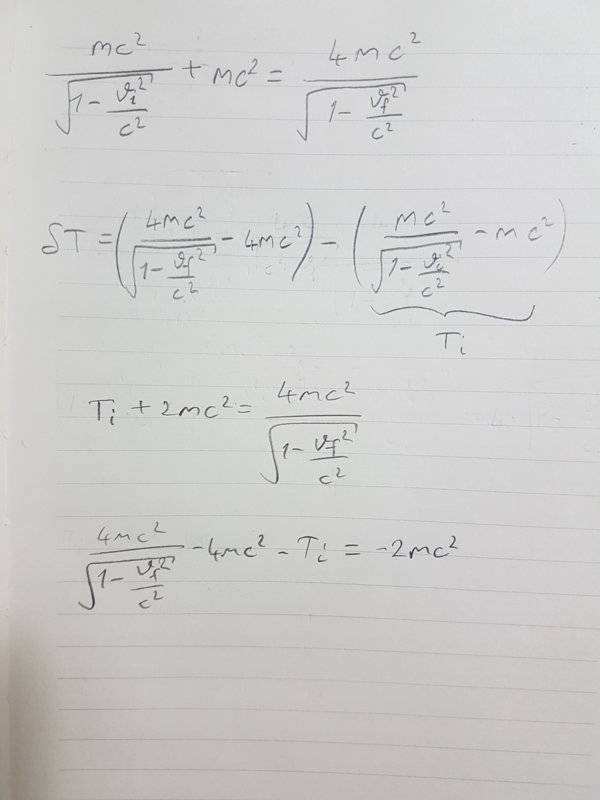
A moving electron collides to an stable electron and in conclusion additionaly 1 electron and 1 positron occur. At the end if all the 4 particles have the same velocity, we can say the kinetic energy required for this process is minimum. Show that KE(min)=6mc^2 (m is the rest mass of an electron)
Relevant Equations
KE=γmc^2-mc^2
Sadly, that's what all I could do.
20190617_011025.jpg
 
Last edited:
Physics news on Phys.org
I find it's better to work with energy and momentum, rather than writing things in terms of velocities.

You've used conservation of energy. What relationship do you get if you use conservation of momentum?
 
I still can't get the answer. I thought I didn't understand the question and calculated for both inital kinetic energy and final kinetic energy ( I know the change in kinetic energy is -mc^2 from the conservation of energy) but couldn't get the answer. There shouldn't be any calculation mistakes because I used a calculator.
20190617_172526.jpg

20190617_172532.jpg

20190617_172538.jpg

20190617_172550.jpg

20190617_172554.jpg
 
That's a lot of work!

1) What can you say about the total momentum after the collision?

2) What can you say about the momentum of each particle after the collision?
 
The momentum of the particles are equal. And that's the momentum which must be conserved.
20190617_172538M.jpg
 
Efeguleroglu said:
The momentum of the particles are equal. And that's the momentum which must be conserved.
View attachment 245271

You've gone wrong, I'm sorry to say. Best to start again. Here are some general hints:

a) Find the total energy of the moving electron. You can easily get the KE from this. Splitting the energy into ##T + mc^2## too soon just complicates the equations.

b) You have 3 key equations:

Conservation of total energy
Conservation of total momentum
The energy-momentum-mass equation for each particle (##E^2 = p^2c^2 + m^2c^4##).

Concentrate on those.
 
There must be a problem in this question. It's ridiculous but V(i) is less than it should be thus I found V(f) is imaginary. I didn't spot any mistake. Sorry for bothering you with this :(
20190617_192443.jpg

20190617_192447.jpg

20190617_192511.jpg
 
Again, it's difficult to see where you are going wrong. This should only be 3-4 lines of algebra using the energy and momentum equations. It's always messy when you try to solve for ##v##.

I would start as follows:

Let ##E_0, p_0## be the energy and momentum of the moving electron; and, ##E_1, p_1## be the energy and momentum of each of the particles after the collision.

Conservation of energy gives:

##E_0 + mc^2 = 4E_1 \ \ \ (1)##

Conservation of momentum gives:

##p_0 = 4p_1 \ \ \ (2)##

And, we have:

##E_0^2 = p_0^2c^2 + m^2c^4 \ \ \ (3a)##
##E_1^2 = p_1^2c^2 + m^2c^4 \ \ \ (3b)##

The next obvious step is to square equation (1), and then do some substitutions. It should come out in a couple of steps.
 
You made an error pretty much from the start. The fourth line is wrong because you did something akin to ##(a+b)^2 = a^2 + b^2##.

As I suggested yesterday and as @PeroK has again suggested, work in terms of energy and momentum.
 
  • Like
Likes PeroK
  • #10
vela said:
You made an error pretty much from the start. The fourth line is wrong because you did something akin to ##(a+b)^2 = a^2 + b^2##.

As I suggested yesterday and as @PeroK has again suggested, work in terms of energy and momentum.

Ahh yes, I saw it. I applied the momentum-energy equation from particles to the set of particles wrongly. Thanks, you helped me to spot that.
 
  • #11
PeroK said:
Again, it's difficult to see where you are going wrong. This should only be 3-4 lines of algebra using the energy and momentum equations. It's always messy when you try to solve for ##v##.

I would start as follows:

Let ##E_0, p_0## be the energy and momentum of the moving electron; and, ##E_1, p_1## be the energy and momentum of each of the particles after the collision.

Conservation of energy gives:

##E_0 + mc^2 = 4E_1 \ \ \ (1)##

Conservation of momentum gives:

##p_0 = 4p_1 \ \ \ (2)##

And, we have:

##E_0^2 = p_0^2c^2 + m^2c^4 \ \ \ (3a)##
##E_1^2 = p_1^2c^2 + m^2c^4 \ \ \ (3b)##

The next obvious step is to square equation (1), and then do some substitutions. It should come out in a couple of steps.

Thank you! It appeared quickly.
20190617_195745.jpg
 
  • Like
Likes BvU and PeroK
  • #12

Similar threads

Replies
8
Views
2K
Replies
2
Views
1K
  • · Replies 33 ·
2
Replies
33
Views
3K
  • · Replies 21 ·
Replies
21
Views
5K
  • · Replies 10 ·
Replies
10
Views
795
  • · Replies 3 ·
Replies
3
Views
1K
Replies
1
Views
1K
  • · Replies 9 ·
Replies
9
Views
2K
Replies
1
Views
1K