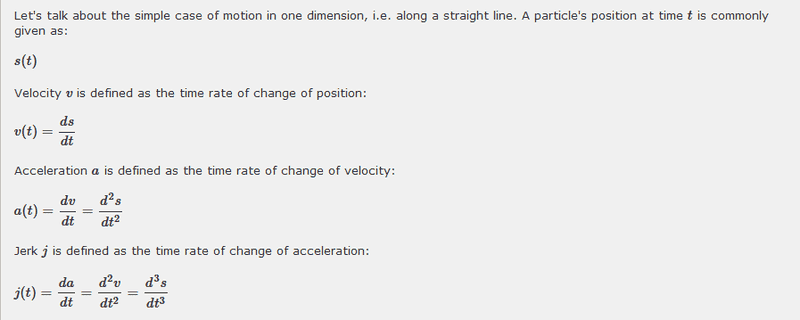
@rosekidcute, it might help if you provide the sources for these two cropped images that you keep re-posting. That the fonts are different suggests they are excerpts from two completely different textbooks. What are these textbooks?
Related to this - when you ask the following about the second excerpt -- this suggests that you don't understand what these functions are trying to describe, but are trying to shoehorn them, unexamined, into a previously learned definition from a different source and different context. But surely understanding of these functions
for what they are ought to come first? E.g. one could go to Kahn Academy and study their presentation of acceleration and velocity:
https://www.khanacademy.org/science...l-motion/acceleration-tutorial/v/acceleration
A more general comment: From previous posts of yours that I've read, you seem to be jury-rigging your self-taught math curriculum by piecing together different sources. That's what I'm doing too (you can search for my various math-related posts or read my https://www.physicsforums.com/members/usablethought.611113/#info), but I think that in attempting this, we have to be careful not to get lost or fall into gaps between different sources. Here you seem to have created such a gap and leaped into it.
I remember a recent thread where you were advised to find a master means of coordinating your curriculum; have you done so yet? Without that, you will keep wandering off course like this and slow your progress way down.