How to construct 4 in+out Feynman diagram from 3 Feynman diagram?

Click For Summary
SUMMARY

The discussion centers on constructing a Feynman diagram with four external lines from three existing diagrams, as explained by Sean Carroll. It emphasizes the importance of maintaining renormalizability in the Lagrangian, specifically requiring the term ##c_4 \phi^4## to counteract logarithmic divergences. The conversation also touches on the implications for electrodynamics with Dirac fermions, where four-photon diagrams are superficially divergent but remain convergent due to gauge invariance and the Ward-Takahashi identity. This highlights the intricate relationship between diagram construction and the underlying theoretical framework.

PREREQUISITES
  • Understanding of Feynman diagrams and their construction
  • Familiarity with renormalization concepts in quantum field theory
  • Knowledge of Lagrangian mechanics and its role in particle physics
  • Basic grasp of gauge invariance and Ward-Takahashi identities
NEXT STEPS
  • Study the principles of Feynman diagram construction in quantum field theory
  • Research the implications of renormalization in Lagrangian formulations
  • Explore the Ward-Takahashi identity and its applications in gauge theories
  • Investigate the role of divergences in quantum electrodynamics and their resolutions
USEFUL FOR

Physicists, particularly those specializing in quantum field theory, particle physicists, and researchers interested in the nuances of renormalization and Feynman diagram analysis.

Martian2020
Messages
49
Reaction score
0
TL;DR
Sean Carroll stated 4 in/out lines Feynman diagram can be constructed from 3 lines one. What does it mean?
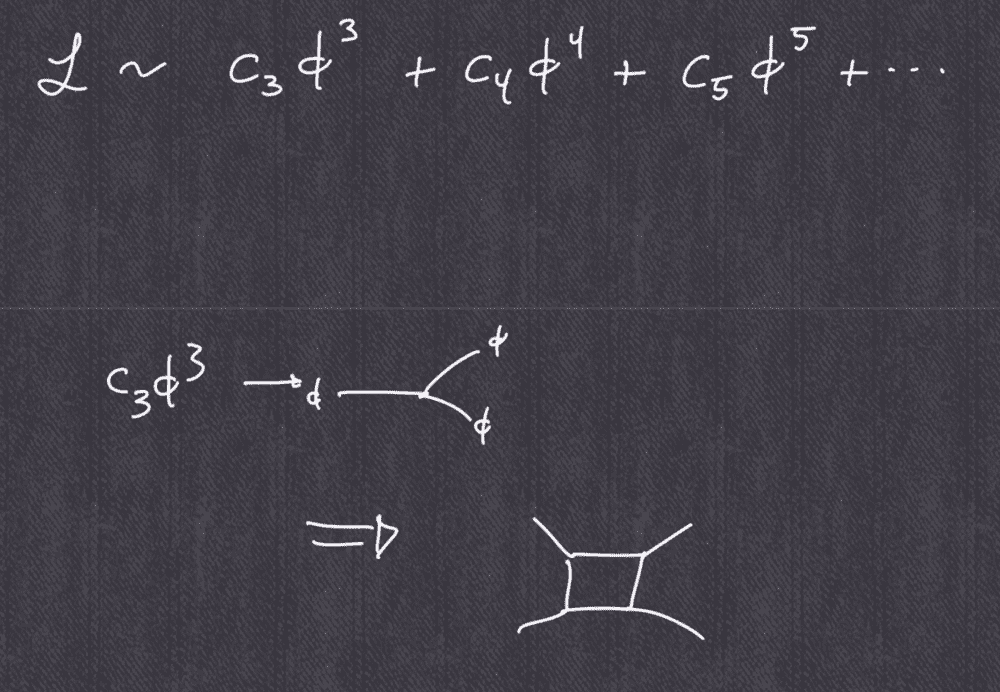
Renormalization talk by Sean Carroll, "but then I could construct from that the following diagram with four lines in it":
Untitled.png


In previous talks he explained about diagrams and told interaction can be represented by many (even infinite) number of diagrams, "in" line can be changed to antiparticle "out" one, but for one particular interaction number of in+out lines was the same. In above he claims to construct 4 from 3. What does it mean? I was not able to find the answer by web search, google gives articles about diagrams "in general".
 
Physics news on Phys.org
You can just draw any diagram consistent with the Feynman rules of the model under consideration. So you can draw the diagram shown in the picture. So even if you set all the constants ##c_4=c_5=\ldots=0## you can have vertices with an arbitrary number of lines.

In connection with renormalizability it's however important that you have all interactions in the Lagrangian such that the model is renormalizable. In this case you must thus keep ##c_4##, because the drawn diagram is logarithmically divergent and you need a counter term to renormalize it, which means you must have a term like ##c_4 \phi^4## in the Lagrangian to make the model renormalizable.

On the other hand, you must not have ##c_5 \phi^5## and higher-order expressions, because then the theory wouldn't be (Dyson-)renormalizable anymore, but without such higher-order expressions the theory is indeed renormalizble, because the diagrams with ##\geq 5## legs are superficially convergent (and thus the entire theory given the BPHZ theorem of renormalization).

It's also interesting to look at electrodynamics with Dirac fermions (e.g., electrons and positrons). There you can also draw diagrams with four photon legs, and such a diagram is superficially logarithmically divergent, which would be a desaster, because then you'd have to find a gauge-invariant expression with four photon fields for your Lagrangian, and there's none that leads to renormalizable couplings. Fortunately gauge invariance saves the day, because the superficially divergent four-photon diagram is convergent thanks to a corresponding Ward-Takahashi identity.
 
  • Like
Likes   Reactions: Martian2020
He just means that you can "glue" together vertices with three external lines together to make a diagram with four external lines.
 
  • Like
Likes   Reactions: Martian2020

Similar threads

  • · Replies 7 ·
Replies
7
Views
3K
  • · Replies 4 ·
Replies
4
Views
3K
  • · Replies 15 ·
Replies
15
Views
3K
  • · Replies 1 ·
Replies
1
Views
2K
  • · Replies 33 ·
2
Replies
33
Views
6K
  • · Replies 1 ·
Replies
1
Views
2K
  • · Replies 2 ·
Replies
2
Views
2K
Replies
8
Views
1K
  • · Replies 3 ·
Replies
3
Views
3K
  • · Replies 1 ·
Replies
1
Views
2K