How to deal with non fixed springs?

  • Thread starter Thread starter girolamo
  • Start date Start date
  • Tags Tags
    Springs
Click For Summary
SUMMARY

This discussion addresses the computation of forces in a system where both ends of a spring are free, specifically when two blocks are connected by a spring and subjected to an external force. The example provided involves a horizontal force of 50N applied to the blocks, with a spring constant of 300N/m. The tension in the spring is calculated using the formula T = k (ΔxB - ΔxA), where ΔxB and ΔxA represent the displacements of the two blocks. This approach allows for the determination of the acceleration of each block in the absence of friction.

PREREQUISITES
  • Understanding of Newton's laws of motion
  • Familiarity with Hooke's Law and spring constants
  • Basic knowledge of force and acceleration calculations
  • Concept of displacement in mechanical systems
NEXT STEPS
  • Study the application of Newton's second law in multi-body systems
  • Explore advanced topics in dynamics involving springs and oscillations
  • Learn about frictionless surfaces and their impact on motion
  • Investigate the effects of varying spring constants in different scenarios
USEFUL FOR

Physics students, mechanical engineers, and anyone interested in understanding dynamics involving springs and forces in free-body systems.

girolamo
Messages
6
Reaction score
0
Hello

In every physics book they explain how to compute the force that a spring exert if one of its ends is fixed to a wall (or equivalent) and the other end is compressed or stretched.

But how to deal with the problem if both ends are 'free'.

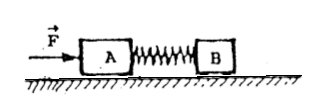
For example, suppose you have two blocks attached with a spring, and someone apply an horizontal force of, say, 50N. (Lets suppose that there is no friction with the surface, the blocks are originally at rest, the spring is originally in its relaxed state, and the spring constant is, say, 300N/m).

How you would compute the acceleration of each block?
2n1c4zb.jpg
 
Last edited:
Physics news on Phys.org
The tension in the spring (assumed mass-less) is equal to the spring constant times the displacement of mass B minus the displacement of mass A:

T = k (ΔxB-ΔxA)

This difference in displacements is the amount that the spring stretches.

Chet
 
  • Like
Likes   Reactions: 1 person

Similar threads

  • · Replies 5 ·
Replies
5
Views
2K
Replies
17
Views
2K
  • · Replies 8 ·
Replies
8
Views
2K
Replies
61
Views
4K
Replies
3
Views
2K
Replies
11
Views
1K
  • · Replies 4 ·
Replies
4
Views
2K
  • · Replies 2 ·
Replies
2
Views
1K
Replies
14
Views
3K
Replies
2
Views
2K