How to determine if all C atoms are coplanar

  • Thread starter Thread starter Janiceleong26
  • Start date Start date
  • Tags Tags
    Atoms
Click For Summary
SUMMARY

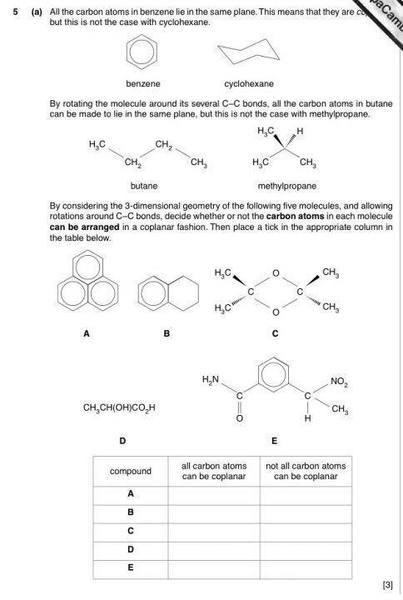
This discussion focuses on determining the coplanarity of carbon atoms in various molecular structures, specifically in compounds C, D, and E. Participants clarify that while sp3 hybridized carbon atoms typically adopt a tetrahedral geometry, this does not inherently prevent them from being coplanar under certain arrangements. The conversation highlights that in structures like methylpropane, although any three carbon atoms can be coplanar, the fourth carbon atom disrupts this arrangement. The importance of visual models for understanding molecular geometry is emphasized throughout the discussion.

PREREQUISITES
  • Understanding of sp3 and sp2 hybridization
  • Familiarity with molecular geometry and bond angles
  • Basic knowledge of molecular models and modeling techniques
  • Experience with structural representations of organic compounds
NEXT STEPS
  • Explore molecular modeling software such as ChemDraw or Avogadro
  • Study the principles of hybridization in organic chemistry
  • Learn about the geometric arrangements of carbon atoms in various hydrocarbons
  • Investigate the effects of molecular rigidity on coplanarity in cyclic compounds
USEFUL FOR

Chemistry students, organic chemists, educators teaching molecular geometry, and anyone interested in understanding the spatial arrangements of carbon atoms in organic compounds.
Janiceleong26
Messages
276
Reaction score
4
1. Homework Statement
image.jpg

Homework Equations

The Attempt at a Solution


I can see that in B, not all C atoms are coplanar , but for C, D and E I can't see how the carbon atoms are coplanar .. I thought they are tetrahedral?
 
Physics news on Phys.org
In E carbon atoms are not coplanar (that is, one of them can "freely" move, so there will be moments when it will be complanar with others).

How many carbon atoms in D? Can you think of such an arrangement of these atoms that they would not lie on a one surface?

When it comes to C it would be best to see a model. Yes, all these carbons are sp3 hybridized, but it doesn't stop them from lying on one surface. Is the central COCO ring flat?
 
Borek said:
In E carbon atoms are not coplanar (that is, one of them can "freely" move, so there will be moments when it will be complanar with others).
Is it the carbon atom in CH3 that is free to move? What about the carbon atom bonded to No2?
Like in their examples, all carbon atoms in benzene lie in a plane because they all use sp2 orbitals and every bond angle is 120°, right? But in the case of cyclohexane, all carbon atoms are sp3 hybridised and they each have a tetrahedral shape, so why can't they all lie in the same plane? How do you know if all carbon atoms can lie in a plane?

Borek said:
How many carbon atoms in D? Can you think of such an arrangement of these atoms that they would not lie on a one surface?
3 carbons. Erm, is it like the arrangement of methylpropane ? Again, I am still confused, why the carbon atoms in methylpropane are not coplanar...

Borek said:
When it comes to C it would be best to see a model. Yes, all these carbons are sp3 hybridized, but it doesn't stop them from lying on one surface. Is the central COCO ring flat?
I'm not sure.. Yes?
 
Janiceleong26 said:
Is it the carbon atom in CH3 that is free to move?

Yes.

What about the carbon atom bonded to No2?

Atoms in the ring are sp2, that means all atoms bonded to the ring lie in the ring plane.

Janiceleong26 said:
3 carbons. Erm, is it like the arrangement of methylpropane ? Again, I am still confused, why the carbon atoms in methylpropane are not coplanar...

But they are - any three points always lie on a surface (technically that hold even when they colinear, even if there are infinitely many such surfaces then).

Janiceleong26 said:
I'm not sure.. Yes?

Yes, the central COCO ring is rigid. That means all carbons sticking out of the C atoms must lie in a plane.

I am afraid if you don't see it it won't be easy to show without a model. All carbons lie on a plane, and O atoms stick up and down, this is a rigid arrangement.

Perhaps try to think about it this way - this molecules consist of two halves, each one containing three carbon atoms and connected by the oxygen bridges. Both halves contain three carbons, so these three carbons have to be coplanar (remember? each connected three carbons lie on a plane). Now, the way these halves are bonded through the oxygen bridges puts these carbon planes in the same place - so there is in fact one plane only.
 
Ahh I see.. That was clear, thanks so much !
But why is it impossible for the carbon atoms in methylpropane to be coplanar?
 
Janiceleong26 said:
Then, why is it impossible for the carbon atoms in methylpropane to be coplanar?

There are four carbons - any three will be coplanar, but the fourth must stick out.

As I said earlier, try to build models - even from putty, or plasticine, and matches/toothpicks.
 
  • Like
Likes Janiceleong26
Borek said:
There are four carbons - any three will be coplanar, but the fourth must stick out.

As I said earlier, try to build models - even from putty, or plasticine, and matches/toothpicks.
Ok, thank you !
 

Similar threads

  • · Replies 1 ·
Replies
1
Views
5K
Replies
1
Views
2K
  • · Replies 2 ·
Replies
2
Views
7K
  • · Replies 6 ·
Replies
6
Views
5K
  • · Replies 14 ·
Replies
14
Views
2K
  • · Replies 10 ·
Replies
10
Views
3K
Replies
3
Views
3K
  • · Replies 1 ·
Replies
1
Views
3K
  • · Replies 4 ·
Replies
4
Views
1K
  • · Replies 6 ·
Replies
6
Views
2K