How to Find Fourier Coefficients for a Given Function

Click For Summary
The discussion focuses on finding Fourier coefficients for two functions, g(x) and f(3x), and understanding their relationships. The main confusion arises around the coefficients an and bn, particularly how they relate when transitioning from g(x) to f(3x). It is clarified that while a0 remains the same, the coefficients should not be directly equated; instead, a relationship between an and am should be established. A suggestion is made to use a simple example function, such as f(x) = cos(x), to illustrate the concept. Ultimately, the conclusion is that the coefficients follow the relationship ao_{3n} = an for all n.
Kqwert
Messages
160
Reaction score
3
Homework Statement
Finding fourrier coefficients by observation
Relevant Equations
No eq. posted
Hello,

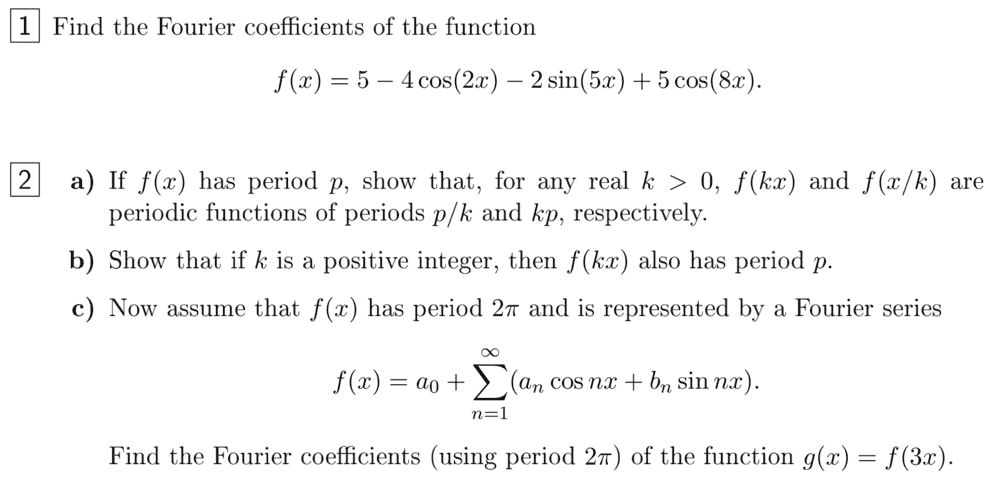
I need help with question #2 c) from the following link (already LateX-formatted so I save some time...):
https://wiki.math.ntnu.no/_media/tma4135/2017h/tma4135_exo1_us29ngb.pdf
ft.png


I do understand that the a0 for both expressions must be the same, but what about an and bn? I don't understand how you find them, given that we'll have an*cos(nx)/bn*sin(nx) in the first case while we will have an*cos(3nx)/bn*sin(3nx) in the second case.
 
Last edited by a moderator:
Physics news on Phys.org
Kqwert said:
we'll have an*cos(nx)/bn*sin(nx) in the first case while we will have an*cos(3nx)/bn*sin(3nx) in the second case
I don't see them in your attempt at solution

anyway, posts that show no attempt can't be assisted in: PF rules
 
Okay,

so
<br /> g(x) = ao_{0} + \sum_{n=1}^{inf} ao_{n}cos(nx)+bo_{n}sin(nx)
<br /> f(3x) = a_{0} + \sum_{n=1}^{inf} a_{n}cos(3nx)+b_{n}sin(3nx)<br />

and g(x) = f(3x)

I understand that
ao_{0} = a_{0}, but not sure what to do with the an and bn parts, to make them equal??

Anyways,

think we have to compare the sin and cos terms?

i.e.

<br /> ao_{3}cos(3x) = a_{1}cos(3x)<br />
so ao_{3} = a_{1} ?
 
Last edited:
You make life difficult for yourself:
Kqwert said:
what to do with the an and bn parts, to make them equal?
You don't want to make the ##a_n## equal at all !
Try using ##m## as summation variable in the second expression and find a relationship between ##a_n## and ##a_m##
 
A tip for if you are in a hurry: try a simple example ##f##, for instance ##f(x) = \cos x## :wink:
 
I edited post #3. Is that correct?
 
That makes the thread rather difficult to follow, but I think you get the idea, yes.

It's really a very simple exercise if you look 'through' it, isn't it !
 
Hold it !
In your notation, the alternative ##ao_{n} = a_{3n}## looks more sensible

again: check with ##f=\cos x##
 
Thanks! not sure how to check that though?
 
  • #10
What is the Fourier series for ##\cos x## ?
Idem ##\cos 3x## ?
 
  • #11
<br /> cos(x) = \sum_{n = 1}^{inf} a_{n}cos(nx)<br />
where every a_{n} apart from a_{1} is zero..?

Similarly,

we'll have
<br /> cos(3x) = a_{3}cos(3x)
 
  • #12
BvU said:
In your notation, the alternative ##ao_{n} = a_{3n}## looks more sensible
again: check with ##f=\cos x##
o:) The above is of course bogus. As you debunked correctly in #11:
If ##f(x) = \cos x \Rightarrow a_1 = 1## and all other ##a_n = 0## then
##\ \ g(x) = f(3x)## has ## a_3 = 1## and all other ##a_n = 0##
which you can easily generalize.

In other words ##\ \ ao_{3n} = a_n \ \ \forall n\ \ ## -- as you concluded in the edited post #3.
 

Similar threads

  • · Replies 14 ·
Replies
14
Views
2K
  • · Replies 7 ·
Replies
7
Views
2K
  • · Replies 3 ·
Replies
3
Views
2K
Replies
3
Views
3K
  • · Replies 2 ·
Replies
2
Views
2K
Replies
3
Views
2K
  • · Replies 1 ·
Replies
1
Views
2K
  • · Replies 1 ·
Replies
1
Views
2K
  • · Replies 8 ·
Replies
8
Views
2K
  • · Replies 4 ·
Replies
4
Views
1K