How to find height in Projectile Motion?

Click For Summary

Homework Help Overview

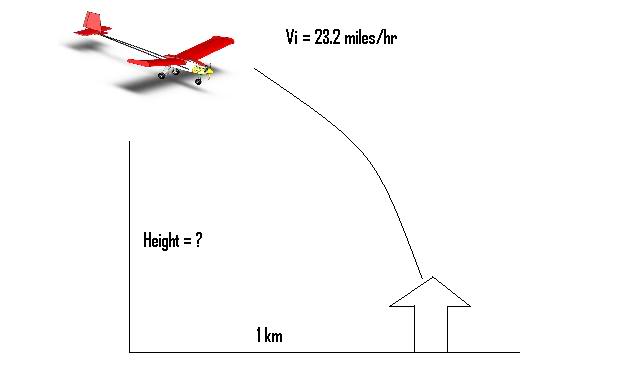
The discussion revolves around a problem in projectile motion, specifically focusing on determining the height of a projectile given an initial velocity and horizontal distance. The original poster presents initial conditions including a velocity of 23.2 miles/hour and a horizontal distance of 1 km, while seeking guidance on how to approach the problem.

Discussion Character

  • Exploratory, Assumption checking, Problem interpretation

Approaches and Questions Raised

  • Participants suggest the need for an angle of projection and emphasize the importance of consistent units. There are discussions about calculating time based on horizontal distance and initial velocity, as well as using kinematic equations to find height. Some participants question the clarity of the provided diagram.

Discussion Status

The discussion is active, with multiple participants contributing different perspectives on how to approach the problem. While there is no explicit consensus, various methods and considerations are being explored, including the relationship between horizontal and vertical motion in projectile motion.

Contextual Notes

There are noted constraints regarding unit consistency and the need for an angle of projection, which have not been provided. The original poster's diagram is also mentioned as unclear, which may affect the interpretation of the problem.

SHENGTON
Messages
6
Reaction score
0
Hello guys!

I need your help regarding Projectile Motion because I kinda novice here. I don't know where to start.

These are the following given:
Vi = 23.2 miles/hour
h = ?
x = 1 km

Here's the situation it looks like, check this image that I created for you to understand.
ProjectTile.jpg


Hope someone can help me with this.

Thanks and God bless. :)
 
Physics news on Phys.org
For a start you'd need to have an angle of projection, and convert all figures into the same system. The diagram isn't over clear to me, as it seems your plane is pointing away from the projection (but it is early here)
 
Unit are not the same here!
You need to find time.
Use these formulae you can get the answer. Don't forget to change same unit here. SI and British Unit!
t=x/Vi
h=0.5gt^2
 
remember that the velocity in x direction is constant then you can use the x component velocity to find time by D=VT then solve for height in y direction
 
Like seto6 said, the acceleration in X is 0. You can find the time that you will need to resolv the Y equation.
 
Actually, All of us(seto6, proculation and inky) method are the same.
v[0x]=v[x]=v
v[0y]=0

t=x/v=1/(23.2*1.6)=0.0269 hr=96.84 s
h=y=v[0y]t+0.5gt[2]=0+0.5(10)(96.84^2)=46890m=46.89 km
 
Last edited:

Similar threads

Replies
40
Views
3K
  • · Replies 4 ·
Replies
4
Views
3K
  • · Replies 1 ·
Replies
1
Views
3K
  • · Replies 8 ·
Replies
8
Views
3K
  • · Replies 15 ·
Replies
15
Views
27K
  • · Replies 21 ·
Replies
21
Views
3K
  • · Replies 3 ·
Replies
3
Views
4K
  • · Replies 3 ·
Replies
3
Views
2K
  • · Replies 1 ·
Replies
1
Views
3K
  • · Replies 5 ·
Replies
5
Views
16K