How to find power and voltage using the mesh current method?

Click For Summary

Discussion Overview

The discussion revolves around using the mesh current method to find power and voltage in a circuit. Participants are engaged in a homework-related inquiry, seeking validation and assistance with their problem-solving process.

Discussion Character

  • Homework-related, Exploratory

Main Points Raised

  • One participant expresses uncertainty about their calculation of Uab and requests feedback on their work.
  • Multiple participants emphasize the importance of showing work before receiving help, reiterating community rules regarding homework assistance.
  • One participant indicates that to calculate power for a current source, it is necessary to first determine the voltage across that source, suggesting a sequential approach to the problem.
  • A later reply confirms that the results presented by the original poster look good, though no specific details are provided.

Areas of Agreement / Disagreement

Participants generally agree on the need to show work for assistance, but there is no consensus on the correctness of the calculations or the approach to finding power and voltage.

Contextual Notes

Some limitations include the absence of specific calculations or detailed explanations of the mesh current method, as well as the need for clarity on the definitions of terms like Uab and power in this context.

Who May Find This Useful

Students preparing for tests in circuit analysis or those learning about the mesh current method may find this discussion relevant.

stipan_relix
Messages
16
Reaction score
1
Member advised to use the formatting template for all homework help requests
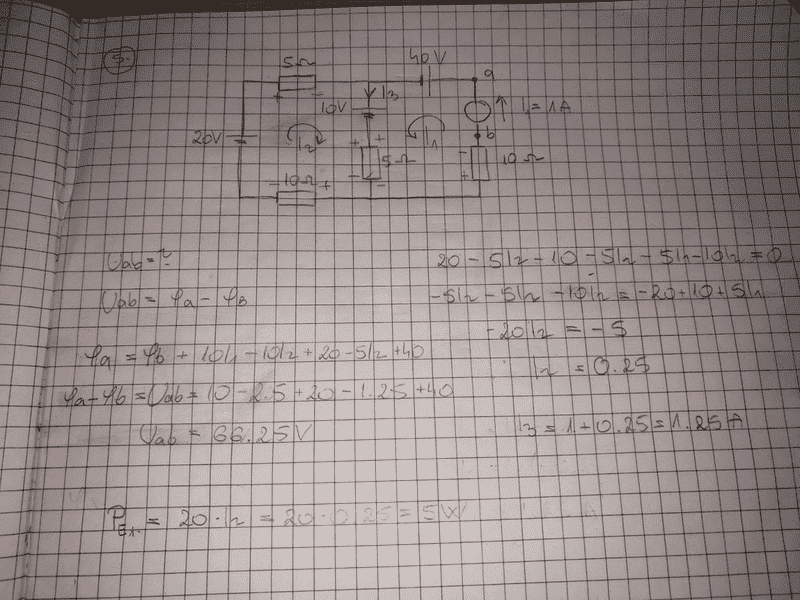
Hi. I am practising for my test and since I don't have the correct answers, I don't know if what I'm doing is right.

I tried to solve this problem, can you check it and correct if it's wrong?
unUAKCg.png


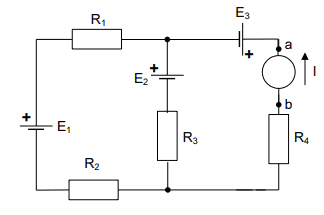
Here's a clearer picture of the circuit.
aYSEOEy.png


I suspect Uab isn't right, but am not sure. Thanks!

EDIT: My work picture link was wrong, sorry.
 

Attachments

  • aYSEOEy.png
    aYSEOEy.png
    2.2 KB · Views: 697
  • unUAKCg.png
    unUAKCg.png
    118.5 KB · Views: 850
Last edited:
Physics news on Phys.org
Thanks for posting in homework, but you deleted the template. Most important, you didn't show us your work. Our rules do not allow helpers to help until you show your attempt at solution first. In other words, we don't do the problem for you. We help you to solve it.
 
anorlunda said:
Thanks for posting in homework, but you deleted the template. Most important, you didn't show us your work. Our rules do not allow helpers to help until you show your attempt at solution first. In other words, we don't do the problem for you. We help you to solve it.
Sorry, the link showing my work was somehow private, I fixed it.
 
  • Like
Likes   Reactions: berkeman
Your results look good.
 
  • Like
Likes   Reactions: stipan_relix
Alright, if I wanted to get P for the current source, I'd have to first get the voltage for that current source, there's no way around that, right?
 
stipan_relix said:
Alright, if I wanted to get P for the current source, I'd have to first get the voltage for that current source, there's no way around that, right?
Well, no way that's any simpler.
 
  • Like
Likes   Reactions: stipan_relix

Similar threads

  • · Replies 5 ·
Replies
5
Views
2K
  • · Replies 7 ·
Replies
7
Views
3K
  • · Replies 4 ·
Replies
4
Views
7K
  • · Replies 1 ·
Replies
1
Views
5K
  • · Replies 28 ·
Replies
28
Views
5K
  • · Replies 15 ·
Replies
15
Views
4K
Replies
5
Views
3K
  • · Replies 7 ·
Replies
7
Views
3K
  • · Replies 1 ·
Replies
1
Views
2K
  • · Replies 1 ·
Replies
1
Views
2K