How to Find the First Buckling Load from the Deflection Equation?

Click For Summary

Discussion Overview

The discussion revolves around calculating the first buckling load from a deflection equation for a column subjected to axial and lateral loads. Participants explore the implications of boundary conditions and the geometry of the problem, focusing on the mathematical approach to derive the buckling load.

Discussion Character

  • Technical explanation
  • Mathematical reasoning
  • Homework-related

Main Points Raised

  • One participant presents a deflection equation derived from taking moments and applying boundary conditions, expressing uncertainty about how to extract the first buckling load from it.
  • Another participant suggests considering the problem as a buckling column with both axial and lateral loads, noting that the pivoted ends affect the critical load.
  • A later reply agrees with the previous suggestion and indicates that the maximum deflection likely occurs at the center of the beam, proposing that evaluating the derivative at this point could simplify the calculations.
  • One participant expresses concern that the suggested method might be overly complex for a two-mark question and seeks clarification on the utility of the professor's hint regarding the displacement at the midpoint.

Areas of Agreement / Disagreement

Participants generally agree on the approach of evaluating the deflection at the midpoint to find the first buckling load, but there is no consensus on the overall complexity of the method or its appropriateness for the problem's context.

Contextual Notes

Participants highlight the dependence on boundary conditions and the geometry of the column, as well as the potential for simplifications in the mathematical approach. Specific assumptions about the loading conditions and the nature of the deflection are also noted but remain unresolved.

Master1022
Messages
590
Reaction score
116
Homework Statement
Use the derived deflection equation to calculate the first buckling load?
Relevant Equations
Derived equation
Hi,

I was working through a problem about calculating buckling loads. The problem had the following geometry (I apologise for the poor drawing skills):
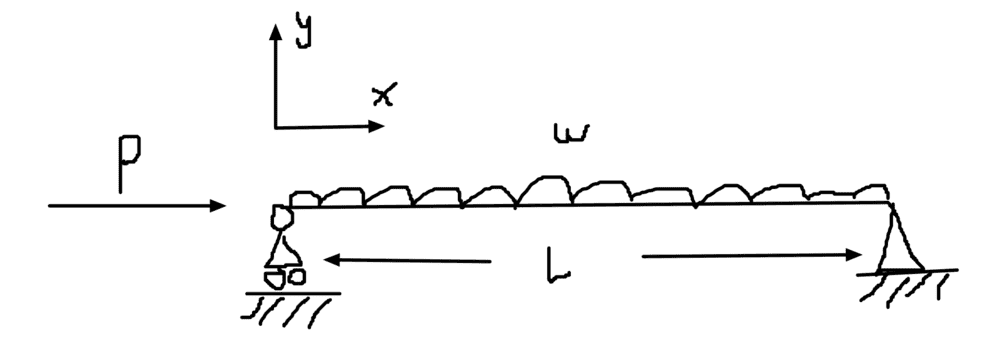
aww-board-3.png
and the total length is ## L ##.

The boundary conditions are therefore:
1. ## y(0) = 0 ##
2. ## y(L) = 0 ##

My approach:
After taking a cut and taking moments we can eventually get the following solution (which agrees with the answer):

$$ y(x) = \frac{-wEI}{P^2} cos(\beta x) + \frac{wEI}{P^2} \left(\frac{cos(\beta L) - 1}{sin(\beta L)} \right) sin(\beta x) - \frac{w}{2P} x^2 + \frac{wL}{2P}x + \frac{wEI}{P^2} $$

where ## \beta^2 = \frac{P}{EI} ##

but I really have no clue how to proceed by using this equation to find the first buckling load. Usually we find expressions for ## \beta ## that arise from the boundary conditions...

Any help is greatly appreciated. Thanks
 
  • Like
Likes   Reactions: sully_01
Physics news on Phys.org
We could consider this case as a buckling column, axially loaded by P and laterally loaded by a uniformly distributed load W.
Note that the column is pivoted in both ends, which, together with the lateral load, reduces the magnitude of critical P.

This Math is too complicated for me, but it may help you:
https://www.continuummechanics.org/multiloadcolumnbuckling.html

:cool:
 
  • Like
Likes   Reactions: Master1022
Lnewqban said:
We could consider this case as a buckling column, axially loaded by P and laterally loaded by a uniformly distributed load W.
Note that the column is pivoted in both ends, which, together with the lateral load, reduces the magnitude of critical P.

This Math is too complicated for me, but it may help you:
https://www.continuummechanics.org/multiloadcolumnbuckling.html

:cool:

Thank you very much for sharing this @Lnewqban - I will try to make my way through this!

Although, I feel that this method, whilst correct, might slightly be a bit too long for 2 marks of working. I have managed to get a hint from the professor that perhaps we can use the displacement at ## x = L/2 ## but I don't really see how that information is useful. Are you able to see how that could be useful?

In the meanwhile, I will read through that link.
 
Your professors hint is correct. The first buckling mode is likely to be when the maximum deflection occurs at the centre of the beam. Hence dy/dx evaluated at x = L/2 will be 0, and you can solve for the corresponding Beta. (The math simplifies down quite a bit and you'll end up having to solve a simple trigonometric equation!).
 
Last edited:

Similar threads

  • · Replies 11 ·
Replies
11
Views
3K
Replies
10
Views
4K
Replies
3
Views
4K
  • · Replies 5 ·
Replies
5
Views
4K
  • · Replies 5 ·
Replies
5
Views
2K
  • · Replies 2 ·
Replies
2
Views
2K
Replies
5
Views
3K
Replies
6
Views
2K
Replies
4
Views
2K
  • · Replies 4 ·
Replies
4
Views
2K