How to find the velocity of a wave in simple harmonic motion given time

Join the discussion
Registration is free. Ask a follow-up in this thread, or start your own.
3 replies · 2K views
MattDutra123
Messages
15
Reaction score
0
Homework Statement
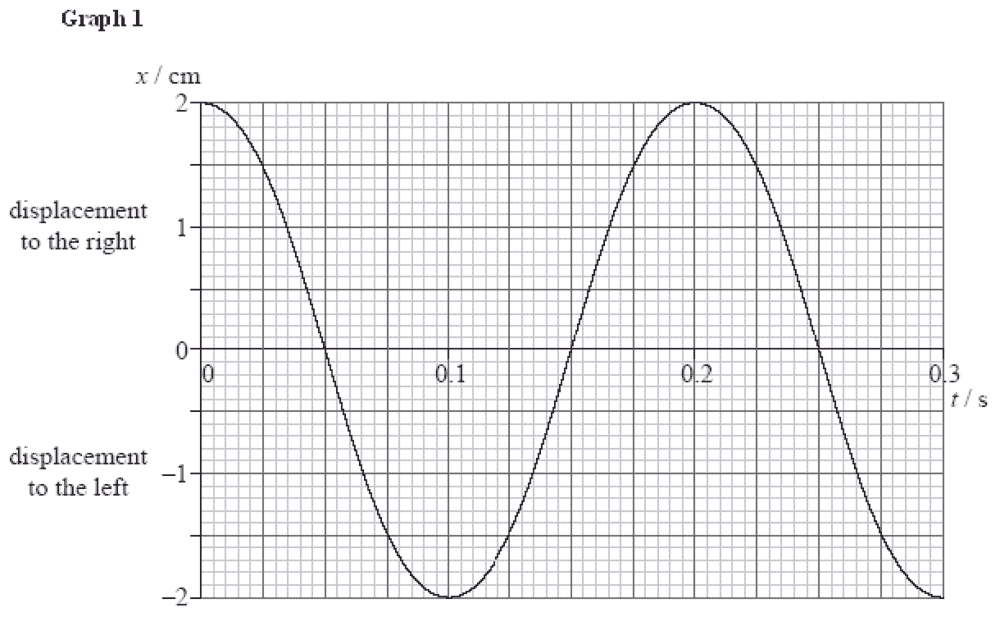
Find the speed of this longitudinal wave at t=0.12s.
Relevant Equations
v=w*xmax*cos(wt)
The graph provided is below. The problem asks for the speed of the wave at 0.12s. I used the formula v=w*xmax*cos(wt), provided in our textbook where xmax is the amplitude of 2 cm, w (omega) is 2pi divided by the period of 0.2. However, for some reason this formula doesn't give me the correct result. Instead, the solution to the problem involves the formula w*sqrt(xmax^2-x^2), which requires us to first find the displacement at t = 0.12.

My question is: why does the formula I used not work? Why must we use the other formula to solve this problem? I apologise for the bad formatting of the formulas.
243757
 
Physics news on Phys.org
It doesn't work because it's the wrong formula to use. It predicts that the velocity is maximum at t = 0. If you look at the graph, the position is maximum at t = 0 which means that the speed is zero at t = 0.

Also, is this a wave or a simple harmonic oscillator? I think the latter.
 
  • Like
Likes   Reactions: MattDutra123
kuruman said:
It doesn't work because it's the wrong formula. It predicts that the velocity is maximum at t = 0. If you look at the graph, the position is maximum at t = 0 which means that the speed is zero at t = 0.

Also, is this a wave or a simple harmonic oscillator? I think the latter.
Why does the formula I used predict that velocity is maximum at t=0?
If I use the same formula but replacing cos with sin, I get the correct answer. Why is that? Is it related to what you said? We were taught to use cos when displacement is maximum at t = 0, and sine when displacement is 0 at t = 0. Is this correct?
 
You wrote
##v(t)=\omega~ x_{max}\cos(\omega~t)##
At ##t = 0##, ##v(0)=\omega~ x_{max}\cos(0)=\omega~ x_{max}(1)\neq 0.##
Try this
1. Find an expression for ##x(t)## consistent with the graph. Hint: As indicated above, ##x_{max}\cos(0)=x_{max}.##
2. Take the derivative with respect to time to find ##v(t)##. The result should answer your second question.
3. Evaluate ##v(t=0.12~s).## This method is neater and there is no need to do what the solution suggests.

MattDutra123 said:
We were taught to use cos when displacement is maximum at t = 0, and sine when displacement is 0 at t = 0. Is this correct?
That is correct. Your mistake was that you used cos for the velocity; you were taught to use cos for the displacement.
 
  • Like
Likes   Reactions: MattDutra123