How to find vibrational frequency for specific bond? (DFT)

Click For Summary
SUMMARY

The discussion focuses on identifying vibrational frequencies for specific bonds using Density Functional Theory (DFT) calculations. The user performed an optimization and frequency calculation at the UB3LYP 6-311G level of theory for the compound C39H41PS2. They encountered difficulties in pinpointing the frequency related to the stretching of a phosphorus-carbon double bond using Molden. The consensus is that while the output does not provide a direct value for the bond stretching, users can analyze normal modes to find contributions from the relevant atoms.

PREREQUISITES
  • Understanding of Density Functional Theory (DFT)
  • Familiarity with UB3LYP 6-311G level of theory
  • Experience using Molden for molecular visualization
  • Knowledge of normal mode analysis in vibrational spectroscopy
NEXT STEPS
  • Explore how to perform normal mode analysis in DFT calculations
  • Learn to extract vibrational frequency data from DFT output files
  • Investigate advanced features of Molden for frequency analysis
  • Study the implications of vibrational modes on molecular properties
USEFUL FOR

Chemists, computational chemists, and researchers involved in vibrational spectroscopy and molecular modeling will benefit from this discussion.

Dan Zar
Messages
8
Reaction score
0
Hello,
I performed an optimization and frequency calculation at the ub3lyp 6-311g level of theory. The compound has the formula C39H41PS2. Using Molden, I am having a hard time identifying the frequency corresponding to the stretching of a phosphorus carbon double bond present in the molecule. I expect the frequency to be very low in intensity which makes my task harder. I am wondering if there is any way to obtain this information directly from the output file without having to click every frequency on Molden. Thank you very much.
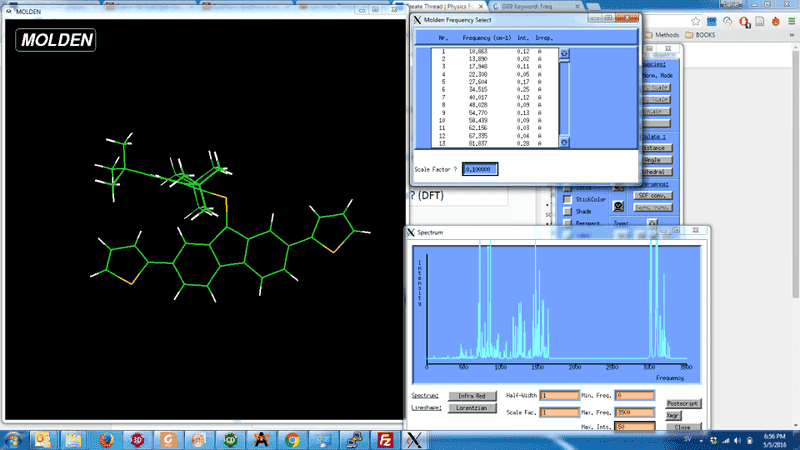
upload_2016-5-5_18-56-52.png
 
Physics news on Phys.org
The calculation does not give you a value for the stretching of only this bond. Rather this stretching will contribute to several normal modes. Looking at the output of your calculation, you should see a list of the normal vibrations and the contribution of the individual atoms. Identify those normal modes where the C and P atom in question make a large contribution.
 

Similar threads

  • · Replies 1 ·
Replies
1
Views
3K
  • · Replies 1 ·
Replies
1
Views
1K
Replies
1
Views
3K
Replies
1
Views
5K
  • · Replies 4 ·
Replies
4
Views
16K
  • · Replies 19 ·
Replies
19
Views
8K
  • · Replies 13 ·
Replies
13
Views
3K
  • · Replies 6 ·
Replies
6
Views
6K
  • · Replies 8 ·
Replies
8
Views
5K