SUMMARY
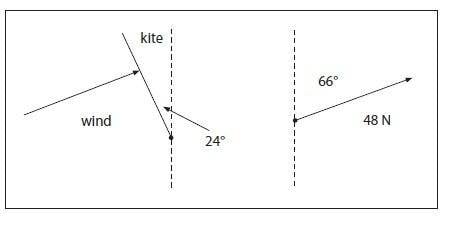
The discussion focuses on interpreting a Free Body Diagram for a kite in flight, specifically addressing the forces acting on the kite when a wind force of 48 N is applied at an angle of 24° to the ground. Key points include the relationship between the angle of the kite, the effective point of attachment of the string, and the lift-to-drag ratio. The flexibility and weight of the kite's tail significantly influence its orientation, with lighter tails being blown horizontally and weighted tails remaining nearly vertical. Clarity on the exact wording of the problem and any accompanying diagrams is essential for accurate interpretation.
PREREQUISITES
- Understanding of Free Body Diagrams
- Knowledge of lift and drag forces
- Familiarity with kite aerodynamics
- Basic principles of physics related to forces and angles
NEXT STEPS
- Research the principles of lift-to-drag ratios in aerodynamics
- Study the effects of angle of attack on kite performance
- Learn about the dynamics of flexible materials in wind conditions
- Examine case studies of kite design and stability
USEFUL FOR
Aerodynamics students, physics educators, kite enthusiasts, and anyone interested in understanding the forces acting on kites during flight.