How to interpret the powder diffraction?

  • Context: Graduate 
  • Thread starter Thread starter HIUk
  • Start date Start date
  • Tags Tags
    Diffraction Powder
Click For Summary

Discussion Overview

The discussion revolves around the interpretation of powder diffraction spectra, focusing on the relationship between diffraction peaks, Ewald's sphere, and the assignment of Miller indices to these peaks. Participants explore the theoretical and practical aspects of analyzing powder diffraction data, including the implications of crystal symmetry and the use of databases for peak identification.

Discussion Character

  • Exploratory
  • Technical explanation
  • Debate/contested

Main Points Raised

  • One participant notes that diffraction peaks correspond to reciprocal lattice points coinciding with Ewald's sphere, but questions how to derive planes and base vectors from this information.
  • Another participant explains that in powder diffraction, peaks arise from all reciprocal lattices due to the random orientation of powder grains, with the smallest scattering angles linked to the lowest Miller indices.
  • A participant expresses confusion about how to assign specific Miller indices (e.g., 111, 200) to peaks based solely on angle and intensity, highlighting the role of Bragg's law in determining d-spacing.
  • One response emphasizes that low symmetry in crystals complicates the assignment of Miller indices, suggesting that conventions play a significant role in this process.
  • Another participant describes a method for calculating d-spacing from known wavelength and measured angles, and mentions the historical approach of using tables to deduce Miller indices.
  • A later reply suggests using JCPDS cards for peak assignment, noting that discrepancies in data may arise from different experimental setups or sample selections.

Areas of Agreement / Disagreement

Participants express varying degrees of understanding regarding the assignment of Miller indices to diffraction peaks, with some proposing methods while others highlight the complexities and conventions involved. The discussion remains unresolved regarding the best approach to interpret the data accurately.

Contextual Notes

Limitations include the dependence on crystal symmetry and conventions for peak assignment, as well as potential discrepancies in data due to different experimental setups or sample characteristics.

HIUk
Messages
2
Reaction score
0
Hi,

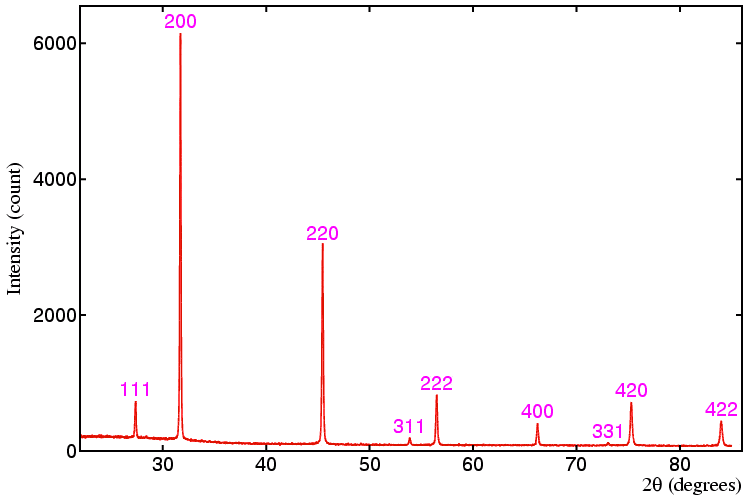
I have tried to understand powder diffraction "spectrum". What I do understand is that those diffraction peaks are peaks from ewalds sphere. What I don't understand is how one can get planes and (3d) base vectors out of that. I would really appreciate some help?
nacldata.gif
 
Physics news on Phys.org
Generally in crystal structure analysis, you see those peaks for which a reciprocal lattice point coincides with the Ewald sphere.
In powder diffraction, you see not only the lattice points of one reciprocal lattice, but of all reciprocal lattices which can be obtained by rotation due to the statistical orientation of the grains of the powder. The smallest reciprocal vectors (=smallest scattering angles) correspond to the planes with lowest Miller indices. The other ones must then correspond to combinations whose indices.
 
Thanks for the answer, I guess my question was a bit unclear. What I originally meant is that how one can say just by knowing the angle and intensity that for example the first peak is 111 and second is 200. As far as I understand these angles are standard bragg diffraction angles and I don't see how to interpret anything from those (or of course with the wavelength of the radiation one can get the distance between planes).
 
That's an excellent question, but I don't know no satisfactory answer. If the crystal is of low symmetry, there is no unique system of basevectors or of Miller indices. So there seems to enter a lot of convention entering the assignment of the peaks.
 
From the known wave length and the measured angle, you can calculate the d-spacing for each peak using Bragg's law.

For a cubic crystal, d=a/sqrt(H^2+K^2+L^2) where a is the lattice parameter, so the classical method was to make a table of 1/d^2, which is (H^2+K^2+L^2)/a^2. By comparing the values you can guess H,K, and L for each of them and find a.

These days you use a computer program to do the analysis for you.
 
Dear HIUk,

The method above is actually the proper way to assign hkl values to each peak.

By any chance this is a XRD phase analysis measurement for Silicon? As far as I know, one can assign a peak to a hkl value by comparing the peak position to a JCPDS card (Joint Committee of Powder Diffraction Standards). In the old days, x-ray laboratories would buy these cards compiled in books consisting of numerous volumes. Nowadays the database should be available in soft copies format stored in the computer operating the X-ray diffractometer.

The JCPDS cards are a collective XRD data of almost all elements/compounds taken from selected experiments. Below is a screenshot from my database for silicon:

asdfasdf.JPG


From your spectrum, first get the 2θ position. Next compare your position to the 2theta column in the database. Consequently, match the hkl values in the corresponding column.

However, I do notice that your data seems to diverge from my database at higher angles and that some peaks are missing. This is probably because my database has been selected to suit my sample or the fact that our experiment is setup differently. Yours might use a different card under the same element. That is if the data above is for silicon.

Pardon my mistakes, if there is any.
 

Similar threads

  • · Replies 1 ·
Replies
1
Views
2K
  • · Replies 3 ·
Replies
3
Views
6K
  • · Replies 3 ·
Replies
3
Views
2K
  • · Replies 9 ·
Replies
9
Views
5K
  • · Replies 2 ·
Replies
2
Views
2K
  • · Replies 4 ·
Replies
4
Views
3K
  • · Replies 5 ·
Replies
5
Views
3K
  • · Replies 4 ·
Replies
4
Views
3K
  • · Replies 16 ·
Replies
16
Views
2K
  • · Replies 32 ·
2
Replies
32
Views
5K