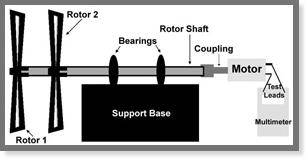
When a DC motor is used as a generator, without a load, the voltage it produces is proportional to RPM. The diagram in post #1 shows a multimeter, which I assume is being used to measure voltage as a measure of RPM. There will be less than 1mW needed to drive the multimeter, so there will be little torque in the shaft and the turbine will spin freely in the airflow. For testing now, you do not immediately need a purpose made coupling, you only need a short rubber tube to couple the two shafts.
It is important to maintain the turbine blade “angle of attack” and so prevent aerodynamic stall of the turbine blades. When significant power is drawn from the generator, you will need to regulate the power extracted so as to maintain an optimum load on the turbine.
The diameter of a shaft is related to the maximum torque it must transfer. The fact that you are coupling two very different diameter shafts suggests you have a torque mismatch. The generating motor and propeller may be matched as far as power is concerned, but since power is torque multiplied by RPM, the motor is probably designed for a higher RPM than the turbine. For serious power generation an efficient gearbox might be needed to better match the torque to RPM ratio. You will need different couplings if you change the ratio with a gearbox or roller chain.