How to measure time in reference frame with clock?

Click For Summary

Discussion Overview

The discussion revolves around measuring time in a reference frame using a light clock, particularly focusing on the implications of time dilation and the relationship between different reference frames. Participants explore the calculations and concepts related to the time measured by a clock in motion versus a clock at rest, as well as the distances involved in these scenarios.

Discussion Character

  • Exploratory
  • Technical explanation
  • Debate/contested
  • Mathematical reasoning

Main Points Raised

  • Some participants propose that the time measured in a moving reference frame is Δt0, but express uncertainty about this assumption.
  • Others argue that the distance covered by light in a moving clock is not cΔt0 but cΔt, suggesting a need for clarity in the definitions of time and distance in different frames.
  • One participant emphasizes the importance of computing the position of the light pulse at different points in time to understand the time taken for the light to travel between points A and B.
  • There is confusion regarding the representation of the diagrams, with participants questioning the accuracy of the illustrations and their implications for the discussion.
  • Some participants clarify that the clock in the moving frame is at rest, leading to further questions about the time measured by that clock during motion.
  • One participant attempts to rephrase the question and seeks to establish an equation for the moving reference frame, indicating a desire for mathematical clarity.

Areas of Agreement / Disagreement

Participants do not reach a consensus on the correct interpretation of time measurement in moving versus stationary frames. Multiple competing views and interpretations remain throughout the discussion.

Contextual Notes

There are limitations in the discussion regarding the assumptions made about the definitions of time and distance in different reference frames, as well as the mathematical relationships involved. Some participants express confusion over the application of Pythagorean theorem to the scenarios presented.

Who May Find This Useful

This discussion may be useful for individuals interested in the concepts of time dilation, reference frames in relativity, and the mathematical relationships governing light clocks in different states of motion.
Mike_bb
Messages
197
Reaction score
20
TL;DR
Time in reference frame with clock
I considered example of time dilation with light clock. I have a question about measuring time in reference frame with clock.

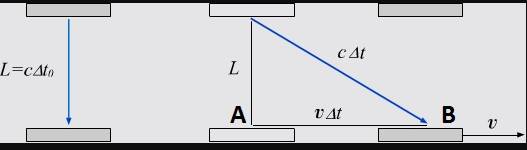
If we know that clock move from A to B in the reference frame with clock then what time of motion is measured in this reference frame? (In non-moving reference frame time is Δt)

1.jpg


I supposed that time is Δt0 because light reach at end point at this time. But I think it's wrong. I have no more guess.

Thanks.
 
Physics news on Phys.org
Mike_bb said:
I supposed that time is Δt0 because light reach at end point at this time. But I think it's wrong.
It's obviously wrong from your diagram, because the distance covered by the light beam in the moving light clock is not ##c \Delta t_0##, it's ##c \Delta t##. Which should make the time it takes in the given frame for the light beam to cover that distance obvious.
 
  • Like
Likes   Reactions: Mike_bb
Don't guess, compute!

Where is the light pulse when the clock is at A? Where is the light pulse when the clock is at B? How far has the light travelled, therefore? Hence, how long has it taken?
 
  • Like
Likes   Reactions: Mike_bb
Sorry. Picture in the first message is wrong.

1.jpg
 
Mike_bb said:
Picture in the first message is wrong.
What has changed? The picture you just posted looks the same as the one in the OP.
 
  • Like
Likes   Reactions: Mike_bb
PeterDonis said:
What has changed? The picture you just posted looks the same as the one in the OP.
I mean that vΔt is length of path in non-moving reference frame (time in this frame is Δt). And what is time in reference frame with clock?
 
Mike_bb said:
I mean that vΔt is length of path in non-moving reference frame (time in this frame is Δt).
Yes. So that's the time the light takes to travel from A to B in the non-moving frame, if the clock is moving in that frame.

Mike_bb said:
And what is time in reference frame with clock?
Do you mean the frame in which the clock is at rest? Isn't that what you've drawn in the left part of your diagram?
 
  • Like
Likes   Reactions: Mike_bb
PeterDonis said:
Do you mean the frame in which the clock is at rest? Isn't that what you've drawn in the left part of your diagram?
No. I mean moving frame with velocity v and with moving clock.
 
Mike_bb said:
No. I mean moving frame with velocity v and with moving clock.
Then what does the left part of your diagram represent?
 
  • Like
Likes   Reactions: Mike_bb
  • #10
PeterDonis said:
Then what does the left part of your diagram represent?
It represent rest frame with zero velocity with rest clock. But I mean right diagram when I say about moving frame.
 
  • #11
Mike_bb said:
It represent rest frame with zero velocity with rest clock.
And that means it represents any light clock with the same parameters (i.e., the same ##L## between its mirrors) in the frame in which it is at rest.

Mike_bb said:
I mean right diagram when I say about moving frame.
Yes, a frame in which the clock is moving. But now you are asking about a frame in which the clock is at rest. Which is exactly what the left diagram shows. See above.
 
  • Like
Likes   Reactions: Mike_bb
  • #12
PeterDonis said:
But now you are asking about a frame in which the clock is at rest.
Ok. I ask about time in moving frame. I want to know time of motion from A to B in moving reference frame. In the rest frame time is Δt.
 
  • #13
Mike_bb said:
I want to know time of motion from A to B in moving reference frame.
What do you mean by "moving reference frame"? You appear to mean a frame that is moving at the same ##v## as the clock. That means the clock is at rest in that frame.
 
  • Like
Likes   Reactions: Mike_bb
  • #14
PeterDonis said:
That means the clock is at rest in that frame.
Sorry, it's my error. Yes. Clock in moving frame is at rest. And I want to know what time is measured by clock in this moving frame.
 
  • #15
Mike_bb said:
Clock in moving frame is at rest. And I want to know what time is measured by clock in this moving frame.
Since the clock is at rest in the frame, the left side of your diagram represents what happens. That is the point I have been trying to get across to you. So you can just look at the left side of your diagram to get the answer to your question.
 
  • Like
Likes   Reactions: Mike_bb
  • #16
PeterDonis said:
Since the clock is at rest in the frame, the left side of your diagram represents what happens. That is the point I have been trying to get across to you. So you can just look at the left side of your diagram to get the answer to your question.
I wrote that time is Δt0, is it true? But I'm confused because if we're moving from A to B then our distance is vΔt for our reference frame. And if time is Δt0 then distance is vΔt0. It's wrong result.
 
  • #17
Mike_bb said:
I wrote that time is Δt0, is it true?
For the case where the clock is at rest, that is what the left part of your diagram says, yes.

Mike_bb said:
I'm confused because if we're moving from A to B then our distance is vΔt for our reference frame. And if time is Δt0 then distance is vΔt0. It's wrong result.
No, it isn't, you're confusing two different things: the time taken in a frame in which the clock is moving, and the time taken in a frame in which the clock is at rest. Your use of the term "moving frame" to denote a frame in which the clock on the right of your diagram is at rest is probably contributing to your confusion.

Perhaps it will help you to think of two separate clocks. In the diagram you have drawn, the clock on the left is at rest and the clock on the right is moving. So in that frame, the time it takes the light beam in the left clock is ##t_0##, and the time it takes the light beam in the right clock is ##t##.

But you could also draw another diagram, in the frame in which the right clock is at rest. In this diagram, on the right there would be a clock at rest (the one that's on the right and moving in your original diagram), and on the left there would be a clock moving to the left with speed ##v## (the one that's on the left in your original diagram). And in that diagram, drawn in a different frame, the time it takes the light beam in the right clock would be ##t_0##, and the time it takes the light beam in the left clock would be ##t##.
 
  • Like
Likes   Reactions: Mike_bb
  • #18
PeterDonis said:
the time taken in a frame in which the clock is moving, and the time taken in a frame in which the clock is at rest.
Why do you say about light beam? I mean another case. Say what time do you measure in moving frame when you travel from A to B?
 
  • #19
Mike_bb said:
Why do you say about light beam?
Um, because your diagram is a diagram of a light clock?

Mike_bb said:
I mean another case. Say what time do you measure in moving frame when you travel from A to B?
The light clock is a clock; it measures time--the time it takes the light beam to go back and forth between its mirrors. That time is the time you have been asking about.
 
  • Like
Likes   Reactions: Mike_bb
  • #20
This conversation seems enormously confusing.

The diagram in #1 has two clocks, the one on the left which is stationary in the frame in which the diagram is drawn, and the one on the right which is moving to the right with velocity ##v##. In this frame, the period of the left clock is ##\Delta t_0## (well, twice that actually because the light pulse needs to travel down and up, but it doesn't matter here). The period of the clock on the right is ##\Delta t##, which turns out to be ##\left(1-v^2/c^2\right)^{-1/2}\Delta t_0##.

As far as I can work out, OP is asking what are the periods of the two clocks in a frame where the right clock is stationary and the left clock is moving to the left with speed ##v## (i.e. velocity ##-v##). If that is correct, then the answer is simply that the periods swap: now the right clock has period ##\Delta t_0## and the left clock has period ##\Delta t##.

Does that answer the question?
 
  • Like
Likes   Reactions: Mike_bb
  • #21
Ok. I'll try to rephrase.

Let's write equation for non-moving reference frame:

##(cΔt)^2 = (cΔt0)^2 + (vΔt)^2##

How to write equation for moving reference frame?
 
  • #22
Mike_bb said:
How to write equation for moving reference frame?
Do you mean the frame where the right hand clock is at rest? And how are you arriving at that equation? Are you just applying Pythagoras' Theorem to the triangle I've marked in red below?
83c47f0b-94f8-4e29-a686-b6d696a81d53.png
 
  • Like
Likes   Reactions: Mike_bb
  • #23
Thanks to all! My mistake was that I tried to find time of motion in moving frame but distance in this frame is 0 because clock in moving frame is at rest.
 
  • Skeptical
Likes   Reactions: Motore

Similar threads

  • · Replies 33 ·
2
Replies
33
Views
2K
  • · Replies 54 ·
2
Replies
54
Views
4K
  • · Replies 88 ·
3
Replies
88
Views
7K
  • · Replies 12 ·
Replies
12
Views
2K
  • · Replies 6 ·
Replies
6
Views
843
  • · Replies 36 ·
2
Replies
36
Views
4K
  • · Replies 55 ·
2
Replies
55
Views
5K
  • · Replies 11 ·
Replies
11
Views
2K
  • · Replies 16 ·
Replies
16
Views
2K
  • · Replies 11 ·
Replies
11
Views
2K