How to prepare my camera for a solar eclipse
Join the discussion
Registration is free. Start your own thread to ask a follow-up.
42 replies · 9K views
Astronomy news on Phys.org
Science Advisor
Gold Member
- 9,747
- 11,965
Wrichik Basu said:We can't even think of photos like those ones you posted. The lenses that we bought was for landscape photography and not meant for astrophotography. Being low on budget, one has to sometimes push things beyond their limits...
you will be surprised what you can achieve, even with a modest camera

good focussing and just enough exposure will give great results
Science Advisor
Homework Helper
- 30,594
- 7,548
Don't be too pessimistic. A good lens is a good lens. You tend to get what you pay for and most commonly used photographic lenses have too short a focal length to produce a big solar image. But that means you are working at the centre of the field which will have the lowest aberrations.Wrichik Basu said:The lenses that we bought was for landscape photography and not meant for astrophotography.
Dave has a fair amount of experience in these matters and I would bet he could produce some pretty fair efforts using your equipment. Just taking the sort of care that you need to produce decent photos of your cat will allow good results - but there is a lot to get right which is nothing to do with the actual camera. Get very used to handling the camera equipment long before you actually need to use it in anger. Keep everything clean and blow dust out of the camera (not with your damp breath!) when you change lenses. Sensor cleaning is no big deal if you are careful. Dust bunnies can show up on the face of the Sun and they are on your sensor not millions of miles away. High f numbers are worst for showing them up.
There are features of regular camera lenses that can affect overall astro quality. For instance, the multi-leaf iris will produce diffraction artefacts with point sources of light. A telescope has just a round tube. Also, a good telescope will also have an appropriately good mount which will / could track the motion of the heavens and avoid star trails on long exposures and produce fewer streaks around the edges of the field (a flat field will cost you).
Science Advisor
Gold Member
- 9,747
- 11,965
Wrichik Basu said:There will be a solar eclipse on 26th December that can be viewed from my city.
All, I just did a search, I see it will be an annular eclipse like in that first photo in my post in post #28
This is when the sun is not fully covered by the moon. You will need a filter throughout the eclipse.
As the eclipse progresses to full annular ( mid-eclipse) you will have to lower the shutter speed as
the amount of the light from the sun decreases, else you will end up with under exposed images.Dave
Science Advisor
Gold Member
- 9,747
- 11,965
@Wrichik Basu
This is great advice ...
You still have a week and a bit before the eclipse. Practice over and over with producing sharp and well
exposed photos of the sun over this time
This is great advice ...
sophiecentaur said:Get very used to handling the camera equipment long before you actually need to use it in anger.
You still have a week and a bit before the eclipse. Practice over and over with producing sharp and well
exposed photos of the sun over this time
Wes Tausend
Gold Member
- 226
- 47
In order to photograph the last total US eclipse in Wyoming, I simply used the pair of low cost protective glasses, that my brother procured for us, by holding them over the small video camera lens as the eclipse approached totality and re-emerged. I figured if the plastic lens was good enough for my eye, it was good enough for the ccd. The video came out great, similar to davenn's above photos. Of course I had to watch the final moments on my view screen, since I had no additional safety glasses. I pre-tested the idea on the normal sun first.The cam was a Sony HDTCX405, and cost about $180 or less on sale.
- 2,188
- 2,694
Today was the long-awaited day.
I woke up to find, to my utter dismay, that it was so gloomy that we had to switch on the lights inside the house. Anyways, I tested my luck and went to the roof. The eclipse started at 08:27am, and I could first see the Sun at about 08:35am, playing hide and seek behind the clouds. Viewing through the glasses with solar film, I could not see anything. So I removed all the ND filters, and took some photos with only the CPL and UV filters attached.
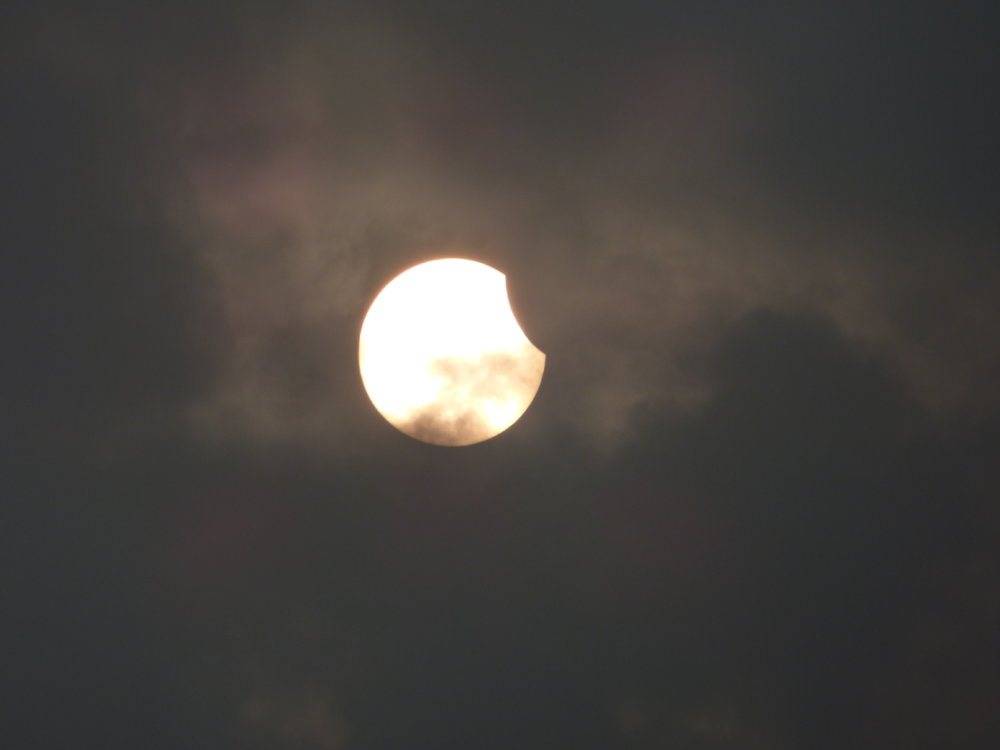
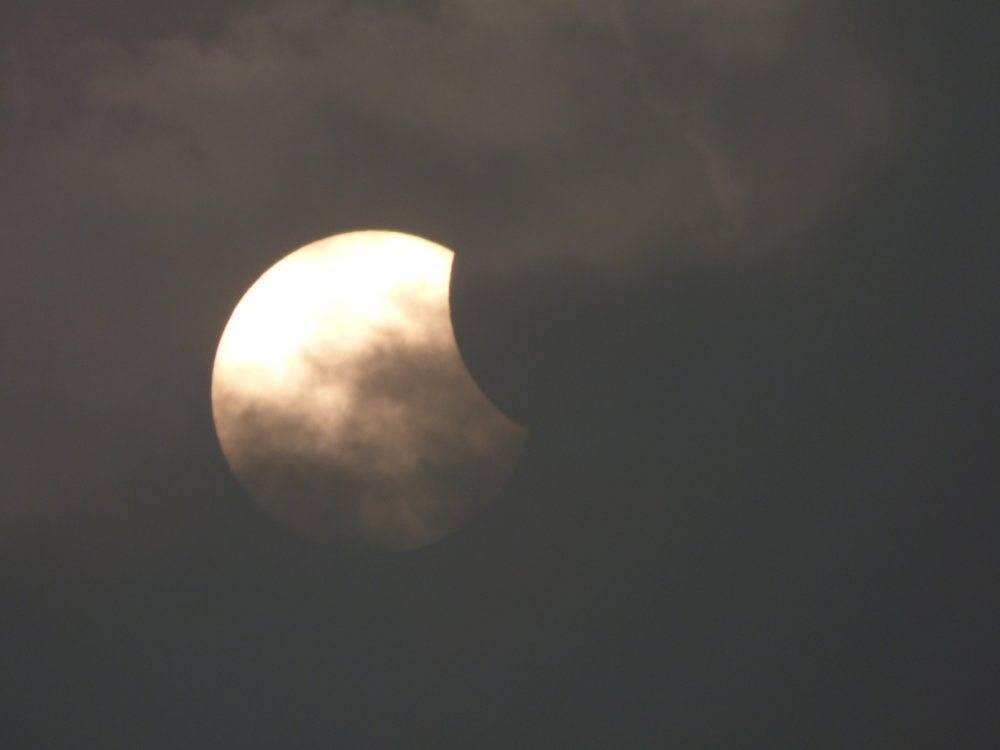
I woke up to find, to my utter dismay, that it was so gloomy that we had to switch on the lights inside the house. Anyways, I tested my luck and went to the roof. The eclipse started at 08:27am, and I could first see the Sun at about 08:35am, playing hide and seek behind the clouds. Viewing through the glasses with solar film, I could not see anything. So I removed all the ND filters, and took some photos with only the CPL and UV filters attached.
- 2,188
- 2,694
After that, the intensity of the light increased a bit, so I attached ND-16 and ND-4 filters stacked over each other.
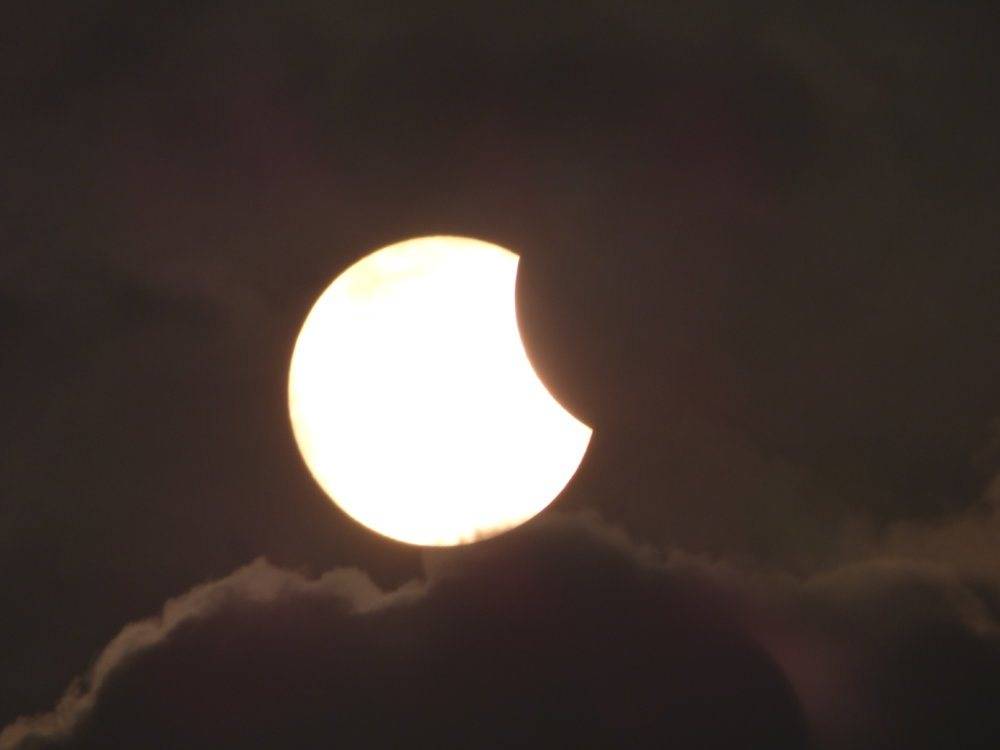
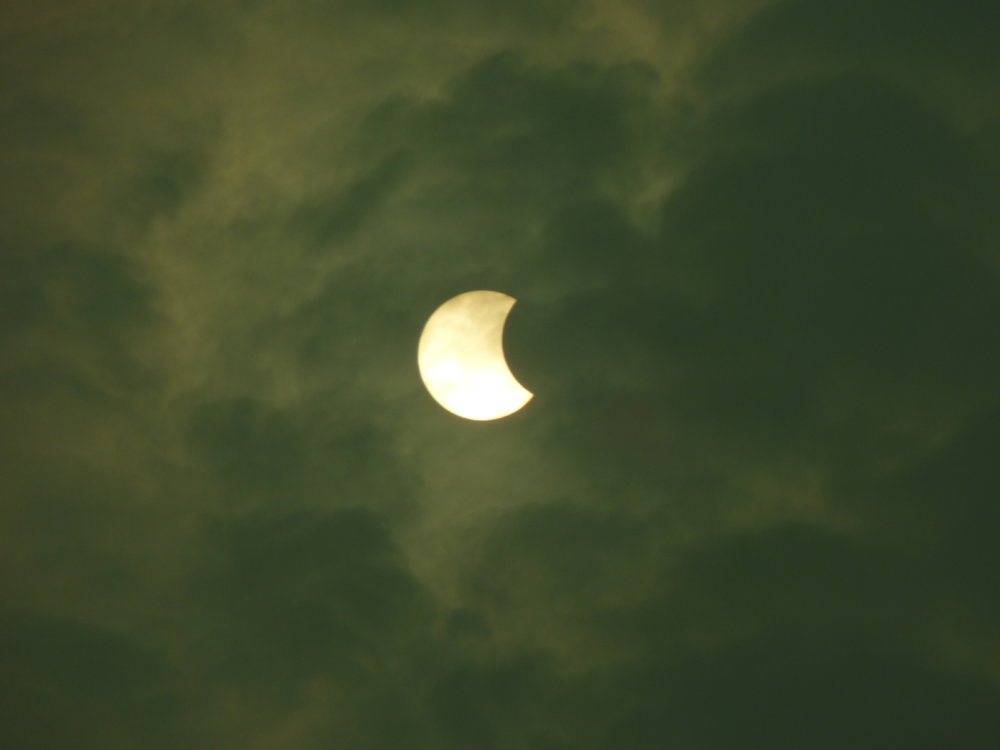
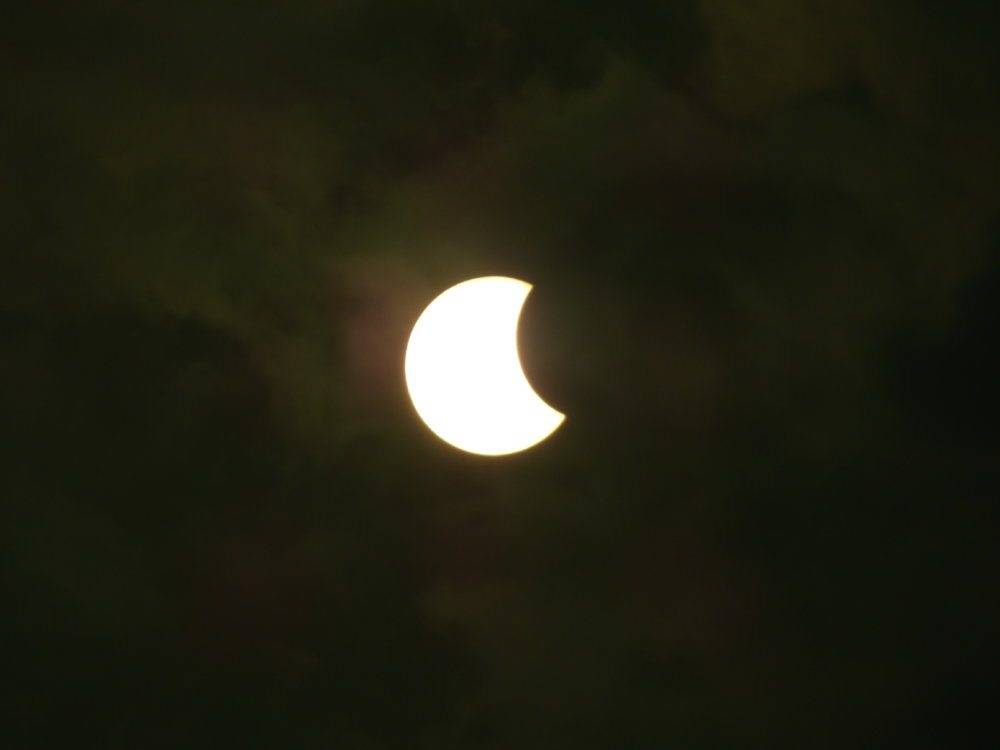
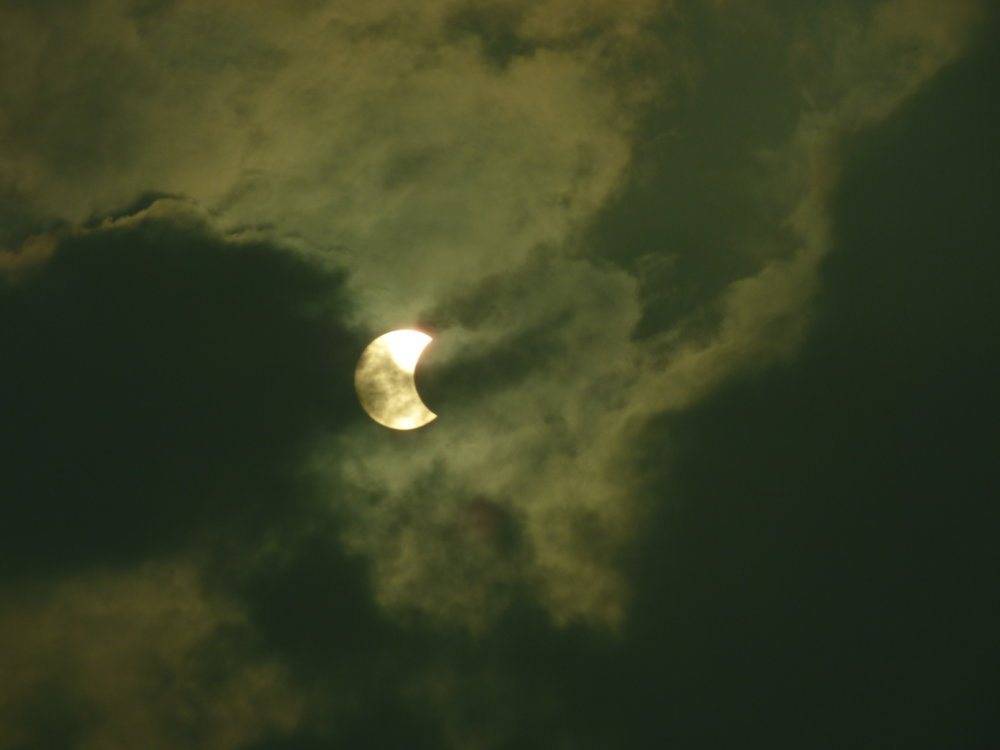
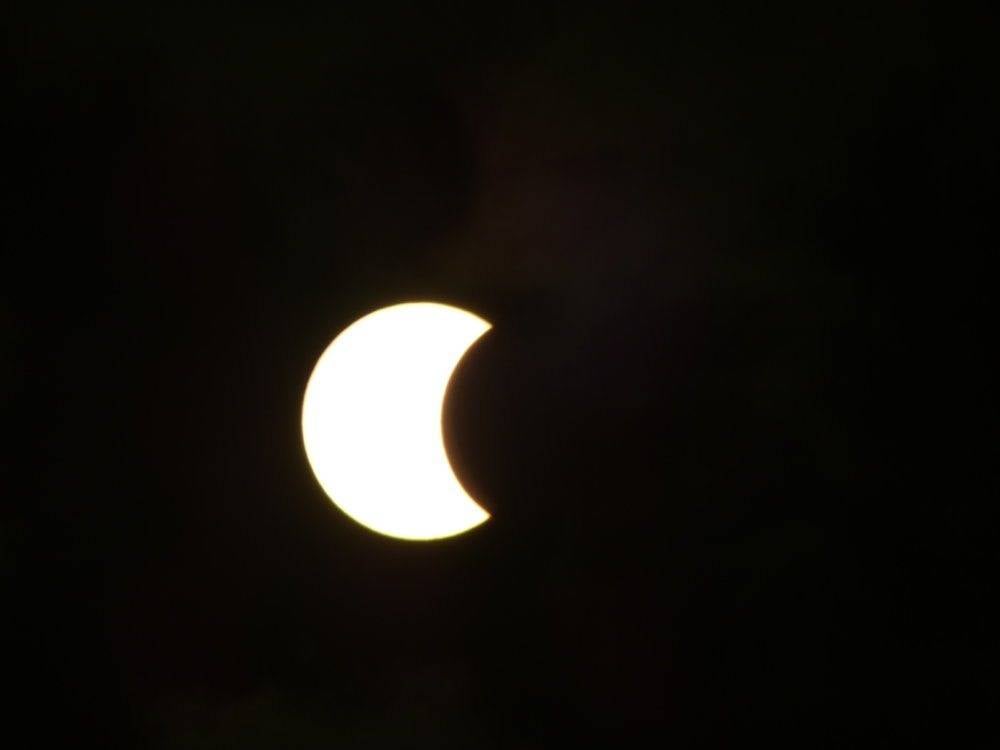
Now it is absolutely gloomy, with no gaps in the clouds. It has started drizzling as well, so no hope of any more shots.
I found that if I used the full 60x zoom, the image was getting blurred.
I have the images in RAW format as well. If somebody has lightroom/photoshop and wants to play with them, I can provide the RAW images.
Now it is absolutely gloomy, with no gaps in the clouds. It has started drizzling as well, so no hope of any more shots.
I found that if I used the full 60x zoom, the image was getting blurred.
I have the images in RAW format as well. If somebody has lightroom/photoshop and wants to play with them, I can provide the RAW images.
Mentor
- 23,902
- 11,357
Not bad, but your exposures are too long -- make them shorter! (or put the filters back on) Take a bunch of photos at varying exposures.Wrichik Basu said:I woke up to find, to my utter dismay, that it was so gloomy that we had to switch on the lights inside the house. Anyways, I tested my luck and went to the roof. The eclipse started at 08:27am, and I could first see the Sun at about 08:35am, playing hide and seek behind the clouds. Viewing through the glasses with solar film, I could not see anything. So I removed all the ND filters, and took some photos with only the CPL and UV filters attached.
The broken clouds moving across the disk actually give a cool extra drama to the photos. They're not ideal, but not that big of a problem either.
Keep 'em coming!
- 2,188
- 2,694
Only one more to post: the parting shot.russ_watters said:Keep 'em coming!
Science Advisor
Gold Member
- 9,747
- 11,965
Wrichik Basu said:Only one more to post: the parting shot.
Awesome effort on all shots :)
As @russ_watters said, the clouds didn't really detract from the images you got
Gave a more "dramatic" effect
Yeah, your exposure was a bit high

Science Advisor
Homework Helper
- 30,594
- 7,548
Agreed. It's hard to believe how much you need to 'under' expose shots of Sun and Moon - and even the planets. If you look at the images with the 'dropper' tool in your editor, you should ideally expect the disc to be a bit less than 255,255,255 all over. Then you would see the change in luminosity across the Sun's disc and have a better idea of structure. Same ideas apply to imaging Moon; low exposure will chow lunar craters and landscape.russ_watters said:Not bad, but your exposures are too long
- 2,188
- 2,694
Partial solar eclipse on 21 June 2020.[/size]
Used four ND filters (16, 8, 4, 2) along with a UV filter; exposure set to minimum possible. Some photos:
All photos were taken with Panasonic FZ70. Taking photos at maximum zoom (60x) was costing the sharpness of the image. Maybe the abberation was due to the five lenses attached.
Similar threads
High School Where to buy certified solar eclipse glasses and camera filters
- LightningInAJar
- · Replies 6 ·
- Astronomy, Astrophysics, Cosmology
- Replies
- 6
Stargazing How can I safely view a solar eclipse?
- PhysicsPost
- · Replies 1 ·
- Astronomy, Astrophysics, Cosmology
- Replies
- 1