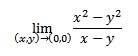
How to prove that a limit of a two-variable function does not exist?

  • Thread starter Thread starter Mike s
  • Start date Start date
  • Tags Tags
    Function Limit
Click For Summary

Homework Help Overview

The discussion revolves around proving that a limit of a two-variable function does not exist, specifically focusing on the behavior of the function near the point (0,0) and the implications of its domain restrictions.

Discussion Character

  • Conceptual clarification, Assumption checking, Problem interpretation

Approaches and Questions Raised

  • Participants explore the validity of the lecturer's explanation regarding the necessity of a punctured disk around the point (0,0) for the limit to exist. Some express confusion about the definitions and interpretations of limits in multivariable calculus.

Discussion Status

The discussion is ongoing, with various interpretations of the limit's existence being explored. Some participants suggest that the limit may exist under certain definitions, while others emphasize the importance of the function being defined in a neighborhood around the point of interest.

Contextual Notes

There is a noted lack of consensus on the definitions of limits for functions of multiple variables, as well as the specific requirements for a limit to be considered valid in this context.

Mike s
Messages
14
Reaction score
0
9065he.jpg
I need to prove this limit does NOT exist. I know that the denominator cancels out, however my lecturer says the limit does not exist because we cannot find a circle with radius [itex]\delta[/itex] that contains the point (0,0), as the function is not defined for all y=x. Here is a little drawing of the domain.

Is my lecturer's explanation valid?Thanks in advance,
Michael
 
Physics news on Phys.org
Rationalize it
 
I guess his explanation makes sense, but that's a funny way of putting it.
 
NewtonianAlch said:
I guess his explanation makes sense, but that's a funny way of putting it.

Can you think of another way? If you do, please post
 
Mike s said:
9065he.jpg


I need to prove this limit does NOT exist. I know that the denominator cancels out, however my lecturer says the limit does not exist because we cannot find a circle with radius [itex]\delta[/itex] that contains the point (0,0), as the function is not defined for all y=x. Here is a little drawing of the domain.

Is my lecturer's explanation valid?

Thanks in advance,
Michael
Well, that limit certainly does exist --- at least it exists using the mufti-variable definition of limit with which I am familiar.

[itex]\displaystyle \text{If }x\ne y\,,\text{ then }\frac{x^2-y^2}{x-y}=\frac{(x-y)(x+y)}{x-y}=x+y\,.[/itex] No matter what continuous path you take (in the domain of the given function) to approach (0,0), x+y → 0 .

On the other hand, the function is not continuous at (x,y) = (0,0) because it's not defined at (x,y) = (0,0) .
 
I think it is common for functions of two variables to be required to be defined in a punctured disk around (a,b) in order to claim a limit as ##(x,y)\to (a,b)## of the function exist. That is presumably required in this case, given the lecturer's statement.
 
SammyS said:
Well, that limit certainly does exist --- at least it exists using the mufti-variable definition of limit with which I am familiar.

[itex]\displaystyle \text{If }x\ne y\,,\text{ then }\frac{x^2-y^2}{x-y}=\frac{(x-y)(x+y)}{x-y}=x+y\,.[/itex] No matter what continuous path you take (in the domain of the given function) to approach (0,0), x+y → 0 .

On the other hand, the function is not continuous at (x,y) = (0,0) because it's not defined at (x,y) = (0,0) .

Well, as far as I know, the limit does not have to be defined at the point itself (0,0), but there must exist at least one disc that contains it.
 
Mike s said:
Well, as far as I know, the limit does not have to be defined at the point itself (0,0), but there must exist at least one disc that contains it.

Yes, there must be a punctured disk around (a,b) in the domain of the function, which you don't have.
 
LCKurtz said:
Yes, there must be a punctured disk around (a,b) in the domain of the function, which you don't have.

Alright, thanks a lot!
 
  • #10
SammyS said:
Well, that limit certainly does exist --- at least it exists using the mufti-variable definition of limit with which I am familiar.

[itex]\displaystyle \text{If }x\ne y\,,\text{ then }\frac{x^2-y^2}{x-y}=\frac{(x-y)(x+y)}{x-y}=x+y\,.[/itex] No matter what continuous path you take (in the domain of the given function) to approach (0,0), x+y → 0 .
Even the path y= x??

On the other hand, the function is not continuous at (x,y) = (0,0) because it's not defined at (x,y) = (0,0) .
 
  • #11
HallsofIvy said:
Even the path y= x??
y=x is not in the domain of [itex]\displaystyle \frac{x^2-y^2}{x-y}\ .[/itex]

It appears that Calculus textbooks don't agree on the definition of the limit for functions of more than one variable.
 

Similar threads

  • · Replies 5 ·
Replies
5
Views
2K
  • · Replies 4 ·
Replies
4
Views
2K
  • · Replies 1 ·
Replies
1
Views
2K
  • · Replies 7 ·
Replies
7
Views
3K
  • · Replies 5 ·
Replies
5
Views
2K
Replies
35
Views
5K
  • · Replies 1 ·
Replies
1
Views
2K
Replies
20
Views
5K
  • · Replies 15 ·
Replies
15
Views
7K
  • · Replies 14 ·
Replies
14
Views
2K