How to Prove This Hermitian Operator Statement?

Join the discussion
Ask a follow-up here, or get your own question answered by working scientists, mathematicians and engineers — people, not an autocomplete.
Real named experts · corrections over time · the nuance an AI answer skips
3 replies · 3K views
abcs22
Messages
11
Reaction score
0
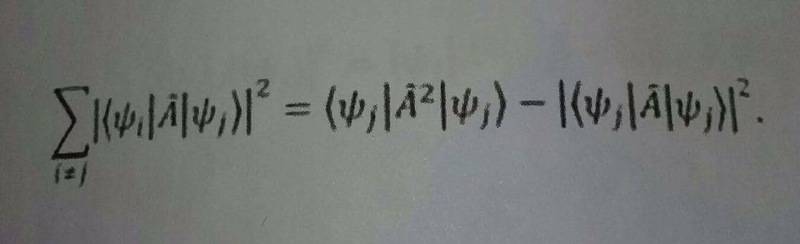
1. Homework Statement prove the following statement:
Hello, can someone help me prove this statement
PzXRBBp.jpg


A is hermitian and {|Ψi>} is a full set of functions

Homework Equations


Σ<r|A|s> <s|B|c>[/B]

The Attempt at a Solution


Since the right term of the equation reminds of the standard deviation, I tried using its definition but it didn't yield any results. Also, I tried to use the hermicity of the operator A to get the complete set but after that I got stuck.
 
Physics news on Phys.org
This is prety simple if you assume ##\psi_i## form a basis for the Hilbert space of states. Just use the complex relation ##|z|^2=z z^*## for the left hand side, and use the completeness relation for ##\psi_i##. Is this what you meant by a full set of functions?
 
Yes, I did, I apologize, English is not my mother language. I tried but I can't get those two terms on the right side
 
abcs22 said:
Yes, I did, I apologize, English is not my mother language. I tried but I can't get those two terms on the right side
No problem. The two terms come as a property of the summation. The completeness relation assumes you sum over all ##i##. The first term comes from the completeness relation. The second term comes from the fact that you are missing the ##i=j## in the summation on the left hand side. The key equation you need to use is
$$
\langle \psi_j | A^2 | \psi_j \rangle=\sum_i \langle \psi_j | A | \psi_i \rangle \langle \psi_i | A | \psi_j \rangle
$$