How to solve a circuit mystery box?

  • Context: Engineering 
  • Thread starter Thread starter Sage4
  • Start date Start date
  • Tags Tags
    Box Circuit Mystery
Click For Summary

Discussion Overview

The discussion revolves around solving a circuit mystery box containing five identical resistors, specifically focusing on two configurations: one with all resistors in series and another that combines series and parallel arrangements. Participants explore resistance measurements between various nodes to deduce the internal structure of the circuit.

Discussion Character

  • Exploratory
  • Technical explanation
  • Debate/contested
  • Mathematical reasoning

Main Points Raised

  • One participant concludes that all resistors are 10k ohm and are connected in series, providing resistance measurements between nodes.
  • Another participant suggests that the presence of five 10k measurements indicates a more complex internal structure than a simple series connection.
  • Some participants question whether the resistor between nodes 3 and 6 creates a parallel circuit, expressing uncertainty about the configuration.
  • There are discussions about the application of circuit analysis techniques, including Ohm's law, Thévenin's theorem, and Norton's theorem, to simplify the problem.
  • Confusion arises regarding specific resistance measurements and their implications, with participants debating the correctness of their interpretations and calculations.
  • Several participants express uncertainty about their conclusions and seek clarification on the circuit's configuration.

Areas of Agreement / Disagreement

Participants do not reach a consensus on the configuration of the circuit or the implications of the resistance measurements. Multiple competing views remain, particularly regarding the presence of parallel connections and the interpretation of resistance values.

Contextual Notes

Participants acknowledge limitations in their understanding and the complexity of the circuit, with some noting potential errors in earlier claims and calculations. The discussion reflects ongoing uncertainty about the internal arrangement of the resistors.

Sage4
Messages
12
Reaction score
2
Homework Statement
deduct the value of each of the 5 resistors of the same value in the 2 black boxes and their organization in a circuit explaining what is being measured.
Relevant Equations
Serie: Req= R+R+R...
Parallele: 1/R_eq =1/R+1/R+1/R….
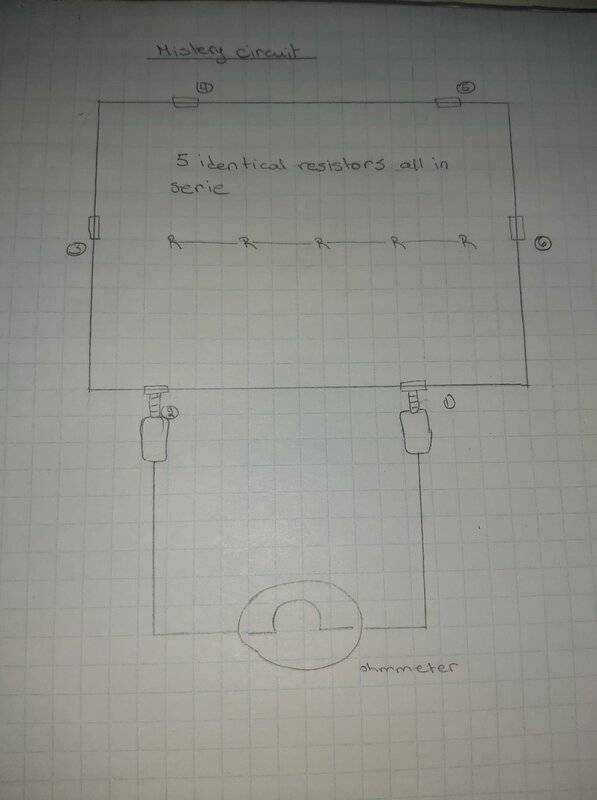
How can I solve a ciruit mystery box only knowing there are 5 identical resistors inside. I have two boxes to solve, one they're all in serie and the other is a combination serie and parallele. Each mystery box has 6 nodes and i can connect 2 nodes at a time to an ohmmeter.
124443921_1036037686860204_3124243026375543004_n.jpg

If i take the one all in serie (it's the only one I've started) this is what I've concluded:

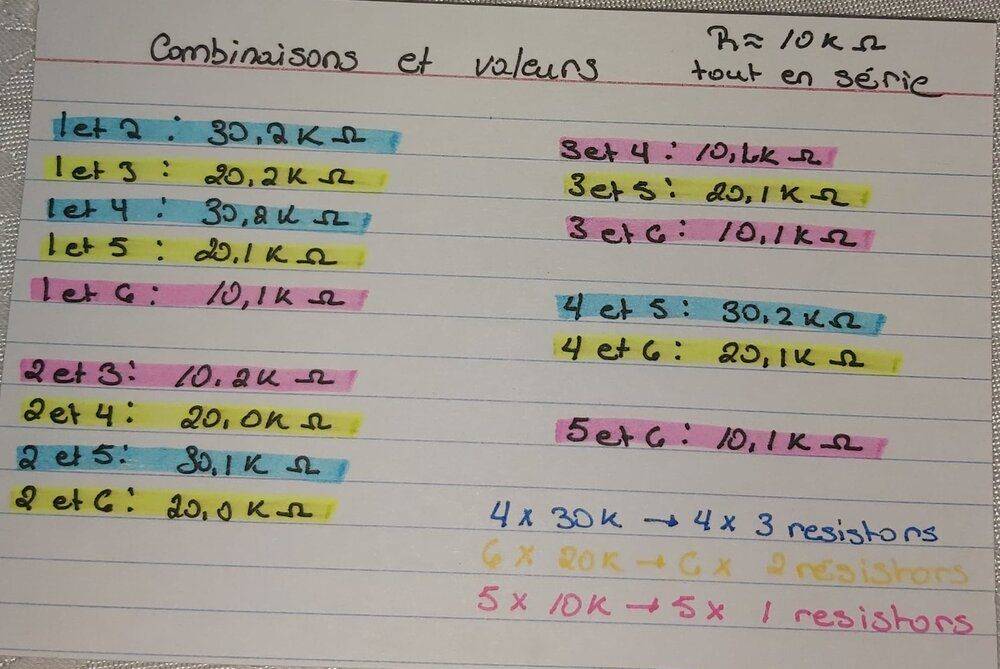
All resistor are 10k ohm and they're all in serie. With 6 nodes i have the 15 following combinations. What other conclusions could be made? The colors are because I'm more of a visual learner.
124657730_782801952577101_4577137079619889906_n.jpg

This is what @Baluncore told me:

https://www.physicsforums.com/threads/how-to-solve-a-circuit-mystery-box.995962/post-6416248

Measure and record the resistance between;
Terminal; t1 and t2=30k, t3=20k, t4=30k, t5=20k, t6=10k
Terminal; t2 and t3=10k, t4=20k, t5=30k, t6=20k
Terminal; t3 and t4=10k, t5=20k, t6=10k
Terminal; t4 and t5=30k, t6=20k
Terminal; t5 and t6=10k

Notice the 5x 10k ?
The 5x 10k resistors are between; t1-t6, t2-t3, t3-t4, t3-t6, t5-t6.

Notice there are three arms from t3 and from t6.
But t3 and t6 are connected by 10k.

t2 and t4 are each connected by 10k to t3.
t1 and t5 are each connected by 10k to t6.
t1, t2, t4 and t5 are the terminal ends of the circuit.
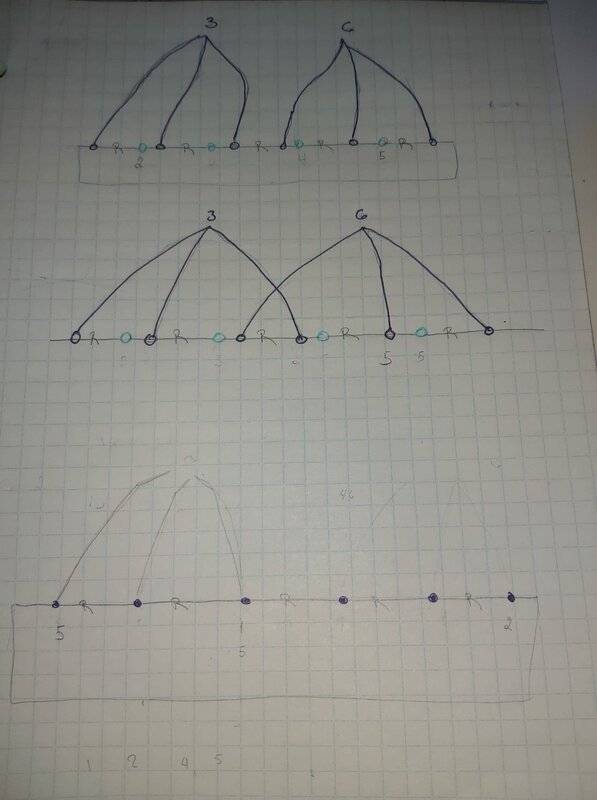
Now check all the 20k and 30k values are series connected paths on the same diagram.This is what I’ve been tryng to do with those info:
124889130_680536935932466_1125850957343163501_n.jpg

The one in the bottom I'm tryng to see if 2 nodes can be connected at the same place/switch but I am still blocked...
 
Last edited by a moderator:
  • Like
Likes   Reactions: .Scott
Physics news on Phys.org
You noticed that there were 5 10K measurements. What does that suggest about any internal nodes (nodes not connected to the outside of the box)?

There are 5 10K readings. That should be a big hint.

These resistors are not lined up like this: -R--R--R--R--R-

Also, none of the measurements indicate an open circuit, so everything is connected - directly or indirectly.
 
.Scott said:
You noticed that there were 5 10K measurements. What does that suggest about any internal nodes (nodes not connected to the outside of the box)?

There are 5 10K readings. That should be a big hint.

These resistors are not lined up like this: -R--R--R--R--R-

Also, none of the measurements indicate an open circuit, so everything is connected - directly or indirectly.

That's what i was suspecting...this is what i have if the resistors are not lined up like this: -R--R--R--R--R-
But doesn't that resistor between 3 and 6 make the circuit parallele? I opened the circuit at 1, 2, 4, and five for that but I'm not sure.

124931614_981260629062078_7397923576203109952_n.jpg
 
  • Like
Likes   Reactions: .Scott
.Scott said:
These resistors are not lined up like this: R--R--R--R--R
@Sage4: Ceci est comme le son de mon camion quand j'essaye de le démarrer par une journée froide ##-## That's like the sound of my truck when I try to start it on a cold day. :wink:

You would prebably benefit from studying some fundamentals of resistor black box analysis.

In addition to Ohm's law, which is of course de rigeur here, Thévenin's theorem and Norton's theorem can help you to simplify things.

You can also apply some principles of algebraic graph theory ##-## with the terminals and junctures as nodes and the resistors and connectors as edges.

Hint: you can use the readings to produce a system of simultaneous equations.

https://diyodemag.com/education/fundamentals_black_box_circuit_analysis
https://www.cs.cmu.edu/~tdear/ee/thevenin_norton.pdf
https://www.khanacademy.org/science...tor-circuits/a/ee-delta-wye-resistor-networks
 
Sage4 said:
sysprog So I'm wrong ...?
I hadn't seen your latest attempt when I wrote my response.
 
Last edited:
Sage4 said:
So I'm wrong ...?

So you should calculate all resistances in your proposed solution and see if they match.

It doesn't sound like you've been very methodical. The way to attack this is 1) figure out where the resistors are, and then 2) figure out how they are connected.
 
  • Like
Likes   Reactions: sysprog
Sage4 said:
But doesn't that resistor between 3 and 6 make the circuit parallele? I opened the circuit at 1, 2, 4, and five for that but I'm not sure.

View attachment 272553
There are no parallel circuits between any 2 terminals in the illustration.
Measure and record the resistance between;
Terminal; t1 and t2=30k, t3=20k, t4=30k, t5=20k, t6=10k
Terminal; t2 and t3=10k, t4=20k, t5=30k, t6=20k
Terminal; t3 and t4=10k, t5=20k, t6=10k
Terminal; t4 and t5=30k, t6=20k
Terminal; t5 and t6=10k

Given the measurements listed, the circuit as cannot be as illustrated here. For explanatory purposes, the illustration is here re-posted with the resistors (arbitrarily) labeled R1 ##-## R5:

1605240331223.png

(edited to emend this part, as it had errors, and the errant vesion is quoted and discussed below).
 
Last edited:
sysprog said:
There are no parallel circuits between any 2 terminals in the illustration.Given the measurements listed, the circuit as cannot be as illustrated here. For explanatory purposes, the illustration is here re-posted with the resistors (arbitrarily) labeled R1 ##-## R5:

View attachment 272558

For example (using ##\leftrightarrow## to mean 'is connected via ammeter to'), if ##\mathtt{T1\leftrightarrow T3 = 20k}##, then ##\\##
##\mathtt{R1=20k}##, and if ##\\##
##\mathtt{T1\leftrightarrow T4 =30k}##, then ##\\##
##\mathtt {R3+R4=20k}##, but if ##\\##
##\mathtt{R1=20k}## and ##\mathtt{R3+R4=20k}##, then ##\\##
##\mathtt{T1 \leftrightarrow T2 = R1+(R3+R4) =20k+20k=40k}##, ##\\##
but the measurement says that ##\\##
##\mathtt{T1 \leftrightarrow T2 = 30k}##, ##\\##
so we have a contradiction.
Hum I am afraid to be wrong but it works everytime i try. Taking your example, how is R1=20k R1 is between t2 and t3 not t1 and t3.
 
  • #10
Plus there is no way only one resistor is 20k, they are identical and 10k
 
  • #11
I was still editing when you quoted me (I missed some things while using Preview), and I recognize that the problem statement says the resistors are all of equal value, but the connection from T2 to T3 inccludes only R1, so if they're all 10k, how do you get a measurement of 20k from T2 to T3 ?
 
  • #12
sysprog said:
I was still editing when you quoted me (I missed some things while using Preview), and I recognize that the problem statement says the resistors are all of equal value, but the connection from T2 to T3 inccludes only R1, so if they're all 10k, how do you get a measurement of 20k from T2 to T3 ?
Haha Haha that's what I am saying t2 to t3 is 10k lol
 
  • #13
Sage4 said:
Haha Haha that's what I am saying t2 to t3 is 10k lol
oops ##-## my mistake ##-## sorry . . .
 
  • #14
So is it right? I am confuse now haha
 
  • #15
Sage4 said:
So is it right? I am confuse now haha
I'll have to review more carefully before I can in good conscience reply to that question.

(edit)
I looked again, and it now looks right to me. I can't not have said what I said, but I can admit that I was hasty, and that my statement that "given the measurements listed, the circuit cannot be as illustrated here", was as far as I can now tell, incorrect. Sorry about the accidental incorrectness.
 
Last edited:
  • #16
Ok thanks. I am now going to try the mixed one using what you sent me earlier. Thank you again.
 
  • #17
sysprog said:
@Sage4: Ceci est comme le son de mon camion quand j'essaye de le démarrer par une journée froide That's like the sound of my truck when I try to start it on a cold day. :wink:
I'm embarrassed to say how long it took me to get this. LOL o0)
 
  • Like
Likes   Reactions: BvU

Similar threads

  • · Replies 7 ·
Replies
7
Views
3K
Replies
11
Views
2K
  • · Replies 4 ·
Replies
4
Views
2K
Replies
14
Views
2K
  • · Replies 3 ·
Replies
3
Views
2K
Replies
15
Views
3K
  • · Replies 8 ·
Replies
8
Views
2K
Replies
1
Views
3K
  • · Replies 10 ·
Replies
10
Views
7K
  • · Replies 3 ·
Replies
3
Views
2K