Discussion Overview
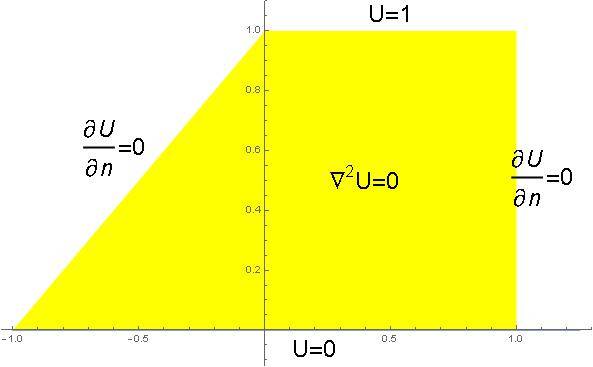
The discussion revolves around finding an analytical solution to the Laplace equation defined on a trapezoidal domain. Participants explore various methods and considerations for solving the equation, including boundary conditions and continuity requirements.
Discussion Character
- Exploratory
- Technical explanation
- Debate/contested
- Mathematical reasoning
Main Points Raised
- One participant expresses familiarity with solving the Laplace equation on squares and rectangles but seeks an analytical method for trapezoids.
- Another participant suggests solving the equation in triangular and square subdomains using different coordinate systems and then patching the solutions together at a specified point.
- A different viewpoint questions the uniqueness of the solution derived from the proposed method, presenting a specific form of the solution based on boundary conditions and continuity.
- Further contributions emphasize the need to consider the derivatives of the solutions at the boundary, highlighting a potential inconsistency in the continuity requirements at a specified boundary.
- Another participant argues against the requirement of continuity for both the function and its derivative at the boundary, suggesting that only a linear combination can be continuous.
- A numerical solution is mentioned, indicating that it yields different results compared to the analytical approaches discussed.
- A participant raises a question about the existence of an analytical solution when switching between Neumann and Dirichlet boundary conditions along the trapezoid's sides.
Areas of Agreement / Disagreement
Participants express differing opinions on the methods for solving the Laplace equation, the uniqueness of solutions, and the requirements for continuity at boundaries. There is no consensus on the best approach or the implications of switching boundary conditions.
Contextual Notes
Participants discuss various assumptions regarding boundary conditions and the mathematical properties of the solutions, but these assumptions are not fully resolved within the discussion.