How to solve this balancing exercise? (towing a boat with two ropes)

Join the discussion
Registration is free. Ask a follow-up in this thread, or start your own.
11 replies · 3K views
Tapias5000
Messages
46
Reaction score
10
Homework Statement
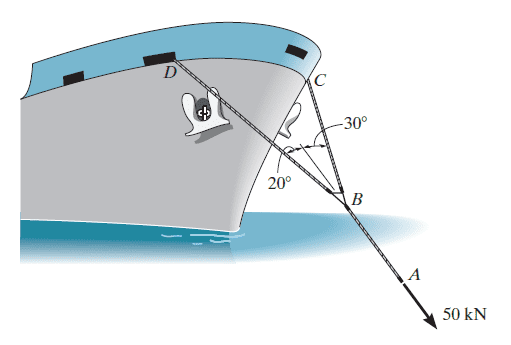
The towing pendant AB is subjected to the force of 50 kN exerted by a tugboat. Determine the force in each of the bridles, BC and BD, if the ship is moving forward with constant velocity.
Relevant Equations
Σfx=0 and Σfy=0
This is the image of the problem
Untitled-4.png

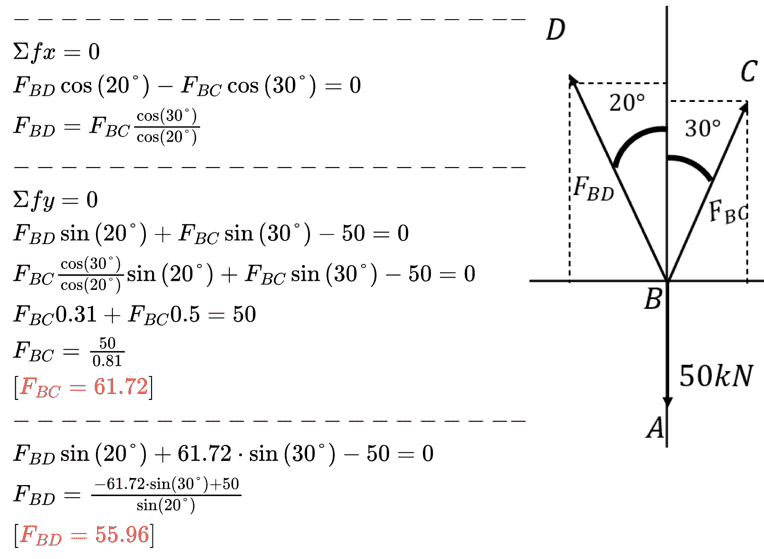
I tried to solve it and I got the following is it correct?
Captura.PNG
 
  • Like
Likes   Reactions: Delta2
Physics news on Phys.org
Your method seems correct in general . Haven't check the arithmetic operations.

BTW why don't you use the first equation you found for ##F_{BD}## to calculate it , once you have found ##F_{BC}## and you instead using a different equation?
 
Oops I now see a flaw, you haven't labeled the x and y-axis explicitly, but it seems to me that the force of 50kN is acting in the x-direction... Though that would imply that the x-axis is the vertical and the y-axis is the horizontal.
 
Delta2 said:
Oops I now see a flaw, you haven't labeled the x and y-axis explicitly, but it seems to me that the force of 50kN is acting in the x-direction... Though that would imply that the x-axis is the vertical and the y-axis is the horizontal.
um the force acts in the direction of x?
So in the directions change? I don't understand, why does that happen, can you show me some other example?
The answer then would be like this? but why?

##
\begin{array}{l}----------------------\\
Σfx=0\\
-F_{BD}\sin \left(20°\right)+F_{BC}\sin \left(30°\right)=0\\
F_{BC}=F_{BD}\frac{\sin \left(20°\right)}{\sin \left(30°\right)}\\
----------------------\\
Σfy=0\\
F_{BD}\cos \left(20°\right)+F_{BC}\cos \left(30°\right)-50=0\\
F_{BD}\cos \left(20°\right)+F_{BD}\frac{\sin \left(20°\right)}{\sin \left(30°\right)}\cos \left(30°\right)-50=0\\
F_{BD}0.93+F_{BD}0.59=50\\
F_{BD}=\frac{50}{1.52}\\
\left[F_{BD}=32.89\right]\\
----------------------\\
F_{BD}\cos \left(20°\right)+F_{BC}\cos \left(30°\right)-50=0\\
32.89\cdot \cos \left(20°\right)+F_{BC}\cos \left(30°\right)-50=0\\
F_{BC}=\frac{-32.89\cdot \cos \left(20°\right)+50}{\cos \left(30°\right)}\\
\left[F_{BC}=22.04\right]\\
----------------------\end{array} ##
 
  • Like
Likes   Reactions: Delta2
Delta2 said:
Yes I think now it is correct.
ok, but how did you realize that the force acted on the x-axis and therefore the directions were changed? what did you look at to reach that conclusion?
 
Tapias5000 said:
ok, but how did you realize that the force acted on the x-axis and therefore the directions were changed? what did you look at to reach that conclusion?
If I ask you to draw the force components that correspond to ##F_{BC}\cos 30## and ##F_{BD}\cos 20## where would you draw them, on the vertical axis or on the horizontal axis?
 
Delta2 said:
If I ask you to draw the force components that correspond to ##F_{BC}\cos 30## and ##F_{BD}\cos 20## where would you draw them, on the vertical axis or on the horizontal axis?
According to me they would go on the red arrows, cosine= a/h
1630994530540.png
 
Delta2 said:
Nope that's not correct, check again the definition of cosine for a right triangle.

aaaaaaaaa, damn I finally understand regarding the angle would be here for cosine, and that's why the directions change, am I right now?
Captura.PNG
 
  • Like
Likes   Reactions: Delta2
Delta2 said:
Yes you are correct now.
Thank you very much for the clarification.
 
  • Like
Likes   Reactions: Delta2