How to solve vector addition problems for physics?

Join the discussion
Ask a follow-up here, or get your own question answered by working scientists, mathematicians and engineers — people, not an autocomplete.
Real named experts · corrections over time · the nuance an AI answer skips
3 replies · 14K views
desi_chick
Messages
2
Reaction score
0
1. For the vectors given in Fig. 3-32 (|A| = 64.0 and θ = 51.0°), determine the following. Find the magnitude and direction for each of the following : 1) A-B+C 2) A+B-C 3) C-A-B.
heres a diagram with it:
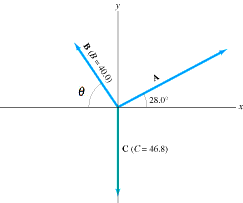
3_35alt.gif


2. The graph above should help, but I'm stuck on what to do


3. I basically set A= D1, B= D2 and C=D3. i found each vector component value: D1X=56.5, D1Y= 55.43 and so on for D2 and D3. i think I'm completely wrong since i don't understand what the question is asking for. i have a physics final on monday and I'm really lost!
 
Physics news on Phys.org
If you add three vectors, the result will be a vector. The question is asking you to find the magnitude and direction of this resultant vector (the sum) in three different cases (for three different ways of combining the three vectors).

I do not see how setting A = D1, B = D2, and C = D3 helps you in any way (other than changing the names of the vectors you are adding together).

Although you are right that adding the three vectors together component-wise is a good strategy, your x and y components of A do not look right. I would double check the calculations.

EDIT: Bear in mind that we can't see your attached picture yet. It takes time for the forum to approve the attachment.

EDIT: And by the way, welcome to PF!
 
oh I'm still pretty lost, like i just want to know what A-B+C means for example.
 
It's vector addition. A - B + C literally means vector A added to the negative of vector B added to vector C. If you have been taught in class how to add vectors (and you must have been), and you have been taught what the negative of a vector means, then you should be able to do the problem.

Now that I see the picture, I see that it might be easier to do the vector addition just by drawing a picture, rather than by calculating x and y components.