How were differential equations for SIR Models calculated?

Click For Summary

Discussion Overview

The discussion revolves around the calculation and understanding of differential equations used in SIR models for infectious disease modeling. Participants explore the mathematical foundations, empirical validation, and the nature of proof in this context.

Discussion Character

  • Exploratory, Technical explanation, Conceptual clarification

Main Points Raised

  • Some participants inquire about the mathematical proof for the equations used in SIR models.
  • Others clarify that these models are descriptive tools and emphasize that validity is determined through comparison with empirical data rather than formal proof.
  • A participant mentions the importance of parameters such as ##\beta, \gamma##, and initial conditions in the SIR model equations.
  • References to original research papers and historical data from outbreaks, such as SARS, are suggested as useful for understanding the models.

Areas of Agreement / Disagreement

Participants express differing views on the concept of "proof" in the context of mathematical modeling, indicating a lack of consensus on how to validate the models.

Contextual Notes

The discussion highlights the dependence on empirical data for validating model parameters and initial conditions, as well as the potential limitations in the models' applicability based on these factors.

Sam Donovan
Messages
11
Reaction score
0
Member advised to do some research before posting
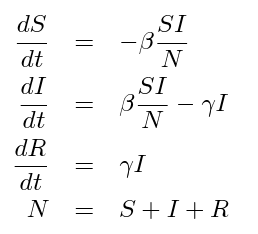
Specifically:
sireqn.png
 
Physics news on Phys.org
What do you mean by proof?
These models are a method to describe what actually happens. It can only be said to which extend their solutions are proper descriptions of reality or not, i.e. whether a certain choice of parameters and initial conditions lead to such a valid description or not. So a "proof" can only be a comparison with empiric data. SIR models are a class of models, depending on the choice of ##\beta, \gamma## and eventually ##N## plus initial conditions like ##\left. \frac{dS}{dt}\right|_{t=0} =S_0##. I would look for the original paper of Reed and Frost or the links on the Wiki page. Also the SARS outbreak in 2002/2003 could provide several data for comparisons.
 

Similar threads

  • · Replies 2 ·
Replies
2
Views
1K
  • · Replies 4 ·
Replies
4
Views
2K
  • · Replies 2 ·
Replies
2
Views
2K
  • · Replies 9 ·
Replies
9
Views
3K
  • · Replies 3 ·
Replies
3
Views
1K
  • · Replies 46 ·
2
Replies
46
Views
6K
  • · Replies 49 ·
2
Replies
49
Views
7K
  • · Replies 3 ·
Replies
3
Views
6K
  • · Replies 9 ·
Replies
9
Views
2K
  • · Replies 16 ·
Replies
16
Views
3K