How's diffraction pattern modied by phonon perturbation?

Click For Summary
SUMMARY

The discussion focuses on the impact of phonon perturbation on the diffraction pattern of a body-centered cubic (bcc) lattice, specifically those atomic planes parallel to the (100) orientation. It is established that phonon perturbation leads to a reduction in the amplitude of normal diffraction peaks, quantified by the Debye-Waller factor, and introduces Thermal Diffuse Scattering. These effects modify the diffraction pattern, resulting in additional peaks beyond those observed in an unperturbed lattice.

PREREQUISITES
  • Understanding of phonon perturbation in solid-state physics
  • Familiarity with diffraction patterns in crystallography
  • Knowledge of the Debye-Waller factor and its implications
  • Basic principles of Thermal Diffuse Scattering
NEXT STEPS
  • Research the mathematical formulation of the Debye-Waller factor
  • Explore the principles of Thermal Diffuse Scattering in detail
  • Study the effects of phonon interactions on diffraction patterns in various crystal structures
  • Investigate experimental techniques for measuring diffraction patterns in perturbed lattices
USEFUL FOR

Physicists, materials scientists, and researchers studying crystallography and solid-state physics, particularly those interested in the effects of phonon perturbations on diffraction patterns.

leehoom
Messages
5
Reaction score
0
Hi there,
I have a problem on phonon perturbation's effect on diffraction pattern.

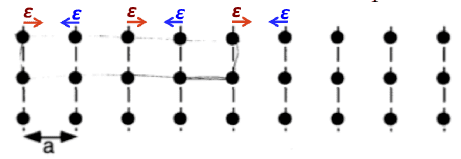
Assume atomic planes parallel to (100) of bcc lattice is periodically perturbed by phonon.

How will diffraction pattern be modified as a result of such perturbation? Will we see any diffraction peaks in addition to those seen for a unperturbed lattice?

Thanks!
Capture.PNG
 
Physics news on Phys.org
You get a reduction in the amplitude of the normal diffraction peaks, usually described by a Debye-Waller factor, and in addition you get Thermal Diffuse Scattering.

http://en.wikipedia.org/wiki/Debye–Waller_factor

http://www.neutron.ethz.ch/education/Lectures/neutronfall/Lecture_4-2
 
Last edited by a moderator:
M Quack said:
You get a reduction in the amplitude of the normal diffraction peaks, usually described by a Debye-Waller factor, and in addition you get Thermal Diffuse Scattering.

http://en.wikipedia.org/wiki/Debye–Waller_factor

http://www.neutron.ethz.ch/education/Lectures/neutronfall/Lecture_4-2
Thank you! It's really helpful.
 
Last edited by a moderator:

Similar threads

  • · Replies 9 ·
Replies
9
Views
4K
  • · Replies 1 ·
Replies
1
Views
2K
  • · Replies 1 ·
Replies
1
Views
6K
  • · Replies 16 ·
Replies
16
Views
2K
  • · Replies 1 ·
Replies
1
Views
2K
  • · Replies 10 ·
Replies
10
Views
2K
  • · Replies 2 ·
Replies
2
Views
3K
  • · Replies 5 ·
Replies
5
Views
6K
Replies
1
Views
5K
  • · Replies 1 ·
Replies
1
Views
5K