Somali_Physicist said:
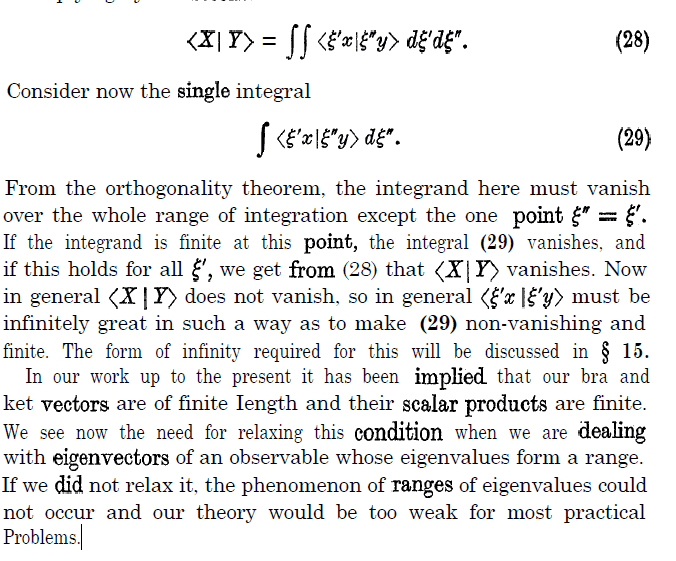
since an integrand that is finite at one point is still zero when integrated over.
I often see integration as simply as the infinitesimally small steps throughout a curve, hence why wouldn't a bump in the curve simply be added onto the zero of the system?
You need to study a subject called analysis. There are many freely available texts on the subject eg:
http://ramanujan.math.trinity.edu/wtrench/texts/TRENCH_REAL_ANALYSIS.PDF
I promised to explain integrals properly.
The axioms of the rationals is exactly the same as the axioms of real numbers - look them up. Except, and this is of crucial importance, the completeness axiom - that only applies to the reals. It is what resolves Zeno's paradox and is a very interesting thing to point out to philosophers that argue about this - I just love 'poking' philosophers a little bit - although I usually come off second best - but not on this one - it is clear cut.
One divides the interval to be integrated over into a partition ie a number of sub-intervals. You take the minimum of the function in any sub-interval and multiply it by the length of that particular sub-interval. Sum it up. Call it the lower sum. Do the same with the maximum value in the partition and call it the upper sum. Now lower sum <= upper sum and will always remain so regardless of partition size ie the number of intervals in the partition.
If the partition is made finer say by dividing each sub-interval in half all the time - but any procedure that makes the sub-intervals smaller will work - we have an increasing sequence of lower sums Ln bounded above by any upper sum. We also have a decreasing sequence of upper sums Un bounded below by any lower sum. Ln is an increasing sequence and one of the defining properties of the real numbers is the least upper bound property - equivalent to completeness mentioned before. This says any sequence of increasing real numbers bounded above has a least upper bound. Thus Ln is bounded above hence has a LUB I will call Rl. There is a simple corollary to the LUB axiom, the greatest lower bound property, that says any sequence of decreasing real numbers that is bounded below has a greatest lower bound. So Un has a greatest lower bound I will call Ru. Now Rl <= Ru. However if Ru = Rl then the function is said to be Riemann integrable with Riemann integral Ru=Rl.
Another advantage of this method is there are other definitions of the integral eg the Lebesgue integral that is defined a bit differently - but defining it the way above allows you to clearly see the difference between the two and to show, in the case of Lebesgue integrals that if a function is Riemann integrable it is Lebesgue integrable.
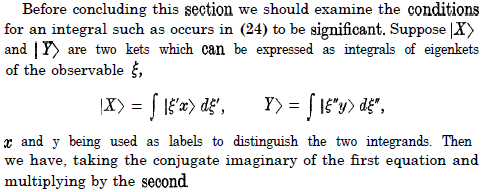
Why are Lebesgue integrals important - well that's another thread but its intimately tied up with the Hilbert space of QM and we have the rather important and very interesting Fubini theorem that does not apply to Riemann integrals:
https://en.wikipedia.org/wiki/Fubini's_theorem
Physicists, and applied mathematicians in general, often exchange integral signs with gay abandon. You can't do that for Riemann Integrals, but you can do that for Lebesgue integrals. Forgetting this can on occasion can lead to problems.
In fact that's why analysis is so important - if you aren't careful - and in analysis you are very careful - you will sometimes come unstuck.
Now let's look at a function that is 0 except at 0 where its infinite. If it had an integral you would think multiplying it by c would be c times that integral. But in the extended reals c*∞ = ∞ so is not true.
Well how do you do it? Its done in a subject called Distribution Theory:
https://en.wikipedia.org/wiki/Distribution_(mathematics)
Thanks
Bill