I with this MCQ question pleae

  • Thread starter Thread starter Shiv Narayanan
  • Start date Start date
Click For Summary

Homework Help Overview

The discussion revolves around a multiple-choice question related to heat transfer and specific heat capacity, involving two identical heaters and their effects on different masses of substances.

Discussion Character

  • Exploratory, Conceptual clarification, Assumption checking

Approaches and Questions Raised

  • Participants discuss the relationship between heat absorbed and the properties of the substances involved. Questions arise regarding the equality of heat transfer (Q1 = Q2) and the implications of mass differences on calculations.

Discussion Status

Some participants have provided hints and guidance on relevant formulas and concepts, while others are exploring different interpretations of the problem. There is an ongoing examination of assumptions regarding mass and energy transfer.

Contextual Notes

Participants are reminded to show their work, and there is a focus on the specific heat capacity and the relationship between power and heat transfer. The original poster acknowledges a misunderstanding of the question's requirements.

Shiv Narayanan
Messages
3
Reaction score
0
< Mentor Note -- Poster has been warned to show their work in future schoolwork threads >[/color]
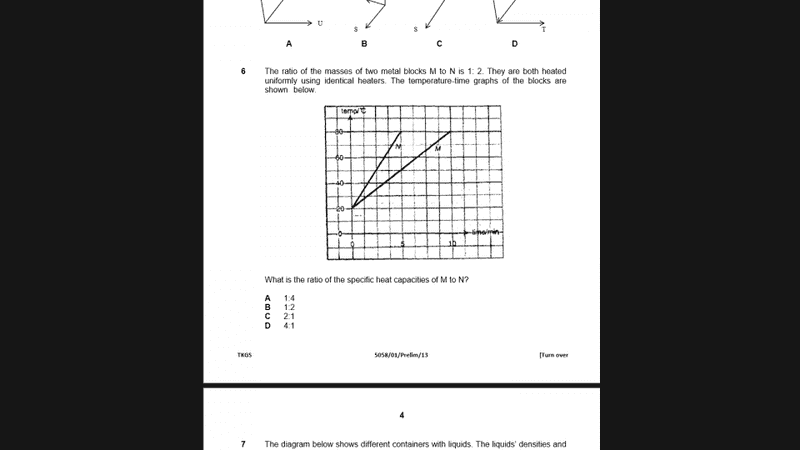
Screenshot 2015-08-10 23.35.26.png
Hello! I need help with this question. The answer is D but I don't understand why :/ Thanks!
 
Last edited by a moderator:
Physics news on Phys.org
Please post your attempt .

Hint : What is formula for ΔQ ? What is power provided ?
 
IMG_20150811_001821.jpg
Hello, Thanks for replying!
 

Attachments

  • IMG_20150811_001821.jpg
    IMG_20150811_001821.jpg
    13.4 KB · Views: 425
Why is Q1 = Q2 ?

Heaters are identical , and so power provided by them will be the same . The heat absorbed by the objects in some time ' t ' will depend on their own properties . It will not necessarily be the same for both .
Try again .

Hope this helps .
 
Oh Yes.. I read the question wrongly. I thought amount of energy provided is the same.

So, if I am not wrong, the gradient of the graph is the specific heat capacity and since mass of N is 2 times the mass of M, in this case, I can just take the mass of N to be 2kg while the mass of M to be 1kg right? (For me to be able to calculate)

I find the gradient of N and divide it by 2 as heat capacity is per kg.Then I have to compare with the gradient of M and derive the ratio.. Am I right?
 
ΔQ = m*c*ΔT ,
∴ P = ΔQ / ΔT = ?

Shiv Narayanan said:
So, if I am not wrong, the gradient of the graph is the specific heat capacity and since mass of N is 2 times the mass of M, in this case, I can just take the mass of N to be 2kg while the mass of M to be 1kg right? (For me to be able to calculate)
No , I think it looks more like ( ΔT / Δt ) .
And no , you can't assume the masses as so . Use P1 / P2 ratio .
 
Last edited:

Similar threads

Replies
42
Views
5K
  • · Replies 2 ·
Replies
2
Views
1K
  • · Replies 7 ·
Replies
7
Views
2K
  • · Replies 58 ·
2
Replies
58
Views
6K
  • · Replies 18 ·
Replies
18
Views
5K
  • · Replies 3 ·
Replies
3
Views
1K
  • · Replies 12 ·
Replies
12
Views
2K
  • · Replies 7 ·
Replies
7
Views
3K
  • · Replies 3 ·
Replies
3
Views
1K