Ideal Ball weight to get the maximum range from a ball launcher?

Click For Summary
SUMMARY

The discussion focuses on determining the ideal ball weight for maximizing the range of a ball launcher designed to propel a line of baits into the sea. The user has successfully launched a soccer ball weighing 1 lb approximately 100 yards without any attachments. Key factors influencing the range include the launch angle of 45 degrees, the mass of the line (1 lb for 100 yards), and the spacing of the baits (10 ft apart). The consensus is that a heavier ball minimizes air resistance, but the launcher's velocity characteristics must be understood to optimize performance.

PREREQUISITES
  • Understanding of projectile motion principles
  • Basic knowledge of air resistance effects on projectiles
  • Familiarity with mass and weight concepts in physics
  • Experience with simplified modeling techniques in physics
NEXT STEPS
  • Research the physics of projectile motion to understand optimal launch angles
  • Investigate the effects of air resistance on different projectile weights
  • Learn about the design and mechanics of ball launchers
  • Explore methods for calculating the ideal mass for maximizing distance
USEFUL FOR

This discussion is beneficial for engineers, hobbyists, and physics enthusiasts interested in designing ball launchers, optimizing projectile performance, and understanding the principles of motion and resistance in projectile dynamics.

cosmo88
Messages
2
Reaction score
0
Hello guys, i am building a ball launcher to proper a line of baits into the sea, the line has 25 baits, each bait weights 30 grams (about 1oz)

ideal shooting degree seems to be 45 to get maximum range, What I would like to figure out is the ideal weight of the ball to achieve the greatest distance for a shot.

Here is an illustration of what I want to do:
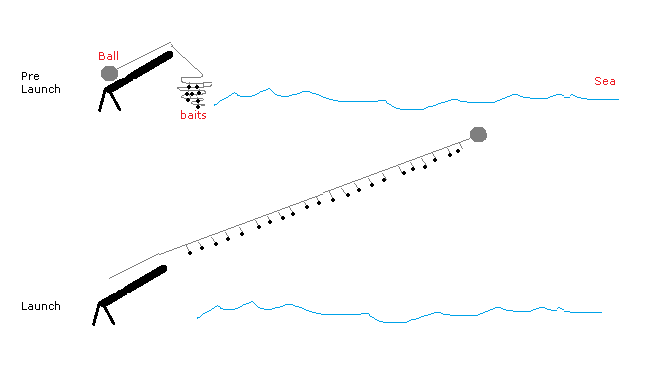
Drawing.png

Many thanks for helping me with this.
 
Physics news on Phys.org
If this is an attempt to design such a device, perhaps start with a simplified model to get a feel for the problem?

You don't mention the weight (better: mass) per unit length of the rope to which the baits are attached. Nor do you define the spacing of the baits on that rope.

Why not simplify the initial attempt by assuming a uniform rope of constant linear mass per unit length that effectively includes the masses of the baits along its length?

I think that this simplified version of the problem will not be an easy task to analyze, even ignoring air resistance on the line and ball.
 
Hi Gneill,

Thank you for your reply, I actually already made a simplified model, I am currently able to shoot a soccer ball (1lbs) about 100 yards, with no line or baits attached to it, that distance should be improved in the future real thing with a better band and design.

The Weight of a line (very thin rope) of 100 yards is about 1lbs too, the spacing between baits is 10 ft.

I thought about air resistance too, but as I am a complete newbie when it comes to physics I have no idea how to do the calculations.

Thanks again for helping.
 
Last edited:
A lot of this depends on the details of the launcher itself. If the launcher always launches at a fixed velocity, ideal ball weight is as heavy as possible to minimize the impact of air resistance. However, all real launchers will have some sort of launch velocity dependence on the mass of the projectile, and you need to know this before you can have an answer.
 

Similar threads

  • · Replies 4 ·
Replies
4
Views
1K
  • · Replies 1 ·
Replies
1
Views
6K
  • · Replies 4 ·
Replies
4
Views
2K
Replies
2
Views
5K
  • · Replies 1 ·
Replies
1
Views
3K
  • · Replies 3 ·
Replies
3
Views
2K
  • · Replies 9 ·
Replies
9
Views
5K
Replies
11
Views
8K
  • · Replies 19 ·
Replies
19
Views
5K
  • · Replies 5 ·
Replies
5
Views
4K