Discussion Overview
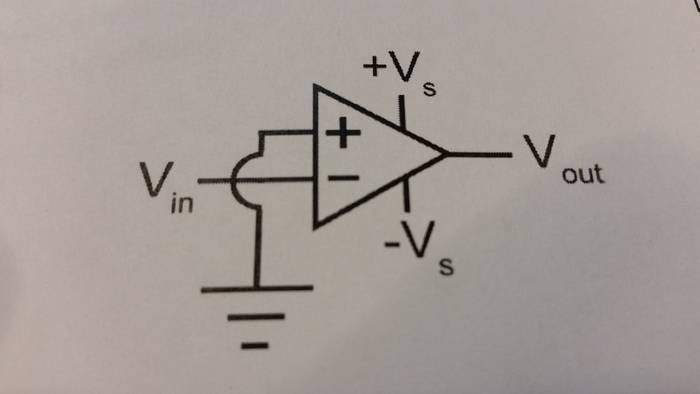
The discussion revolves around the analysis of an ideal operational amplifier (op-amp) to determine the output voltage (Vout) given an input voltage (Vin) of 2V and a supply voltage (Vs) of 15V. The scope includes theoretical considerations of op-amp behavior, particularly in relation to feedback and output saturation.
Discussion Character
- Technical explanation
- Debate/contested
Main Points Raised
- One participant suggests that with an infinite gain of the ideal op-amp and a substantial difference between V+ and V-, the output would theoretically be infinitely large but would instead max out at Vs.
- Another participant agrees and elaborates that proper DC feedback is necessary for linear amplification, which helps establish a suitable operating point between supply voltages.
- A different participant points out that the output would be pinned at the -Vs rail due to the inverting input being higher than the non-inverting input.
- There is a question about whether the output should be -15V, with some uncertainty expressed about the behavior of different op-amps regarding their ability to drive outputs to the rails.
- A later reply asks for clarification on whether this scenario is from a schoolwork assignment, indicating a potential context for the question.
Areas of Agreement / Disagreement
Participants express differing views on the output voltage behavior of the op-amp, particularly regarding whether it would be -15V or if it could reach the rails, indicating that multiple competing views remain unresolved.
Contextual Notes
There are limitations in the assumptions about the op-amp's behavior, particularly regarding feedback and the specific characteristics of the ideal op-amp versus real-world op-amps.