Ideal Opamp Analysis: Determine Vout for Vin = 2V & Vs = 15V

Click For Summary
SUMMARY

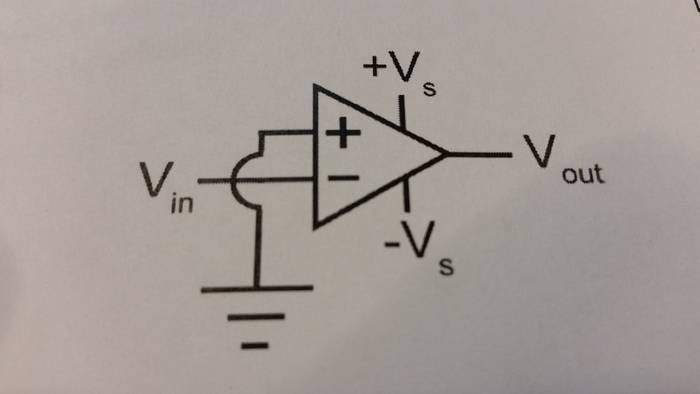
The discussion focuses on determining the output voltage (Vout) of an ideal operational amplifier (op-amp) given an input voltage (Vin) of 2V and a supply voltage (Vs) of 15V. It is established that while the ideal op-amp has infinite gain, the output will be limited by the supply voltage, resulting in Vout being pinned at -15V due to the inverting input being higher than the non-inverting input. The necessity of DC feedback for proper operation and the behavior of real op-amps in saturation conditions are also highlighted.

PREREQUISITES
  • Understanding of ideal operational amplifier characteristics
  • Knowledge of DC feedback mechanisms in op-amp circuits
  • Familiarity with voltage supply configurations in op-amps
  • Basic concepts of input and output voltage relationships in amplifiers
NEXT STEPS
  • Study the effects of DC feedback on op-amp performance
  • Learn about the differences between ideal and real op-amps
  • Research op-amp saturation behavior and output limitations
  • Explore various op-amp configurations and their applications
USEFUL FOR

Electrical engineers, students in electronics courses, and anyone involved in designing or analyzing op-amp circuits will benefit from this discussion.

joel amos
Messages
104
Reaction score
0
Given this ideal op-amp, determine Vout if Vin = 2V and Vs = 15 V.
k97403.jpg

So I know that the ideal op-amp has infinite gain. As the difference between V+ and V- is substantial (2V), wouldn't that mean the output would theoretically by infinitely large but instead max out at Vs? Am I understanding correctly, or am I way off?
 
Engineering news on Phys.org
Yes - you are right. Each application of opamps as linear amplifiers requires dc feedback. This allows a suitable dc operating point in the mddle region between the supply voltages as well as an amplification factor that is determined by the feedback resistors only.
Otherwise, even very small input voltages cannot be amplified (in case of REAL opamps) because an always present offset voltage will drive the output into saturation.
 
Okay, that makes sense. Thanks for the response!
 
The way it is drawn the output would be pinned at the -Vs rail, not Vs. The inverting input (-) is higher than the non-inverting input (+) here.
 
So it should be -15 V?
 
joel amos said:
So it should be -15 V?

Depends on the opamp. Some can drive their output to the rails, and others saturate somewhere close to the rails (within a volt or two). If you are to assume it is an ideal opamp, what do you think?

BTW, is this from a schoolwork assignment? What is the context of the question?
 

Similar threads

  • · Replies 50 ·
2
Replies
50
Views
8K
Replies
15
Views
2K
  • · Replies 11 ·
Replies
11
Views
3K
  • · Replies 4 ·
Replies
4
Views
2K
Replies
7
Views
4K
  • · Replies 1 ·
Replies
1
Views
3K
  • · Replies 9 ·
Replies
9
Views
2K
  • · Replies 3 ·
Replies
3
Views
2K
  • · Replies 13 ·
Replies
13
Views
78K
  • · Replies 4 ·
Replies
4
Views
22K