I'm stuck on this problem involving Tension, Force, and Acceleration

Click For Summary

Homework Help Overview

The discussion revolves around a physics problem involving two masses connected by a string over a frictionless pulley, with one mass on an incline. Participants are exploring concepts related to tension, force, and acceleration in the context of Newton's laws of motion.

Discussion Character

  • Exploratory, Conceptual clarification, Assumption checking

Approaches and Questions Raised

  • Participants discuss the necessity of summing forces when dealing with multiple masses and question the application of sine and cosine in force equations for different masses. There are inquiries about the derivation of tension and the implications of mass positions on the incline.

Discussion Status

Some participants have provided clarifications regarding the use of trigonometric functions for forces acting on inclined planes. There is ongoing exploration of the relationship between the two masses and their respective forces, with no explicit consensus reached on all points raised.

Contextual Notes

Participants express confusion regarding the application of sine and cosine in the context of forces acting on mass 2, which is on an incline. The discussion highlights the need for clarity on the components of gravitational force in relation to the incline's angle.

riseofphoenix
Messages
294
Reaction score
2
Two packing crates of masses m1 = 10.0 kg and m2 = 4.80 kg are connected by a light string that passes over a frictionless pulley as in the figure. The 4.80-kg crate lies on a smooth incline of angle 41.0°.
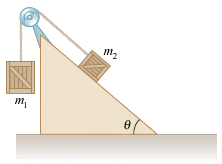
4-p-028alt.gif


(a) Find the acceleration of the 4.80-kg crate.

QUESTION 1: WHENEVER I'm given TWO things such as m1 and m2, that means I will be taking the SUM of something right in ORDER to find a variable such as "a" (acceleration) or something else, right?

This is what I did...

Mass 1:
Fnet = T1 + (-m1g)
-m1a = T - m1g

Mass 2:
Fnet = T2 + (-m2gsin θ)
QUESTION 2: Why is sin θ being included in THIS equation for mass 2 but not in the equation for mass 1?
m2a = T - m2gsin θ

Subtract mass 2 from mass 1:

Mass 2: m2a = T - m2g[/B]sin θ
Mass 1: -(-m1a = T - m1g)
–––––––––––––––––––––––––––––––––––––
Equation: m2a + m1a = m1g - m2gsin θ

a(m2 + m1) = m1g - m2gsin θ
a = (m1g - m2gsin θ) / (m2 + m1)
a = [ (10)(9.81) - (4.80)(9.81)(sin 41) ] / (4.80 + 10.00)
a = (98.1 - 30.86) / 14.8
a = 67.24 / 14.8
a = 4.54 m/s2

(b) Find the tension in the string.

QUESTION 3: How would I go about solving for this one?
Just plug in a in either of the original mass equations??

Can you please, please, not be vague/abstract in your answer also?
Thank you.
 
Physics news on Phys.org
Question 1:
Typically, if you are given two masses, the sum of them will be involved somewhere.

Question 2:
Mass 1 is not on an inclined plane, and thus feels the full effect of gravity; however mass 2 is on the incline, and thus has gravity affecting it in both the x and y directions, but the y direction is what you are concerned with. Multiplying the total force of gravity by the sine of the angle gives the y component; likewise, taking the cosine would show the x component. You could also do this for mass 1, but since it makes a 90 degree angle with the ground, the sine of that angle would result in 1.

Question 3:
Yes, but you would have to derive an equation that deals with the total tension, taking both masses into account. You want to add T1 and T2, resulting in Ttotal.
 
riseofphoenix said:
QUESTION 1: WHENEVER I'm given TWO things such as m1 and m2, that means I will be taking the SUM of something right in ORDER to find a variable such as "a" (acceleration) or something else, right?
I don't know what you mean. When two masses are involved you'll usually have two force equations, which you'll solve simultaneously.
This is what I did...

Mass 1:
Fnet = T1 + (-m1g)
-m1a = T - m1g

Mass 2:
Fnet = T2 + (-m2gsin θ)
Good.
QUESTION 2: Why is sin θ being included in THIS equation for mass 2 but not in the equation for mass 1?
You want force components parallel to the incline, which is the direction of the acceleration for m2.
m2a = T - m2gsin θ

Subtract mass 2 from mass 1:

Mass 2: m2a = T - m2g[/B]sin θ
Mass 1: -(-m1a = T - m1g)
–––––––––––––––––––––––––––––––––––––
Equation: m2a + m1a = m1g - m2gsin θ

a(m2 + m1) = m1g - m2gsin θ
a = (m1g - m2gsin θ) / (m2 + m1)
a = [ (10)(9.81) - (4.80)(9.81)(sin 41) ] / (4.80 + 10.00)
a = (98.1 - 30.86) / 14.8
a = 67.24 / 14.8
a = 4.54 m/s2
OK.
(b) Find the tension in the string.

QUESTION 3: How would I go about solving for this one?
Just plug in a in either of the original mass equations??
Sure.
 
danielu13 said:
Question 3:
Yes, but you would have to derive an equation that deals with the total tension, taking both masses into account. You want to add T1 and T2, resulting in Ttotal.
:bugeye: The rope has a single tension throughout its length.
 
Good point. Throughout my tension unit, we only did problems with multiple strings so I got that stuck in my head. My fault, but now I'll remember. Thanks!
 
Ok...I think I understand..

Imma get back to y'all if I'm even more confused

WAIIIT.
I STILL don't get why the sin theta is being multiplied to -m2g...

It literally makes no sense to me. I've read all of your responses and I'm trying to understand it but it just doesn't make any sense...

The mass 2 is technically on the HYPOTENUSE of the triangle... You only do mg cos theta OR mg sin theta when you are looking for 2 legs (?)
 
Last edited:
danielu13 said:
Question 1:
Typically, if you are given two masses, the sum of them will be involved somewhere.

Question 2:
Mass 1 is not on an inclined plane, and thus feels the full effect of gravity; however mass 2 is on the incline, and thus has gravity affecting it in both the x and y directions, but the y direction is what you are concerned with. Multiplying the total force of gravity by the sine of the angle gives the y component; likewise, taking the cosine would show the x component. You could also do this for mass 1, but since it makes a 90 degree angle with the ground, the sine of that angle would result in 1.

Question 3:
Yes, but you would have to derive an equation that deals with the total tension, taking both masses into account. You want to add T1 and T2, resulting in Ttotal.

SO for my Question 2, you ESSENTIALLY multiply -mg (for whatever mass that's attached to the pulley) by the sin of WHATEVER angle THAT mass is in right?
 
Correct, it's just like if you were wanting to find one component of any other force or value when working with vectors.
 
OK!
Thanks SO much everyone!
 
  • #10
riseofphoenix said:
It literally makes no sense to me. I've read all of your responses and I'm trying to understand it but it just doesn't make any sense...

The mass 2 is technically on the HYPOTENUSE of the triangle... You only do mg cos theta OR mg sin theta when you are looking for 2 legs (?)
The surface of the incline is not the hypotenuse of the force triangle. (It's the hypotenuse of the incline plane triangle, but so what.) You are finding the components of the weight (mg) parallel and perpendicular to the incline, so the weight must be the hypotenuse of your force right triangle.

Read this: Inclined Planes
 

Similar threads

  • · Replies 5 ·
Replies
5
Views
2K
  • · Replies 1 ·
Replies
1
Views
3K
Replies
23
Views
3K
  • · Replies 4 ·
Replies
4
Views
2K
  • · Replies 10 ·
Replies
10
Views
3K
  • · Replies 5 ·
Replies
5
Views
5K
  • · Replies 2 ·
Replies
2
Views
1K
  • · Replies 3 ·
Replies
3
Views
2K
Replies
8
Views
2K
  • · Replies 35 ·
2
Replies
35
Views
4K