Importance of Hanbury Brown and Twiss experiment

  • Context: Undergrad 
  • Thread starter Thread starter qnach
  • Start date Start date
Click For Summary

Discussion Overview

The discussion revolves around the Hanbury Brown and Twiss experiment, focusing on its methodology, comparison with other experiments like Stern-Gerlach, Michelson, and Mach-Zehnder interferometers, and the nature of correlations being measured. Participants explore the differences in how these experiments handle light beams and correlations, particularly in terms of intensity versus amplitude.

Discussion Character

  • Exploratory
  • Technical explanation
  • Debate/contested
  • Conceptual clarification

Main Points Raised

  • Some participants express confusion about the Hanbury Brown and Twiss experiment using one beam split into two for correlation testing, contrasting it with traditional correlation tests that involve two beams.
  • There is a discussion about the nature of correlation experiments, with one participant noting that Stern-Gerlach experiments require two devices to measure entangled particles, similar to the Hanbury Brown and Twiss effect.
  • Participants mention that traditional interferometers focus on amplitude, while the Hanbury Brown and Twiss experiment focuses on intensity, leading to questions about the relationship between amplitude and intensity.
  • One participant provides a reference to a Physics Today article that states the Hanbury Brown–Twiss apparatus measures correlation in intensities.
  • Another participant references a Wikipedia page discussing the classical understanding of the Hanbury Brown and Twiss effect, mentioning Dirac's remark about photons interfering with themselves.
  • There is a clarification that Michelson and Mach-Zehnder interferometers use one source that is split into two beams, similar to the setup in the Hanbury Brown and Twiss experiment.
  • Participants discuss the differences in what is measured in interferometers versus the Hanbury Brown and Twiss experiment, particularly regarding field correlations and the implications for identifying nonclassical states.

Areas of Agreement / Disagreement

Participants express confusion and uncertainty regarding the distinctions between different types of experiments and their methodologies. There is no consensus on the interpretations of the experiments or the implications of their findings.

Contextual Notes

Participants note limitations in their understanding and seek clarifications on specific references and concepts, indicating that some assumptions may not be fully articulated or understood.
qnach
Messages
154
Reaction score
4
I read Hanbury Brown and Twiss's experiment is using one beam but split into two to test their correlation.
It said the traditional correlation test were using two beams........
This confused me, sorry.

All the correlation tests I learnt such as Stern-Gerlash are using one beam? (Sorry if I am wrong)
I was also told traditional interferometers are concerning about amplitude but Hanbury Brown and Twiss were concerning about intensity?
Isn't the square of amplitude is the intensity?

Please advice me where did I made mistake?
 
Physics news on Phys.org
qnach said:
Stern-Gerlash
A single Stern-Gerlach experiment is not a "correlation experiment". To do a correlation experiment with Stern-Gerlach devices, you need two such devices, each of which measures one of two entangled particles. Just as in the Hanbury-Brown-Twiss effect, you need two detectors, not one.
 
qnach said:
I read Hanbury Brown and Twiss's experiment is using one beam but split into two to test their correlation.
qnach said:
I was also told traditional interferometers are concerning about amplitude but Hanbury Brown and Twiss were concerning about intensity?
It would help if you would give specific references for where you read or were told these things.
 
qnach said:
using one beam but split into two to test their correlation
Yes. You have one light beam coming from a source, which is split by a beam splitter, and then you have two detectors, and you look for correlations between the detections. The correlations give you information about the light source.
 
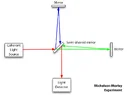
This is the Michelson-Morley interferometery I know of. Is it one source or two sources?
 

Attachments

  • Michelson-Morley.webp
    Michelson-Morley.webp
    14.5 KB · Views: 17
This is the Mach-Zender interferometer I know of. Is it one source or two sources?
 

Attachments

Have a look at https://en.wikipedia.org/wiki/Hanbury_Brown_and_Twiss_effect

The effect seemed puzzling at the time, because of Dirac's remark that "a photon only interferes with itself" in his textbook. But E.Purcell showed that the HBT effect can also be understood classically:
E. Purcell (1956). "The Question of Correlation Between Photons in Coherent Light Rays". Nature. 178 (4548): 1449–1450.
(from the Wikipedia page)
 
PeterDonis said:
A single Stern-Gerlach experiment is not a "correlation experiment". To do a correlation experiment with Stern-Gerlach devices, you need two such devices, each of which measures one of two entangled particles. Just as in the Hanbury-Brown-Twiss effect, you need two detectors, not one.
OK Stern-Glash is not (Sorry I am very confused). It is not even an interferometry. But how about Michelson-Morley and Mach-Zehnder?
 
  • #10
WernerQH said:
Have a look at https://en.wikipedia.org/wiki/Hanbury_Brown_and_Twiss_effect

The effect seemed puzzling at the time, because of Dirac's remark that "a photon only interferes with itself" in his textbook. But E.Purcell showed that the HBT effect can also be understood classically:
E. Purcell (1956). "The Question of Correlation Between Photons in Coherent Light Rays". Nature. 178 (4548): 1449–1450.
(from the Wikipedia page)
I tried to obtain this paper https://www.nature.com/articles/1781449a0
But why has it no title as you said "The Question of Correlation Between Photons in Coherent Light Rays"
 
  • #11
qnach said:
I tried to obtain this paper https://www.nature.com/articles/1781449a0
But why has it no title as you said "The Question of Correlation Between Photons in Coherent Light Rays"
I just copied the wikipedia reference, and it seems to point to a nature paper with that title. Unfortunately it's behind a paywall. Have your read the wikipedia page?
 
  • #12
qnach said:
This is the Michelson-Morley interferometery I know of. Is it one source or two sources?
qnach said:
This is the Mach-Zender interferometer I know of. Is it one source or two sources?
Both of them have one source, which gets split by a beam splitter into two beams. Just as I described in post #4.
 
  • #13
qnach said:
Stern-Glash is not (Sorry I am very confused). It is not even an interferometry.
Correct.

qnach said:
But how about Michelson-Morley and Mach-Zehnder?
Both of them are interferometers, yes. What gets observed at any detector depends on the relative amplitude and phase of the beams.

In the HBT effect, by contrast, what gets observed at each detector depends only on the intensity of the beam coming to that detector.
 
  • #14
qnach said:
OK Stern-Glash is not (Sorry I am very confused). It is not even an interferometry. But how about Michelson-Morley and Mach-Zehnder?

Michelson interferometers, Mach-Zehnder interferometers (and also the double slit) measure field correlations. The quantity you measure in the end is of course an intensity (because this is how detectors work), but you delay or offset one field in space or time and quantify the correlation between the fields. Loosely speaking, the information you get is: If I know the value of my field at some time and some position, how well can I predict the value of the field at a temporal delay t' and a position offset x'. This is entirely classical information and cannot be used to identify nonclassical states.

In HBT, the question you ask is: If I detect one photon from my light field at one detector, what is the normalized probability to detect another photon at the other detector? This information may tell you something about whether a state is nonclassical. Take for example the simple example of a single-photon state. If the photon gets detected at the first detector, it is gone and you will never find a simultaneous detection at the second detector. A Michelson interferometer cannot give you that kind of information.
 
  • Like
Likes   Reactions: realJohn, Nugatory and PeterDonis

Similar threads

  • · Replies 4 ·
Replies
4
Views
1K
  • · Replies 13 ·
Replies
13
Views
2K
Replies
2
Views
2K
  • · Replies 28 ·
Replies
28
Views
12K
  • · Replies 54 ·
2
Replies
54
Views
8K
  • · Replies 1 ·
Replies
1
Views
2K
  • · Replies 43 ·
2
Replies
43
Views
4K
  • · Replies 3 ·
Replies
3
Views
2K
  • · Replies 9 ·
Replies
9
Views
2K
  • · Replies 1 ·
Replies
1
Views
1K